
Harishyam Arts Blog
Different Types of Buddha Statues and Their Meanings
By Lakshay Sharma | On 09 October, 2025 | Views
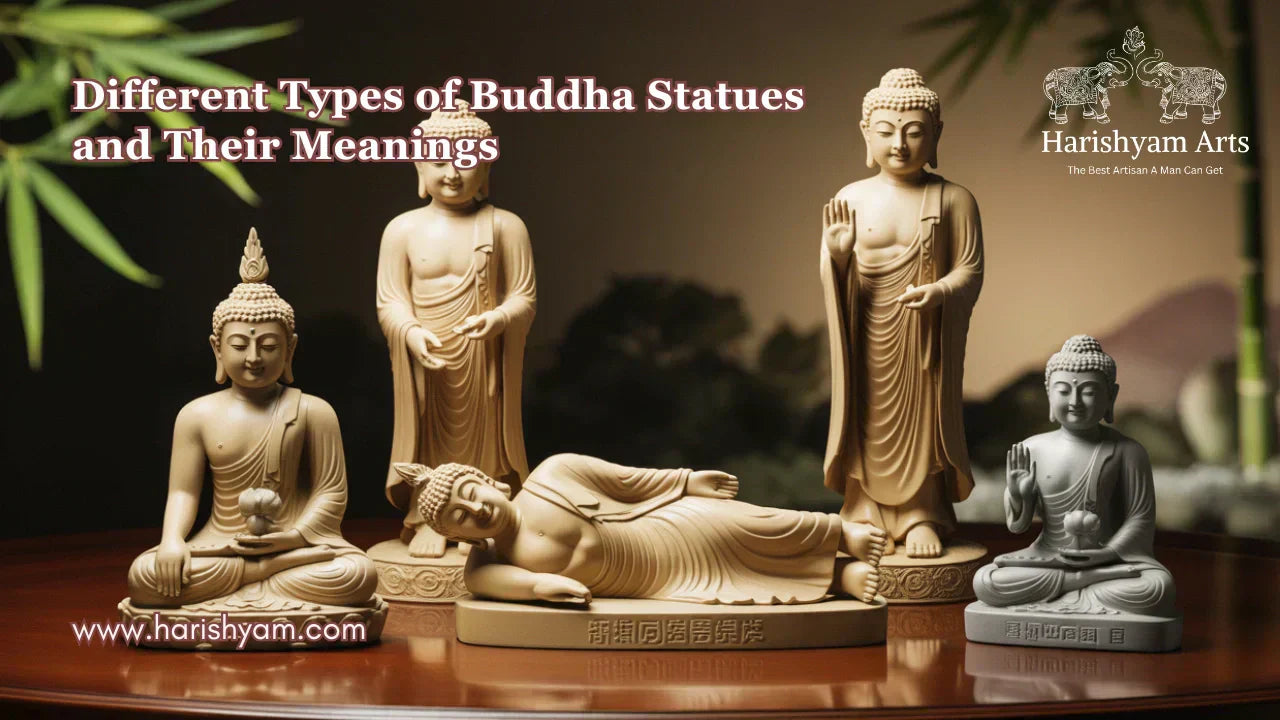
Buddha statues are more than just beautiful decorative pieces—they symbolize spiritual teachings, inner peace, and virtues of Gautama Buddha. Each posture, expression, and hand gesture (mudra) carries deep meaning, reflecting different aspects of enlightenment, compassion, and meditation. Understanding these meanings can help you choose a statue that resonates with your spiritual or aesthetic intentions.
Origins of Buddha Statues
The tradition of Buddha statues dates back to around the 1st–2nd century CE in regions such as India, Gandhara (modern-day Pakistan & Afghanistan), and Mathura. Initially, Buddhist art avoided depicting Buddha in human form, using symbols like footprints, the lotus, or an empty throne to represent him.
The first human-shaped Buddha statues appeared under the Gandhara and Mathura schools of art, which blended Greek, Roman, and Indian artistic influences. From India, Buddha statues spread across Asia—to China, Japan, Thailand, Tibet, and Southeast Asia, with each region adding its own artistic style and symbolism, creating the diverse representations we see today.
Different Types of Buddha Statues and Their Meanings
1. Meditating Buddha (Dhyana Mudra)
-
Description: Seated cross-legged with hands resting in the lap, eyes often closed.
-
Meaning: Represents meditation, inner peace, and concentration, inspiring mindfulness and spiritual awakening.

2. Laughing Buddha (Hotei or Budai)
-
Description: Plump, joyful figure with a big belly, often holding a sack or prayer beads.
-
Meaning: Symbolizes happiness, abundance, and good fortune. Rubbing the belly is believed to bring wealth and joy.

3. Reclining Buddha (Parinirvana)
-
Description: Buddha lying on his right side with his head supported by his hand.
-
Meaning: Depicts Buddha’s final moments before entering Nirvana, symbolizing peace, detachment, and liberation from suffering.

4. Standing Buddha
-
Description: Buddha standing upright, sometimes with one hand raised in a gesture of blessing.
-
Meaning: Represents teaching, protection, and guidance, offering spiritual reassurance to devotees.

5. Walking Buddha
-
Description: Buddha in mid-step, often with a hand raised in blessing.
-
Meaning: Symbolizes grace, progress on the spiritual path, and harmony, often found in Thai Buddhist art.

6. Earth Touching Buddha (Bhumisparsha Mudra)
-
Description: Seated Buddha with right hand touching the ground.
-
Meaning: Represents the moment of enlightenment under the Bodhi tree, symbolizing determination and spiritual steadfastness.

7. Teaching Buddha (Dharmachakra Mudra)
-
Description: Hands held in front of the chest, forming a circle.
-
Meaning: Symbolizes Buddha’s first sermon and the turning of the “Wheel of Dharma”, representing wisdom and sharing knowledge.

8. Protection Buddha (Abhaya Mudra)
-
Description: Right hand raised, palm outward.
-
Meaning: Stands for protection, fearlessness, and peace, assuring devotees of divine safety.

9. Medicine Buddha (Bhaisajyaguru)
-
Description: Often holds a bowl of medicinal herbs or displays a blessing gesture.
-
Meaning: Represents healing of physical and mental suffering, promoting wellness and recovery.

10. Green Tara / Avalokiteshvara Buddha
-
Description: Seated posture with compassionate gaze, sometimes depicted with multiple arms.
-
Meaning: Embodies compassion, mercy, and loving-kindness, guiding devotees towards spiritual and emotional healing.

How to Choose a Buddha Statue
1. Purpose Matters:
Begin by identifying your intention. Different Buddha statues serve unique purposes—some inspire meditation and mindfulness, others symbolize protection, prosperity, or healing. Choose a statue that aligns with the energy or quality you wish to invite into your life.
2. Material Significance:
The material of your Buddha statue also carries meaning and aesthetic value.
-
Marble Buddha Statues represent purity, calmness, and serenity—ideal for meditation spaces.
-
Brass Buddha Idols radiate strength, longevity, and protection, making them perfect for homes or entrances.
-
Wooden Buddha Moortis embody warmth and natural harmony, suitable for creating a peaceful and grounding atmosphere.
3. Placement is Important:
Place your Buddha statue respectfully on a clean, elevated surface such as an altar or dedicated shelf. Avoid placing it directly on the floor or in bedrooms, as per certain traditions. Ensure the space around the statue is clean and serene.
4. Mindful Intention:
A Buddha statue is more than a decorative piece—it is a symbol of mindfulness, peace, and spiritual growth. Approach it with reverence and allow its presence to inspire positive energy and tranquility in your surroundings.
FAQs on Buddha Statues and Their Meanings
Q1. Why do Buddha statues have different hand gestures (mudras)?
Ans: Each hand gesture, or mudra, represents a specific teaching or moment from Buddha’s life. For example, the Dharmachakra Mudra symbolizes the turning of the wheel of Dharma, while the Bhumisparsha Mudra represents enlightenment.
Q2. Which type of Buddha statue is best for home?
Ans: A Meditation Buddha or Laughing Buddha is often recommended for homes to bring peace, positive energy, and mindfulness into daily life. Placement also matters—facing east is considered auspicious.
Q3. What is the meaning of the Standing Buddha statue?
Ans: A Standing Buddha often signifies blessing, fearlessness, or offering protection. In some traditions, it also symbolizes Buddha rising to teach after attaining enlightenment.
Q4. How do I identify an authentic Buddha statue?
Ans: Look for details such as serene facial expressions, symbolic mudras, lotus bases, and traditional features like elongated earlobes, ushnisha (top knot), and urna (dot on forehead). These signify Buddha’s spiritual qualities.
Q5. Do Buddha statues have cultural differences in meaning?
Ans: Yes. For example, Thai Buddha statues emphasize grace and elegance, while Tibetan ones highlight compassion and wisdom with added symbolic ornaments. Meanings remain rooted in Buddhism but reflect regional traditions.
Q6. Can gifting a Buddha statue be considered auspicious?
Ans: Absolutely. At Harishyam Arts, we offer a wide range of beautifully crafted Buddha statues in materials like marble, brass, and wood, making them perfect for gifting. Presenting a Buddha statue is considered highly auspicious, as it symbolizes peace, harmony, and spiritual blessings. It’s a thoughtful gesture that conveys goodwill, positivity, and the wish for enlightenment in the recipient’s life.
Conclusion
Buddha statues are a beautiful fusion of art, history, and spirituality. Each type, posture, and gesture carries a unique meaning, inspiring inner peace, mindfulness, and compassion. Whether you choose a meditating Buddha for focus, a laughing Buddha for joy, or a medicine Buddha for healing, these statues serve as daily reminders of Buddha’s teachings.

Lakshay Sharma
I’m Lakshay Sharma, a writer with a deep passion for Hindu mythology, Vastu Shastra, and home interiors. I enjoy exploring the rich traditions of Hindu gods and goddesses, sharing insights into Vastu principles, and offering guidance on creating sacred spaces like Puja Mandirs. Through my writing, I aim to inspire harmony and spiritual well-being, blending traditional knowledge with modern perspectives.
Harishyam Arts | Jaipur
Related Blogs

Bhagavad Gita Chapter 3 Verse 16 Meaning in Hindi and English
Lakshay Sharma | June 09, 2026
Bhagavad Gita Chapter 3 Verse 16 continues Lord Krishna's explanation of the d...
Read More...
Bhagavad Gita Chapter 3 Verse 15 Meaning in Hindi and English
Lakshay Sharma | June 09, 2026
Bhagavad Gita Chapter 3 Verse 15 deepens the understanding of the sacred cycle...
Read More...
Bhagavad Gita Chapter 3 Verse 14 Meaning in Hindi and English
Lakshay Sharma | June 09, 2026
Bhagavad Gita Chapter 3 Verse 14 explains the sacred cycle that sustains life ...
Read More...
Bhagavad Gita Chapter 3 Verse 11 Meaning in Hindi and English
Lakshay Sharma | June 09, 2026
Bhagavad Gita Chapter 3 Verse 11 highlights the principle of mutual cooperatio...
Read More...
Bhagavad Gita Chapter 3 Verse 9 Meaning in Hindi & English
Lakshay Sharma | June 09, 2026
Bhagavad Gita Chapter 3 Verse 9 introduces one of the most important principle...
Read More...
Bhagavad Gita Chapter 3 Verse 7 Meaning in Hindi & English
Lakshay Sharma | June 09, 2026
Bhagavad Gita Chapter 3 Verse 7 presents Lord Krishna's solution to the proble...
Read More...
Bhagavad Gita Chapter 3 Verse 5 Meaning in Hindi & English
Lakshay Sharma | June 09, 2026
Bhagavad Gita Chapter 3 Verse 5 continues Lord Krishna's explanation of Karma ...
Read More...
Bhagavad Gita Chapter 3 Verse 4 Meaning in Hindi & English
Lakshay Sharma | June 09, 2026
Bhagavad Gita Chapter 3 Verse 4 continues Lord Krishna's explanation of Karma ...
Read More...
Bhagavad Gita Chapter 3 Verse 3 Meaning in Hindi & English
Lakshay Sharma | June 09, 2026
Bhagavad Gita Chapter 3 Verse 3 is Lord Krishna's direct response to Arjuna's ...
Read More...
Bhagavad Gita Chapter 3 Verse 2 Meaning in Hindi & English
Lakshay Sharma | June 09, 2026
Bhagavad Gita Chapter 3 Verse 2 continues Arjuna's confusion regarding the tea...
Read More...
Bhagavad Gita Chapter 3 Verse 1 Meaning in Hindi & English
Lakshay Sharma | June 09, 2026
Bhagavad Gita Chapter 3 Verse 1 marks the beginning of Karma Yoga...
Read More...
The Spiritual Warmth and Natural Energy of Handcrafted Wooden Statues
Lakshay Sharma | June 09, 2026
In a world filled with machine-made décor and mass-produced art, handcrafted w...
Read More...
Bhagavad Gita Chapter 3 Verse 18 Meaning in Hindi and English
Lakshay Sharma | June 08, 2026
Bhagavad Gita Chapter 3 Verse 18 continues Lord Krishna's description of the s...
Read More...
Bhagavad Gita Chapter 3 Verse 17 Meaning in Hindi and English
Lakshay Sharma | June 08, 2026
Bhagavad Gita Chapter 3 Verse 17 marks an important transition in Lord Krishna...
Read More...
Bhagavad Gita Chapter 3 Verse 12 Meaning in Hindi and English
Lakshay Sharma | June 08, 2026
Bhagavad Gita Chapter 3 Verse 12 continues Lord Krishna’s teaching on <...
Read More...
Bhagavad Gita Chapter 2 Verse 65 Meaning in Hindi and English
Lakshay Sharma | June 08, 2026
Bhagavad Gita Chapter 2 Verse 65 explains the profound benefits of attaining i...
Read More...
Bhagavad Gita Chapter 2 Verse 64 Meaning in Hindi and English
Lakshay Sharma | June 08, 2026
Bhagavad Gita Chapter 2 Verse 64 presents a powerful teaching on self-control,...
Read More...
Bhagavad Gita Chapter 3 Verse 10 Meaning in Hindi & English
Lakshay Sharma | June 08, 2026
Bhagavad Gita Chapter 3 Verse 10 continues Lord Krishna's teaching on <...
Read More...
Why Traditional Wooden Mandirs Are Still Preferred in Modern Homes
Lakshay Sharma | June 08, 2026
In today’s fast-paced world, modern homes are becoming more stylish, compact, ...
Read More...
The Symbolic Meaning of the Lotus in Hindu Tradition
Lakshay Sharma | June 08, 2026
The lotus flower holds a sacred and timeless place in Hindu tradition. Known f...
Read More...
Bhagavad Gita Chapter 2 Verse 23 Meaning in Hindi & English
Lakshay Sharma | June 08, 2026
As Lord Krishna continues to explain the eternal and indestructible nature of ...
Read More...
Bhagavad Gita Chapter 2 Verse 21 Meaning in Hindi & English
Lakshay Sharma | June 08, 2026
After revealing that the soul is unborn, eternal, and indestructible in the pr...
Read More...
The Greatest Philosophers and Thinkers of Ancient India
Lakshay Sharma | June 08, 2026
India has long been regarded as one of the world’s oldest centers of wisdom, s...
Read More...
Bhagavad Gita Chapter 2 Verse 22 Meaning in Hindi & English
Lakshay Sharma | June 08, 2026
Bhagavad Gita Chapter 2 Verse 22 contains one of the most famous and beautiful...
Read More...
Bhagavad Gita Chapter 2 Verse 20 Meaning in Hindi & English
Lakshay Sharma | June 08, 2026
Bhagavad Gita Chapter 2 Verse 20 is one of the most famous and profound verses...
Read More...
Bhagavad Gita Chapter 2 Verse 19 Meaning in Hindi & English
Lakshay Sharma | June 08, 2026
As Lord Krishna continues to reveal the eternal nature of the soul, He now add...
Read More...
Bhagavad Gita Chapter 2 Verse 18 Meaning in Hindi & English
Lakshay Sharma | June 08, 2026
After explaining the indestructible nature of the soul in the previous verse, ...
Read More...
Bhagavad Gita Chapter 2 Verse 16 Meaning in Hindi & English
Lakshay Sharma | June 08, 2026
As Lord Krishna continues to guide the grief-stricken Arjuna, He now introduce...
Read More...
Bhagavad Gita Chapter 3 Verse 8 Meaning in Hindi & English
Lakshay Sharma | June 08, 2026
Bhagavad Gita Chapter 3 Verse 8 is one of the most practical teachings in the ...
Read More...
Bhagavad Gita Chapter 2 Verse 56 Meaning in Hindi And English
Lakshay Sharma | June 08, 2026
In Bhagavad Gita Chapter 2 Verse 55, Lord Krishna explained that a person of steady wisdom (St...
Read More...
Bhagavad Gita Chapter 2 Verse 54 Meaning in Hindi And English
Lakshay Sharma | June 08, 2026
Bhagavad Gita Chapter 2 Verse 54 marks the beginning of one of the most important discussions ...
Read More...
Bhagavad Gita Chapter 2 Verse 30 Meaning in Hindi & English
Lakshay Sharma | June 08, 2026
Bhagavad Gita Chapter 2 Verse 30 serves as the conclusion of Lord Krishna's pr...
Read More...
Bhagavad Gita Chapter 2 Verse 17 Meaning in Hindi & English
Lakshay Sharma | June 08, 2026
After establishing the distinction between the eternal (Sat) and the temporary...
Read More...
Bhagavad Gita Chapter 2 Verse 15 Meaning in Hindi & English
Lakshay Sharma | June 08, 2026
After teaching Arjuna that pleasure and pain are temporary experiences arising...
Read More...
Bhagavad Gita Chapter 2 Verse 55 Meaning in Hindi And English
Lakshay Sharma | June 08, 2026
Bhagavad Gita Chapter 2 Verse 55 is one of the most significant verses in the entire Bhagavad ...
Read More...
Bhagavad Gita Chapter 2 Verse 58 Meaning in Hindi And English
Lakshay Sharma | June 08, 2026
Bhagavad Gita Chapter 2 Verse 58 continues Lord Krishna's descr...
Read More...
Bhagavad Gita Chapter 3 Verse 6 Meaning in Hindi & English
Lakshay Sharma | June 08, 2026
Bhagavad Gita Chapter 3 Verse 6 continues Lord Krishna's teachings on Karma Yo...
Read More...
Bhagavad Gita Chapter 2 Verse 61 Meaning in Hindi And English
Lakshay Sharma | June 08, 2026
Bhagavad Gita Chapter 2 Verse 61 provides Lord Krishna's practical solution to...
Read More...
Bhagavad Gita Chapter 2 Verse 62 Meaning in Hindi & English
Lakshay Sharma | June 08, 2026
Bhagavad Gita Chapter 2 Verse 62 is one of the most psychologically insightful...
Read More...
The Unique Glow Effect in Corian Mandirs and Its Spiritual Ambience
Lakshay Sharma | June 08, 2026
In modern home temple design, Corian mandirs have become a symbol of elegance,...
Read More...
Bhagavad Gita Chapter 2 Verse 59 Meaning in Hindi & English
Lakshay Sharma | June 08, 2026
Bhagavad Gita Chapter 2 Verse 59 continues Lord Krishna's explanation of sense...
Read More...
Bhagavad Gita Chapter 2 Verse 60 Meaning in Hindi And English
Lakshay Sharma | June 08, 2026
Bhagavad Gita Chapter 2 Verse 60 continues Lord Krishna's profo...
Read More...
Bhagavad Gita Chapter 2 Verse 63 Meaning in Hindi & English
Lakshay Sharma | June 08, 2026
Bhagavad Gita Chapter 2 Verse 63 continues the powerful psychological teaching...
Read More...
Bhagavad Gita Chapter 2 Verse 57 Meaning in Hindi And English
Lakshay Sharma | June 08, 2026
In Bhagavad Gita Chapter 2 Verse 56, Lord Krishna explained that a person of steady wisdom rem...
Read More...
Bhagavad Gita Chapter 2 Verse 53 Meaning in Hindi and English
Lakshay Sharma | June 08, 2026
Bhagavad Gita Chapter 2 Verse 53 describes the state of a person whose mind ha...
Read More...
Bhagavad Gita Chapter 2 Verse 52 Meaning in Hindi and English
Lakshay Sharma | June 08, 2026
Bhagavad Gita Chapter 2 Verse 52 marks a significant turning point in Lord Kri...
Read More...
Bhagavad Gita Chapter 2 Verse 51 Meaning in Hindi and English
Lakshay Sharma | June 08, 2026
Bhagavad Gita Chapter 2 Verse 51 continues Lord Krishna's teaching on Karma Yo...
Read More...
Bhagavad Gita Chapter 2 Verse 46 Meaning in Hindi and English
Lakshay Sharma | June 08, 2026
Bhagavad Gita Chapter 2 Verse 46 presents a profound teaching about spiritual ...
Read More...
Bhagavad Gita Chapter 2 Verse 29 Meaning in Hindi & English
Lakshay Sharma | June 08, 2026
After explaining that the soul is eternal, invisible, unmanifest before birth,...
Read More...
Bhagavad Gita Chapter 2 Verse 47 Meaning in Hindi and English
Lakshay Sharma | June 08, 2026
Bhagavad Gita Chapter 2 Verse 47 is one of the most famous and widely quoted v...
Read More...


