
Harishyam Arts Blog
10 Stunning Mandir Designs Under the Staircase
By Lakshay Sharma | On 28 July, 2025 | Views
In today’s space-conscious homes, especially in urban apartments or duplexes, every square foot matters. One area often overlooked for functional use is the space beneath the staircase. With some creativity and intention, it can be transformed into a peaceful and beautifully designed home mandir.
Whether you're seeking a traditional temple look or a minimalist modern touch, this blog presents 10 inspiring under-stair mandir designs, complete with decor ideas, Vastu tips, and visual prompts.
1. Minimalist Marble Mandir
Elegant & Serene Mandir Design Under Stairs
Simplicity meets divinity in a minimalist marble mandir. Using pure white or beige marble, this design creates a calming spiritual corner with clean lines, minimal décor, and a floating marble platform. Soft LED lighting highlights the natural stone’s texture, making the mandir feel light, peaceful, and timeless.

2. Wooden Elegance
Traditional Wooden Mandir with Rich Texture
Carved wooden mandirs bring a timeless elegance. Use rich woods like teak or sheesham to create intricate temple doors, domes, and side pillars. Add a jali or arched frame backdrop for extra traditional charm. Pair with brass idols and lamps for a warm, sacred ambiance.

3. Glass-Enclosed Mandir
Modern Puja Room Under Staircase with Glass Panels
This sleek and modern mandir is enclosed in clear or frosted glass, making it ideal for dust protection while maintaining visibility. Use wooden or acrylic bases and add focused lighting. This design blends seamlessly with minimalist or contemporary home interiors.

4. Wall-Mounted Shelves Design
Compact Mandir Idea Using Floating Shelves
This space-saving design uses tiered wall-mounted shelves under the stairs. Ideal for smaller homes or apartments, it allows idols and puja items to be arranged neatly. Add a decorative background or wallpaper and incorporate warm lighting to make it feel inviting.

5. Traditional Temple Arches
Ethnic Mandir Design Inspired by Indian Temples
Celebrate Indian temple architecture with arch-shaped frames, miniature domes, and carved columns. Use gold, red, or terracotta tones, and decorate with hanging diyas, bells, and rangoli. This design works well for larger staircases where space allows for ornate structure.

6. Pop of Color
Bright & Vibrant Mandir Designs for Modern Homes
Break the mold of neutral tones by choosing vibrant wall colors like turmeric yellow, deep red, or teal blue. Use white or brass idols to contrast the background, and finish with a colorful cushion, rug, or mandala artwork for a lively, festive look.

7. Compact Sliding Mandir
Smart Hidden Mandir Design for Small Spaces
Perfect for homes where space is at a premium, a sliding or pull-out mandir offers privacy and convenience. Incorporate drawers for storing incense, diyas, and sacred items. Choose a matte finish or paneling that matches the staircase design for a cohesive look.

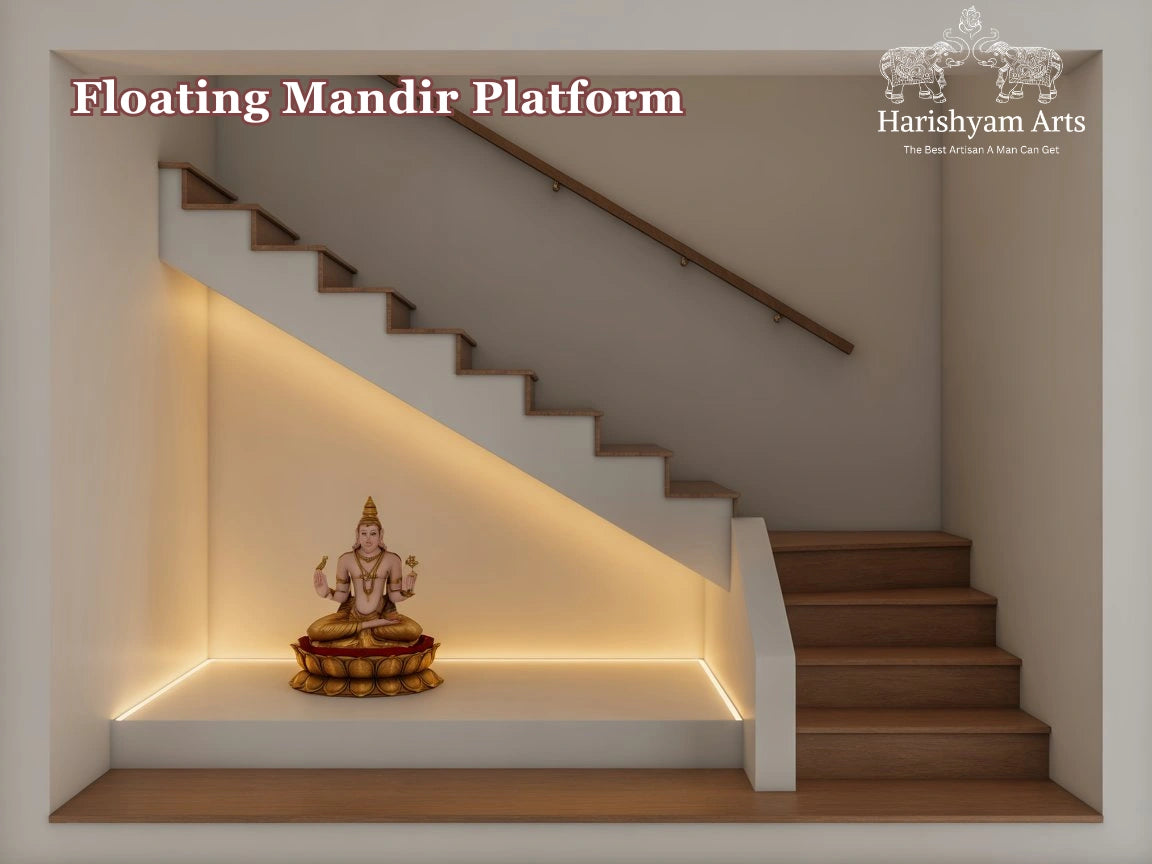
8. Floating Mandir Platform
Modern Under-Stair Mandir with Airy Aesthetic
This modern design uses a floating wooden or marble slab with concealed brackets to give the illusion of space. Place a single idol or frame, use indirect LED lighting underneath, and add a small green plant or candle for a serene ambiance.
9. Stone Cladding Backdrop
Earthy Mandir Design with Natural Stone Texture
For a rustic, earthy vibe, use stone cladding like slate or sandstone behind the mandir. Combine with wooden shelves or a pedestal for idols, and add potted plants or brass lamps. This gives the mandir a grounded, nature-inspired atmosphere.

10. Mirror & Lighting Magic
Reflective Mandir Design to Maximize Space
Mirrors enhance space and light, making your mandir look larger. Use mirror panels behind the idols and warm golden lighting. Acrylic or gold idols and crystal diyas enhance the reflective effect, making this a glamorous mandir option.

Vastu Tips for Staircase Mandir Placement
To maintain the spiritual energy and harmony of your home, keep the following Vastu guidelines in mind when designing your mandir:
-
Idol Direction: Idols should face east or north.
-
Placement: Avoid placing a mandir below a toilet or kitchen.
-
Cleanliness: Always keep the area clean and sacred.
-
Lighting: Use soft, warm lighting to create a calm, inviting ambiance.
-
Storage: Store incense, oil, and scriptures in concealed drawers, not exposed shelves.
Final Thoughts: Transform Corners into Sacred Spaces
Creating a pooja mandir for home under the staircase is not only a smart space-saving idea but also a meaningful way to keep spirituality at the heart of your living space. Whether you opt for minimalist marble or rich wood designs, what truly matters is that the mandir brings peace, positivity, and a deep personal connection. With thoughtful design and intention, even the quietest corners can become sacred sanctuaries.
FAQ’s
Q1. Is it okay to place a mandir under the staircase according to Vastu?
Ans: Yes, it is generally acceptable to place a mandir under the staircase if the space is not used for storage or clutter and there is no bathroom directly above. Ensure the idols face east or north, and the space is well-lit, clean, and used solely for spiritual purposes.
Q2. What materials are best for under-staircase mandirs?
Ans: The best materials include wood (like teak or sheesham), marble, stone cladding, or glass—depending on your design preference. Wood and marble are ideal for traditional aesthetics, while glass and floating platforms are better for modern homes.
Q3. Can I install lighting in a staircase mandir?
Ans: Absolutely! Lighting is essential to create a divine atmosphere. Use soft, warm-toned LED lights, preferably recessed or hidden, to avoid harsh glare. Backlit panels, spotlights, or diya-inspired lights add charm and focus to the mandir.
Q4. How do I maintain a mandir under the staircase?
Ans: Regular cleaning is key. Use closed storage to keep incense, diya oil, and puja items out of sight. Wipe down idols and shelves weekly. For marble and glass surfaces, avoid harsh chemicals—use a soft damp cloth or natural cleaners.
Q5. Does Harishyam Arts offer custom mandir designs for staircases?
Ans: Yes, Harishyam Arts specializes in custom handcrafted mandir designs, including unique under-staircase concepts tailored to your home’s dimensions, décor, and spiritual preferences. Whether you prefer a modern glass setup or a traditional wooden temple, their skilled artisans can bring your vision to life with precision and devotion.

Lakshay Sharma
I’m Lakshay Sharma, a writer with a deep passion for Hindu mythology, Vastu Shastra, and home interiors. I enjoy exploring the rich traditions of Hindu gods and goddesses, sharing insights into Vastu principles, and offering guidance on creating sacred spaces like Puja Mandirs. Through my writing, I aim to inspire harmony and spiritual well-being, blending traditional knowledge with modern perspectives.
Harishyam Arts | Jaipur
Related Blogs

Bhagavad Gita Chapter 4 Verse 42 Meaning in Hindi and English
Lakshay Sharma | June 16, 2026
Bhagavad Gita Chapter 4 Verse 42 is the concluding verse of Chapt...
Read More...
Bhagavad Gita Chapter 4 Verse 41 Meaning in Hindi and English
Lakshay Sharma | June 16, 2026
Bhagavad Gita Chapter 4 Verse 41 reveals the state of a person who has attaine...
Read More...
Bhagavad Gita Chapter 4 Verse 39 Meaning in Hindi and English
Lakshay Sharma | June 16, 2026
Bhagavad Gita Chapter 4 Verse 39 beautifully explains the qualiti...
Read More...
Bhagavad Gita Chapter 4 Verse 38 Meaning in Hindi and English
Lakshay Sharma | June 16, 2026
Bhagavad Gita Chapter 4 Verse 38 is one of the most celebrated verses on the g...
Read More...
Bhagavad Gita Chapter 4 Verse 37 Meaning in Hindi and English
Lakshay Sharma | June 16, 2026
Bhagavad Gita Chapter 4 Verse 37 uses a powerful metaphor to describe the tran...
Read More...
Bhagavad Gita Chapter 4 Verse 36 Meaning in Hindi and English
Lakshay Sharma | June 16, 2026
Bhagavad Gita Chapter 4 Verse 36 is one of the most reassuring verses in the G...
Read More...
Powerful Lord Ganesha Mantras to Remove Obstacles in Life
Lakshay Sharma | June 15, 2026
In Hindu spirituality, Lord Ganesha is worshipped as the remover of obstacles,...
Read More...
Bhagavad Gita Chapter 4 Verse 40 Meaning in Hindi and English
Lakshay Sharma | June 15, 2026
Bhagavad Gita Chapter 4 Verse 40 serves as a profound warning about the obstac...
Read More...
Why White Marble Mandirs Are Associated with Purity, Peace, and Divine Energy
Lakshay Sharma | June 14, 2026
In Indian culture and spiritual traditions, temples are not just places of wor...
Read More...
Bhagavad Gita Chapter 4 Verse 35 Meaning in Hindi and English
Lakshay Sharma | June 13, 2026
Bhagavad Gita Chapter 4 Verse 35 reveals the transformative power...
Read More...
Bhagavad Gita Chapter 4 Verse 34 Meaning in Hindi and English
Lakshay Sharma | June 13, 2026
Bhagavad Gita Chapter 4 Verse 34 is one of the most influential verses on the ...
Read More...
Bhagavad Gita Chapter 4 Verse 33 Meaning in Hindi and English
Lakshay Sharma | June 13, 2026
Bhagavad Gita Chapter 4 Verse 33 marks a turning point in Lord Krishna’s teach...
Read More...
Bhagavad Gita Chapter 4 Verse 32 Meaning in Hindi and English
Lakshay Sharma | June 13, 2026
Bhagavad Gita Chapter 4 Verse 32 concludes Lord Krishna’s discussion on the va...
Read More...
Bhagavad Gita Chapter 4 Verse 31 Meaning in Hindi and English
Lakshay Sharma | June 12, 2026
Bhagavad Gita Chapter 4 Verse 31 highlights the immense importance of <...
Read More...
Bhagavad Gita Chapter 4 Verse 30 Meaning in Hindi and English
Lakshay Sharma | June 12, 2026
Bhagavad Gita Chapter 4 Verse 30 continues Lord Krishna’s discussion on the di...
Read More...
Bhagavad Gita Chapter 4 Verse 29 Meaning in Hindi and English
Lakshay Sharma | June 12, 2026
Bhagavad Gita Chapter 4 Verse 29 continues Lord Krishna’s explanation of the d...
Read More...
Bhagavad Gita Chapter 4 Verse 28 Meaning in Hindi and English
Lakshay Sharma | June 12, 2026
Bhagavad Gita Chapter 4 Verse 28 continues Lord Krishna’s explanation of the m...
Read More...
Bhagavad Gita Chapter 4 Verse 27 Meaning in Hindi and English
Lakshay Sharma | June 12, 2026
Bhagavad Gita Chapter 4 Verse 27 continues Lord Krishna’s discourse on the var...
Read More...
Bhagavad Gita Chapter 4 Verse 25 Meaning in Hindi & English
Lakshay Sharma | June 12, 2026
Bhagavad Gita Chapter 4 Verse 25 marks the beginning of Lord Krishna's detaile...
Read More...
Bhagavad Gita Chapter 4 Verse 24 Meaning in Hindi & English
Lakshay Sharma | June 12, 2026
Bhagavad Gita Chapter 4 Verse 24 is one of the most profound and philosophical...
Read More...
Bhagavad Gita Chapter 4 Verse 23 Meaning in Hindi & English
Lakshay Sharma | June 12, 2026
Bhagavad Gita Chapter 4 Verse 23 continues Lord Krishna's profound teachings o...
Read More...
Bhagavad Gita Chapter 4 Verse 22 Meaning in Hindi & English
Lakshay Sharma | June 12, 2026
Bhagavad Gita Chapter 4 Verse 22 presents one of the clearest descriptions of ...
Read More...
Bhagavad Gita Chapter 4 Verse 21 Meaning in Hindi and English
Lakshay Sharma | June 12, 2026
Bhagavad Gita Chapter 4 Verse 21 further elaborates on the qualities of a true...
Read More...
Bhagavad Gita Chapter 4 Verse 20 Meaning in Hindi and English
Lakshay Sharma | June 12, 2026
Bhagavad Gita Chapter 4 Verse 20 continues Lord Krishna’s profound explanation...
Read More...
Bhagavad Gita Chapter 4 Verse 19 Meaning in Hindi and English
Lakshay Sharma | June 12, 2026
Bhagavad Gita Chapter 4 Verse 19 describes the qualities of a truly enlightene...
Read More...
Bhagavad Gita Chapter 4 Verse 18 Meaning in Hindi and English
Lakshay Sharma | June 12, 2026
Bhagavad Gita Chapter 4 Verse 18 presents one of the most profound and paradox...
Read More...
Bhagavad Gita Chapter 4 Verse 17 Meaning in Hindi and English
Lakshay Sharma | June 12, 2026
Bhagavad Gita Chapter 4 Verse 17 continues Lord Krishna’s profound teaching on...
Read More...
Bhagavad Gita Chapter 4 Verse 15 Meaning in Hindi & English
Lakshay Sharma | June 12, 2026
Bhagavad Gita Chapter 4 Verse 15 builds upon Krishna's teaching about detached...
Read More...
Bhagavad Gita Chapter 4 Verse 14 Meaning in Hindi & English
Lakshay Sharma | June 12, 2026
Bhagavad Gita Chapter 4 Verse 14 continues Lord Krishna's explanation of His d...
Read More...
Bhagavad Gita Chapter 4 Verse 13 Meaning in Hindi & English
Lakshay Sharma | June 12, 2026
Bhagavad Gita Chapter 4 Verse 13 is one of the most discussed verses in the Bh...
Read More...
Bhagavad Gita Chapter 4 Verse 12 Meaning in Hindi & English
Lakshay Sharma | June 12, 2026
Bhagavad Gita Chapter 4 Verse 12 explains why many people worship various deit...
Read More...
Bhagavad Gita Chapter 4 Verse 11 Meaning in Hindi & English
Lakshay Sharma | June 12, 2026
Bhagavad Gita Chapter 4 Verse 11 is one of the most inclusive and universal te...
Read More...
Bhagavad Gita Chapter 4 Verse 10 Meaning in Hindi & English
Lakshay Sharma | June 12, 2026
Bhagavad Gita Chapter 4 Verse 10 reveals the qualities and spiritual practices...
Read More...
Shankh, Chakra & Tilak in Mandir: Their Significance, Placement, and Benefits Explained
Lakshay Sharma | June 12, 2026
Indian temples are not just places of worship; they are centers of spiritual e...
Read More...
Bhagavad Gita Chapter 4 Verse 9 Meaning in Hindi & English
Lakshay Sharma | June 11, 2026
Bhagavad Gita Chapter 4 Verse 9 is one of the most celebrated verses in the Bh...
Read More...
Bhagavad Gita Chapter 4 Verse 8 Meaning in Hindi and English
Lakshay Sharma | June 11, 2026
Bhagavad Gita Chapter 4 Verse 8 is the continuation of Lord Krishna's declarat...
Read More...
Bhagavad Gita Chapter 4 Verse 7 Meaning in Hindi and English
Lakshay Sharma | June 11, 2026
Bhagavad Gita Chapter 4 Verse 7 is one of the most famous and widely quoted ve...
Read More...
Bhagavad Gita Chapter 4 Verse 6 Meaning in Hindi and English
Lakshay Sharma | June 11, 2026
Bhagavad Gita Chapter 4 Verse 6 is one of the most profound...
Read More...
Bhagavad Gita Chapter 4 Verse 5 Meaning in Hindi and English
Lakshay Sharma | June 11, 2026
Bhagavad Gita Chapter 4 Verse 5 contains Lord Krishna's response to Arjuna's q...
Read More...
Bhagavad Gita Chapter 4 Verse 4 Meaning in Hindi and English
Lakshay Sharma | June 11, 2026
Bhagavad Gita Chapter 4 Verse 4 presents an important question from Arjuna. Af...
Read More...
Bhagavad Gita Chapter 4 Verse 3 Meaning in Hindi and English
Lakshay Sharma | June 11, 2026
Bhagavad Gita Chapter 4 Verse 3 is a significant verse where Lord Krishna reve...
Read More...
Bhagavad Gita Chapter 4 Verse 2 Meaning in Hindi and English
Lakshay Sharma | June 11, 2026
Bhagavad Gita Chapter 4 Verse 2 continues Lord Krishna's explanation of the an...
Read More...
Bhagavad Gita Chapter 4 Verse 1 Meaning in Hindi and English
Lakshay Sharma | June 11, 2026
Bhagavad Gita Chapter 4 Verse 1 marks the beginning of the fourth chapter, kno...
Read More...
Bhagavad Gita Chapter 3 Verse 43 Meaning in Hindi & English
Lakshay Sharma | June 11, 2026
Bhagavad Gita Chapter 3 Verse 43 is the concluding verse of Chapter 3 (Karma Y...
Read More...
Bhagavad Gita Chapter 3 Verse 42 Meaning in Hindi & English
Lakshay Sharma | June 11, 2026
Bhagavad Gita Chapter 3 Verse 42 is one of the most profound verses in the Bha...
Read More...
Bhagavad Gita Chapter 3 Verse 33 Meaning in Hindi & English
Lakshay Sharma | June 11, 2026
Bhagavad Gita Chapter 3 Verse 33 addresses a fundamental aspect of human behav...
Read More...
Bhagavad Gita Chapter 3 Verse 32 Meaning in Hindi & English
Lakshay Sharma | June 11, 2026
Bhagavad Gita Chapter 3 Verse 32 serves as a warning from Lord Krishna about t...
Read More...
Bhagavad Gita Chapter 3 Verse 31 Meaning in Hindi & English
Lakshay Sharma | June 11, 2026
Bhagavad Gita Chapter 3 Verse 31 highlights the importance of fai...
Read More...
Bhagavad Gita Chapter 3 Verse 30 Meaning in Hindi & English
Lakshay Sharma | June 11, 2026
Bhagavad Gita Chapter 3 Verse 30 is one of the most powerful teachings on Read More...

Bhagavad Gita Chapter 3 Verse 29 Meaning in Hindi & English
Lakshay Sharma | June 11, 2026
Bhagavad Gita Chapter 3 Verse 29 continues Lord Krishna's discussion about the...
Read More...


