

Marble Kalratri Statue

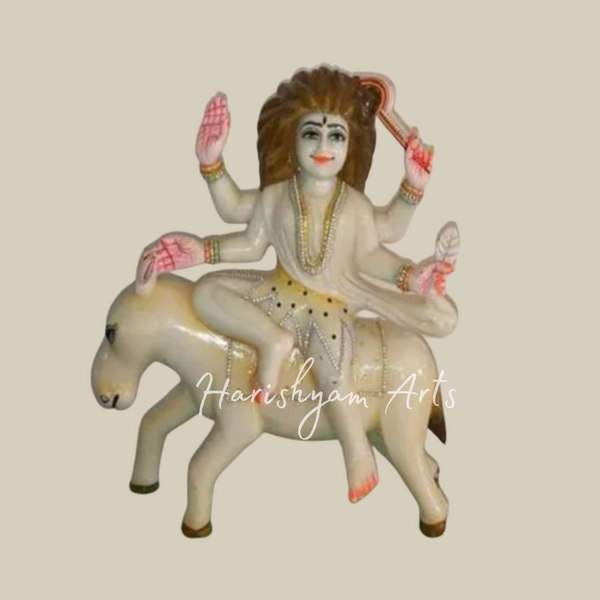
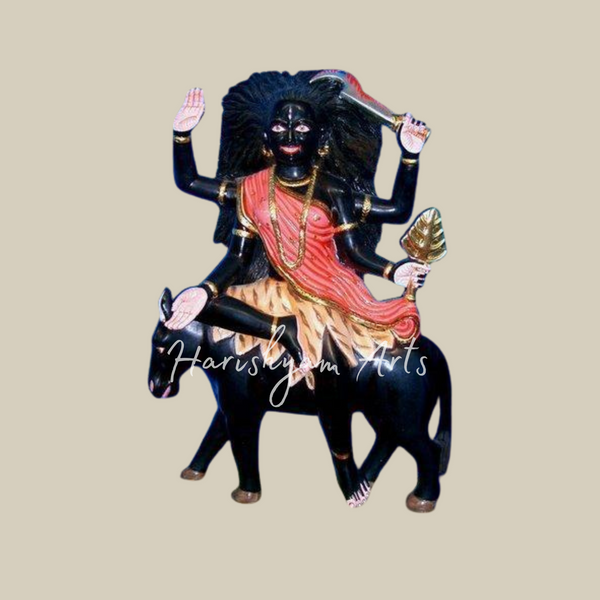
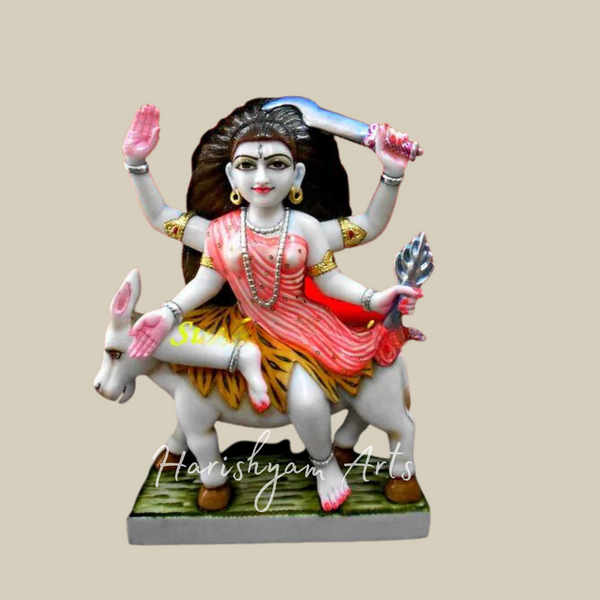
The Marble Kalratri Statue collection by Harishyam Arts represents the seventh form of Navadurga through a powerful and deeply symbolic interpretation of the Divine Mother. Maa Kalratri is traditionally worshipped on the seventh day of Navratri and is regarded as one of the most formidable manifestations of Shakti. Her dark appearance, three eyes, flowing hair, powerful expression, four arms, and traditional donkey vahana represent the destruction of fear, darkness, ignorance, and destructive forces. Despite her fierce appearance, Maa Kalratri is revered as Shubhankari, the auspicious one, because her formidable power is ultimately directed toward protection and the welfare of her devotees. A finely handcrafted Marble Kalratri Maa Murti captures this extraordinary contrast between fierce divine energy and compassionate protection through carefully carved facial features, traditional weapons, expressive hands, flowing hair, ornaments, garments, and the distinctive form of her vahana. At Harishyam Arts, experienced artisans combine traditional Indian marble carving with detailed hand-finishing and careful quality inspection to create sculptures suitable for home temples, Navratri shrines, spiritual spaces, temples, meditation areas, and large devotional installations.
Maa Kalratri – The Seventh Navadurga
Maa Kalratri is traditionally recognized as the seventh form of Navadurga, worshipped on the seventh day of Navratri.
Her position in the sequence is significant because she represents the stage where spiritual strength confronts the deepest forms of darkness and fear.
The earlier manifestations of the Goddess express stability, discipline, courage, creation, motherhood, and righteous action. Kalratri takes this progression further by representing the power required to destroy obstacles and confront destructive forces directly.
A Marble Kalratri Statue therefore carries a particularly strong message of fearlessness, transformation, protection, and spiritual courage.
The Meaning of the Name Kalratri
The name Kalratri is traditionally understood in connection with Kala and Ratri, often interpreted as the dark night or the night associated with dissolution.
Her darkness should not be understood simply as something negative. In traditional symbolism, it represents the profound and mysterious power through which darkness, ignorance, fear, and destructive influences are overcome.
Her form reminds devotees that darkness can be confronted rather than feared.
This gives a Marble Kalratri Maa Statue a unique spiritual identity among the Navadurga forms.
The Fierce Yet Auspicious Mother
Maa Kalratri's appearance is intentionally formidable.
Her dark complexion, dishevelled hair, intense expression, three eyes, and powerful posture communicate an overwhelming force that cannot easily be challenged.
Yet this fierce appearance is balanced by her protective and blessing gestures.
This contrast is central to her identity. She may appear terrifying to destructive forces, but for devotees who seek her protection, she is regarded as a compassionate and auspicious mother.
This idea is beautifully expressed through a carefully sculpted marble murti where the face communicates strength while the hands communicate reassurance.
Four-Armed Form of Maa Kalratri
Maa Kalratri is traditionally represented with four arms.
Her hands commonly hold a sword and an iron weapon or hook-like implement, while the remaining hands display the Abhaya and Varada mudras.
These elements create a visually distinctive composition.
The sword represents the power to cut through ignorance and destructive influences, while the second weapon reflects her formidable protective strength.
The Abhaya Mudra represents fearlessness and reassurance, while the Varada Mudra represents blessings and divine grace.
Creating these gestures accurately in marble requires exceptional attention to the fingers, palm shapes, and hand proportions.
The Sword of Kalratri
The sword is one of the most recognizable attributes of Maa Kalratri.
It represents decisive spiritual strength and the ability to destroy forces that obstruct righteousness and inner development.
For the artisan, the sword is also a technically demanding element because its narrow shape must remain elegant while being sufficiently strong.
The blade, handle, guard, and positioning can all be carefully carved according to the selected traditional design.
In a large Marble Kalratri Murti, additional ornamental details can be incorporated into the weapon to create a richer sculptural appearance.
The Iron Weapon and Protective Power
Traditional representations of Maa Kalratri may include an iron weapon, often described as an iron hook or similar implement.
Its presence reinforces the Goddess's formidable and uncompromising nature.
The weapon is not merely an element of visual decoration. It represents the strength required to confront destructive influences and remove obstacles.
Harishyam Arts artisans pay close attention to the shape, proportion, and placement of such attributes so that they remain clearly identifiable without disrupting the overall balance of the sculpture.
Abhaya Mudra – Freedom from Fear
The Abhaya Mudra is particularly meaningful in the representation of Maa Kalratri.
Her appearance may be fierce, but the raised hand conveys reassurance and protection.
The gesture traditionally communicates the message of fearlessness and encourages devotees to face difficulties with confidence.
In a marble sculpture, the hand and fingers must be carved with exceptional precision because even a small change in finger placement can alter the character of the mudra.
This makes hand detailing one of the most important stages in creating an authentic-looking Marble Kalratri Mata Statue.
Varada Mudra – Divine Blessings
The Varada Mudra complements the protective character of the Abhaya Mudra.
It is traditionally associated with generosity, compassion, blessings, and the granting of divine grace.
Together, the two gestures create a powerful symbolic contrast: one removes fear while the other represents divine benevolence.
This balance helps communicate the deeper meaning of Maa Kalratri's form—that fierce divine power ultimately exists for protection and auspiciousness.
The Three Eyes of Maa Kalratri
Maa Kalratri is traditionally depicted with three eyes, representing heightened divine perception and awareness.
The third eye is a recurring symbol within Shaiva and Shakta traditions and is associated with insight beyond ordinary perception.
For the marble artisan, creating three clearly defined eyes within a powerful facial expression requires considerable precision.
The eyes, eyebrows, forehead, nose, and lips must work together to create the intense yet controlled expression associated with Kalratri.
Flowing and Dishevelled Hair
The flowing hair of Maa Kalratri is one of her most recognizable visual characteristics.
Unlike the carefully arranged hairstyles seen in many serene forms of the Goddess, her hair is traditionally depicted as loose and dishevelled.
This creates a sense of untamed divine energy and reinforces the formidable nature of her manifestation.
Carving flowing hair in marble requires the artisan to create numerous overlapping strands and natural movement while maintaining sufficient structural strength.
For larger sculptures, the hair can become an especially dramatic element of the composition.
The Donkey – Vahana of Maa Kalratri
Maa Kalratri is traditionally depicted riding a donkey, an unusual vahana compared with the lion, tiger, bull, or lotus associated with other forms of Navadurga.
This distinctive element gives her sculpture a recognizable identity.
The donkey is traditionally understood in devotional interpretations as reinforcing the idea that divine power does not depend on outward grandeur. Even through a humble vehicle, the Goddess possesses immense spiritual authority.
Creating the donkey in marble requires careful attention to its proportions, facial expression, legs, ears, body structure, and posture.
A well-carved vahana gives the complete Marble Kalratri Statue greater depth and visual character.
The Face of Maa Kalratri
The face is perhaps the most challenging and expressive part of a Kalratri sculpture.
Her expression needs to communicate tremendous power without becoming visually uncontrolled.
The eyes may be intense, the eyebrows strongly defined, and the facial structure powerful, while the overall composition remains dignified and traditionally devotional.
Harishyam Arts artisans carefully refine the facial proportions to create a powerful expression appropriate to the fierce form of Maa Kalratri.
Traditional Ornaments and Garland
Although Maa Kalratri has a fierce appearance, her sculpture can include traditional ornaments and a distinctive devotional garland.
Jewelry such as earrings, necklaces, bangles, armlets, waist ornaments, and other details can be incorporated according to the selected iconographic style.
The ornaments create contrast against the flowing hair and powerful expression, adding richness to the marble composition.
For larger commissions, artisans can develop these elements with deeper carving and more elaborate ornamental patterns.
Traditional Garments and Drapery
The garments of Maa Kalratri can be represented with flowing folds that complement her dynamic appearance.
Rather than creating an overly static form, carefully carved fabric can introduce movement and depth.
Artisans gradually develop the garment folds from broader structural shapes into finer lines, ensuring that the marble retains sufficient strength.
The final result combines the formidable character of Kalratri with the refined craftsmanship expected from a traditional marble devotional sculpture.
Handcrafted Marble Kalratri Sculpture
Creating a handcrafted Marble Kalratri Statue requires both technical skill and a detailed understanding of traditional Goddess iconography.
The process begins with selecting suitable marble according to the desired dimensions and complexity of the design.
The artisan establishes the main structure of the Goddess and her donkey before gradually developing the face, three eyes, four arms, hands, weapons, hair, ornaments, garments, and pedestal.
The most delicate details are completed only after the primary proportions have been carefully established.
Once carving is complete, the sculpture undergoes smoothing, polishing, and detailed inspection.
Carefully Selected Marble
A high-quality marble surface provides an excellent foundation for the detailed carving required for Maa Kalratri.
The stone must be capable of supporting delicate elements such as fingers, weapon edges, hair strands, facial features, ornaments, and the structural connection between the Goddess and her vahana.
Harishyam Arts selects marble according to the size, composition, carving complexity, and intended placement of each sculpture.
With proper care and an appropriate installation environment, a handcrafted marble murti can remain a lasting part of a devotional space for generations.
Marble Kalratri Statues in Different Sizes
Harishyam Arts offers Marble Kalratri Statues in multiple sizes, making the collection suitable for both intimate prayer spaces and larger devotional projects.
Compact sizes are appropriate for home mandirs, personal shrines, prayer rooms, meditation spaces, and Navratri worship.
Medium-sized sculptures can become prominent focal points within larger home temples, spiritual centers, and dedicated worship areas.
Large sculptures can be commissioned for temples, religious institutions, luxury residences, cultural spaces, and architectural installations.
Available sizes can include 6 inches, 8 inches, 12 inches, 18 inches, 24 inches, 30 inches, 36 inches, and 48 inches, with larger custom-made Marble Kalratri Statues available for temple and architectural requirements.
Custom Marble Kalratri Maa Statues
Harishyam Arts offers custom Marble Kalratri Maa Statues for customers who require specific dimensions, posture, iconography, detailing, or finishing.
Customization can include the overall size, Goddess posture, four-arm arrangement, weapon design, hand gestures, facial expression, hair treatment, ornaments, garments, donkey posture, pedestal, and level of carving.
Customers can request a comparatively traditional and restrained representation or a more dramatic interpretation featuring extensive hair detailing, expressive facial features, elaborate weapons, and a richly carved vahana.
For large temple projects, the sculpture can be developed according to the dimensions of the sanctum, altar, niche, entrance, or Navadurga installation.
Marble Kalratri for Navratri
Maa Kalratri is traditionally worshipped on the seventh day of Navratri, known as Saptami.
A Marble Kalratri statue for Navratri offers a permanent devotional representation of the seventh Navadurga rather than a temporary festival display.
For families and institutions that observe the complete Navadurga tradition, a handcrafted Kalratri murti can form an important part of a nine-form collection.
Her powerful symbolism of protection and fearlessness makes her especially significant during Navratri worship.
Marble Kalratri for Home Temples
A Marble Kalratri idol for home temple creates a distinctive and spiritually powerful focal point.
Her symbolism can be meaningful for devotees who associate her with courage, protection, overcoming fear, and the removal of negativity.
Smaller sculptures can be placed within compact home mandirs or personal shrines, while larger murtis can become the principal devotional focus of a spacious prayer room.
The refined surface of polished marble provides a beautiful contrast to traditional wooden mandirs, lamps, flowers, carved interiors, and other devotional elements.
Marble Kalratri for Temples and Spiritual Spaces
A Marble Kalratri statue for temple can be created as an individual deity sculpture or as part of a complete Navadurga installation.
Temple commissions require careful attention to the relationship between the Goddess, donkey, pedestal, surrounding architecture, and viewing distance.
Harishyam Arts can create custom Kalratri sculptures for temples, spiritual institutions, private shrines, community devotional spaces, and large religious projects.
Large installations can be planned with consideration for structural strength, transportation, finishing, and installation requirements.
Kalratri as a Symbol of Fearlessness
The central spiritual message of Maa Kalratri is the transformation of fear into courage.
Her fierce appearance demonstrates that darkness and adversity do not have to control the devotee.
The sword represents the power to cut through ignorance and destructive influences, while her protective gesture communicates reassurance.
Her form can therefore serve as a powerful reminder to remain courageous when confronting difficult circumstances.
The Auspicious Nature of Shubhankari
Although Kalratri is among the most formidable forms of the Goddess, she is also traditionally associated with the name Shubhankari, meaning the auspicious one.
This apparent contrast is essential to understanding her symbolism.
Her fierceness is directed toward destructive forces, while her relationship with devotees is protective and benevolent.
A Marble Kalratri Maa Murti therefore represents not destruction for its own sake, but the removal of what prevents spiritual, emotional, and personal growth.
Spiritual Significance of Maa Kalratri
Maa Kalratri can be understood as a powerful symbol of courage, transformation, protection, awareness, fearlessness, and the destruction of negativity.
Her form encourages devotees to confront internal and external obstacles rather than surrendering to fear.
The transition from Kalratri to the next Navadurga form, Mahagauri, is traditionally understood as a movement from darkness toward purification and radiance.
This makes her place within Navadurga especially meaningful: darkness becomes part of the journey toward higher light.
Vastu and Placement Considerations
Maa Kalratri is traditionally represented in devotional environments such as home temples, shrines, temples, Navdurga installations, and spiritual spaces.
Vastu practices can differ according to regional traditions, family customs, architectural layouts, and individual beliefs. Placement should therefore be considered in relation to the complete devotional environment rather than according to one universal rule.
Customers who wish to follow particular Vastu principles can consult a qualified Vastu practitioner for guidance based on their specific prayer space or property.
For temple installations, placement, consecration, and worship practices should follow the relevant religious tradition and guidance of appropriate temple authorities.
A Meaningful Devotional Gift
A Marble Kalratri statue makes a distinctive devotional gift for devotees connected with Navdurga, Navratri, Goddess Durga, or traditional Shakti worship.
It can be considered for housewarmings, Navratri celebrations, religious occasions, new prayer spaces, temple inaugurations, spiritual milestones, and family devotional environments.
Because Kalratri represents fearlessness and protection, her sculpture can carry a particularly meaningful message for someone beginning a challenging journey or seeking strength during a period of change.
Marble Polishing and Finishing
The final finishing stage is carefully performed to enhance the natural character of the marble while preserving the detailed carving.
Special attention is given to the face, eyes, hands, weapons, hair, ornaments, garments, donkey, and pedestal.
The surface is gradually refined to achieve a smooth and elegant appearance while retaining the depth and definition of the carving.
For custom commissions, the finishing treatment can be selected according to the desired visual character and installation environment.
Artisan Craftsmanship at Harishyam Arts
Creating a detailed Marble Kalratri Maa sculpture requires an experienced understanding of both marble craftsmanship and traditional Navadurga iconography.
The artisan must balance several contrasting qualities: a fierce expression with protective gestures, flowing hair with structural including her powerful expression, three eyes, four arms, traditional weapons, protective mudras, flowing of the Divine Mother. Her distinctive appearance, three eyes, four arms, sacred weapons, Abhaya and Varada mudras, flowing hair, and humble donkey vahana create a sculpture unlike any other to your preferred dimensions, posture, arm arrangement, weapons, facial expression, hair detailing, ornaments, garments, v or large architectural installation, Harishyam Arts creates each Marble Kalratri sculpture through skilled hand carving, careful detailing, refined polishing, and thorough quality stability, delicate hands with powerful weapons, and the Goddess with her distinctive donkey vahana.
Harishyam Arts artisans combine time-honored Indian stone-carving traditions with detailed handwork and refined finishing techniques.
Every sculpture is developed patiently, allowing the artisan to refine both its technical proportions and its spiritual character.
Quality Checks and Finishing Standards
Every Marble Kalratri sculpture undergoes careful quality inspection during and after production.
Artisans review the facial expression, three eyes, four arms, hands, weapons, hair, ornaments, garments, donkey, pedestal, surface finish, polishing, and overall balance.
For larger custom sculptures, additional checks are performed for exact dimensions, structural stability, transportation requirements, finishing consistency, and installation suitability.
These standards help Harishyam Arts maintain dependable craftsmanship across compact devotional murtis and large temple sculptures.
Why Choose Harishyam Arts for Marble Kalratri Statues?
Harishyam Arts combines traditional Indian marble craftsmanship with experienced artisans, carefully selected stone, detailed hand carving, customization, and refined finishing standards.
Our Marble Kalratri Statues are created for customers who value the spiritual significance of the seventh Navadurga as well as the artistic beauty of authentic handcrafted marble sculpture.
Every murti receives careful attention to the distinctive identity of Maa Kalratri, including her powerful expression, three eyes, four arms, traditional weapons, protective mudras, flowing hair, ornaments, garments, and donkey vahana.
Whether you require a compact sculpture for a home mandir, a Navratri devotional murti, a spiritual centerpiece, or a large custom statue for a temple or architectural project, Harishyam Arts approaches every creation with patience, precision, and respect for traditional craftsmanship.
Explore the Marble Kalratri Collection
The Marble Kalratri collection by Harishyam Arts brings together one of the most powerful manifestations of Shakti with the enduring beauty of handcrafted Indian marble sculpture.
As the seventh form of Navadurga, Maa Kalratri represents the courage to confront darkness, the strength to overcome fear, and the protective power of the Divine Mother. Her distinctive appearance, three eyes, four arms, sacred weapons, Abhaya and Varada mudras, flowing hair, and humble donkey vahana create a sculpture unlike any other form in the Navadurga tradition.
Choose from different sizes and levels of detailing, or commission a custom Marble Kalratri Maa Statue according to your preferred dimensions, posture, arm arrangement, weapons, facial expression, hair detailing, ornaments, garments, vahana, pedestal, carving style, and finish.
From a home mandir and Navratri shrine to a temple, spiritual institution, meditation space, or large architectural installation, Harishyam Arts creates each Marble Kalratri sculpture through skilled hand carving, careful detailing, refined polishing, and thorough quality inspection—creating a lasting expression of fearlessness, protection, divine strength, transformation, and India's rich marble sculptural heritage.


