

Marble Kushmanda Marble Statue

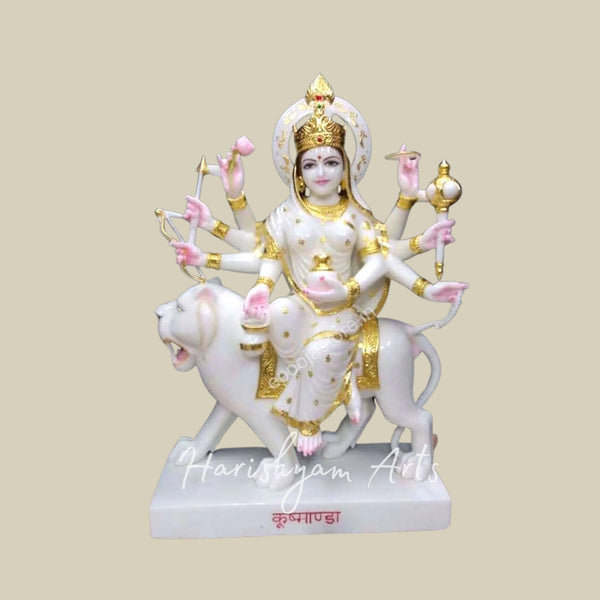
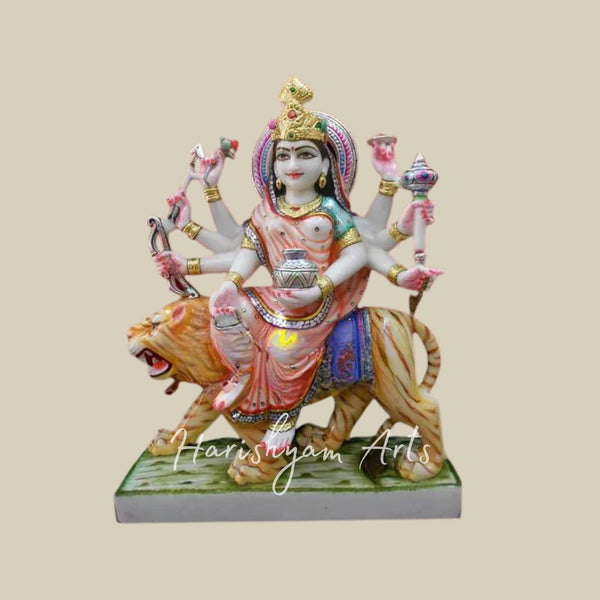
The Marble Kushmanda Marble Statue collection by Harishyam Arts represents the fourth form of Navadurga through the luminous beauty and intricate craftsmanship of handcrafted Indian marble sculpture. Maa Kushmanda is traditionally worshipped on the fourth day of Navratri and is revered as a powerful manifestation of the Divine Mother associated with creation, cosmic energy, radiance, vitality, abundance, and the life-giving force of the universe. Her name is traditionally connected with the cosmic egg, while her radiant association with the Sun reflects light, warmth, energy, and the sustaining power of creation. Maa Kushmanda is commonly represented with eight arms, known as Ashtabhuja Devi, carrying sacred attributes such as a lotus, bow, arrow, discus, mace, rosary, kamandalu, and vessel of nectar, with her divine vehicle traditionally represented as a lion or, in some traditions, a tiger. A finely carved Marble Kushmanda Maa Statue brings these powerful spiritual symbols together in a graceful and majestic composition. At Harishyam Arts, every sculpture is developed by experienced artisans who carefully work on the Goddess's serene expression, eight arms, sacred attributes, crown, ornaments, garments, vehicle, and pedestal, using traditional hand-carving techniques and refined finishing methods to create a devotional sculpture worthy of a home temple, Navratri shrine, temple, spiritual center, meditation space, or architectural installation.
Maa Kushmanda – The Fourth Form of Navadurga
Maa Kushmanda is traditionally recognized as the fourth form of Navadurga, the nine manifestations of Goddess Durga worshipped during Navratri.
Her place in the sequence is particularly meaningful. After the stability of Shailputri, the spiritual discipline of Brahmacharini, and the courageous strength of Chandraghanta, Kushmanda represents the creative energy that brings light and life into existence.
Her form is therefore associated with creation, vitality, positive energy, illumination, nourishment, and abundance.
A Marble Kushmanda Maa Murti can serve as a beautiful representation of these qualities, making it especially meaningful for devotional spaces dedicated to spiritual growth, positivity, and divine energy.
The Meaning of Maa Kushmanda
The traditional interpretation of the name Kushmanda is associated with the idea of the cosmic egg, or Brahmanda.
According to traditional devotional narratives, when darkness prevailed, the Goddess brought light and creation into existence through her divine smile.
This imagery gives Kushmanda a distinctive identity among the Navadurga. She is not only associated with protection but also with the creative force that transforms darkness into light and potential into existence.
For devotees, her form can symbolize the ability to create positive energy, begin anew, and bring light into difficult circumstances.
Kushmanda and Cosmic Creative Energy
Maa Kushmanda is traditionally connected with the radiant energy of the Sun. Her luminous character represents the warmth and vitality required to sustain life.
This association gives her marble sculpture a naturally radiant visual character.
The Goddess's serene face, elaborate crown, multiple arms, sacred attributes, and traditional vehicle combine to create a composition that conveys both cosmic grandeur and maternal grace.
A Marble Kushmanda Statue can therefore be especially appropriate for spaces where devotees wish to cultivate an atmosphere of positivity, spiritual energy, optimism, and abundance.
The Eight-Armed Form of Maa Kushmanda
Maa Kushmanda is traditionally depicted with eight arms, earning her the name Ashtabhuja Devi.
Her eight hands hold different sacred objects that represent various dimensions of divine power. Traditional representations commonly include the lotus, bow, arrow, discus, mace, rosary, kamandalu, and vessel of nectar, although specific arrangements and attributes may vary according to iconographic tradition.
Creating an eight-armed Goddess in marble is an intricate task. Each arm must be proportionally connected to the body while allowing enough space for the sacred objects to remain clearly visible.
Harishyam Arts artisans carefully plan the entire composition before developing the finer details, helping the final sculpture maintain both traditional character and structural stability.
Sacred Attributes of Kushmanda Maa
The various objects held by Maa Kushmanda add layers of meaning to her representation.
The lotus is traditionally associated with purity and spiritual beauty. The bow and arrow represent focus, determination, and directed energy. The discus and mace convey divine power and protection, while the rosary represents devotion and spiritual practice.
The kamandalu and vessel of nectar are associated with nourishment, life, and divine sustenance.
Together, these attributes create a rich symbolic language within the sculpture.
For a handcrafted marble murti, each object also becomes an opportunity for detailed artistic work, requiring careful carving of slender weapons, rounded vessels, lotus petals, beads, and other fine elements.
The Lotus in Maa Kushmanda's Hand
The lotus is one of the most recognizable sacred motifs in Indian devotional sculpture.
When incorporated into a Marble Kushmanda Maa Statue, the lotus adds softness to an otherwise elaborate composition of multiple arms and sacred attributes.
Artisans carefully carve individual petals and layered forms to give the flower a natural three-dimensional appearance.
The contrast between the delicate lotus and the stronger forms of the mace, discus, bow, and other attributes creates a balanced visual composition.
The Radiant Expression of Maa Kushmanda
The traditional character of Maa Kushmanda is often represented through a pleasant and radiant expression.
Her face is intended to communicate benevolence, confidence, vitality, and maternal grace rather than fear or aggression.
This expression is particularly important because the face becomes the emotional center of a multi-armed sculpture.
At Harishyam Arts, artisans gradually refine the eyes, eyebrows, nose, lips, cheeks, and forehead to achieve a balanced expression that remains serene while conveying the divine strength of the Goddess.
Crown, Jewellery and Royal Ornamentation
Maa Kushmanda's cosmic and divine identity is complemented by traditional royal ornamentation.
Her crown, necklaces, earrings, bangles, armlets, waist ornaments, and other jewelry can be intricately carved into the marble.
These details require careful handwork because each ornamental pattern needs to remain defined without compromising the strength of the stone.
For larger sculptures, the crown and jewelry can be developed with additional layers of detailing, creating a richly finished appearance suitable for temples and grand devotional interiors.
Traditional Garments and Drapery
The garments of Maa Kushmanda contribute movement and elegance to the sculpture.
Artisans carve flowing fabric folds around the body and legs, creating natural shadows and depth within the solid marble.
Traditional decorative patterns can also be incorporated into the garments according to the chosen design.
The combination of finely carved fabric and polished marble creates a graceful contrast between softness and stone.
Maa Kushmanda and Her Divine Vehicle
The traditional vehicle associated with Kushmanda is commonly represented as a lion, while some regional or artistic traditions depict a tiger.
The vehicle is an important component of the sculpture because it represents strength, courage, confidence, and the powerful nature of the Goddess.
Creating the animal in marble requires detailed attention to its facial expression, body structure, paws, mane or fur, posture, and overall proportions.
For a large Marble Kushmanda Maa Statue, the vehicle can become an impressive sculptural element that adds depth and movement to the complete composition.
Customers commissioning a custom murti can specify the preferred traditional representation according to their devotional tradition.
Handcrafted Marble Kushmanda Sculpture
The creation of a handcrafted Marble Kushmanda Maa Statue is a detailed process that combines traditional iconography with experienced stone-carving skills.
The process begins with selecting suitable marble according to the size and complexity of the sculpture.
Artisans first establish the primary proportions of the Goddess and her vehicle before gradually developing the body, face, eight arms, hands, sacred attributes, garments, crown, ornaments, pedestal, and other decorative elements.
The carving progresses from broad structural forms to delicate finishing details.
The multiple arms and sacred objects require especially careful planning because they must remain visually balanced and structurally secure.
After the carving is completed, the marble is carefully smoothed and polished before undergoing final quality inspection.
Quality Marble for Detailed Sculpture
Marble is particularly suitable for a Marble Kushmanda Murti because its smooth and durable surface allows artisans to create both large structural forms and delicate decorative details.
The sculpture may include intricate facial features, fingers, lotus petals, rosary beads, weapons, vessels, jewelry, garments, crown patterns, and detailed animal features.
Harishyam Arts selects marble according to the size, design complexity, structural requirements, and intended placement of each commission.
With proper care and a suitable installation environment, a handcrafted marble sculpture can remain a beautiful devotional heirloom for generations.
Marble Kushmanda Statues in Multiple Sizes
Harishyam Arts offers Marble Kushmanda Statues in a variety of sizes, allowing customers to choose a sculpture according to the available space and intended purpose.
Compact sizes can be suitable for home mandirs, personal shrines, prayer rooms, meditation spaces, and Navratri devotional displays.
Medium-sized sculptures can become prominent features in larger home temples, spiritual centers, offices, and dedicated prayer environments.
Large Kushmanda sculptures can be developed for temples, spiritual institutions, luxury residences, cultural spaces, and architectural installations.
Available sizes can include 6 inches, 8 inches, 12 inches, 18 inches, 24 inches, 30 inches, 36 inches, and 48 inches, with larger custom-made Marble Kushmanda Statues available for major temple and architectural projects.
Custom Marble Kushmanda Maa Statues
Harishyam Arts offers custom Marble Kushmanda Maa Statues for customers who require specific dimensions, iconography, posture, detailing, or finishing.
Customization can include the overall height and width, Goddess posture, number and arrangement of arms, sacred attributes, crown design, jewelry, garments, vehicle design, pedestal, carving depth, and overall aesthetic.
Customers can choose a relatively refined representation with moderate ornamentation or commission a highly detailed sculpture featuring elaborate jewelry, sacred objects, garments, and an intricately carved vehicle.
For temple projects, the complete sculpture can be developed according to the dimensions of the sanctum, altar, niche, entrance, or designated Navadurga installation.
Marble Kushmanda for Navratri
Maa Kushmanda is traditionally worshipped on the fourth day of Navratri, making her an important part of the Navadurga devotional sequence.
A Marble Kushmanda statue for Navratri can provide a permanent representation of the Goddess that remains within the devotional space long after the festival has concluded.
For families who observe the nine forms of Durga throughout Navratri, a handcrafted marble Kushmanda murti can also become part of a broader Navadurga collection.
Her association with light, vitality, creation, and abundance makes her especially meaningful during a festival centered on the worship of the Divine Mother.
Marble Kushmanda for Home Temples
A Marble Kushmanda idol for home temple can bring a graceful and radiant presence to a family prayer space.
Her symbolism of positive energy, creation, vitality, and divine nourishment can make her a meaningful choice for devotees seeking a spiritually uplifting atmosphere.
Compact statues can fit into smaller mandirs, while larger sculptures can serve as the primary focus of a spacious prayer room.
The natural brightness of polished marble complements wooden temples, traditional architectural elements, lamps, flowers, brass devotional accessories, and other sacred décor.
Marble Kushmanda for Temples and Spiritual Centers
A Marble Kushmanda statue for temple can be designed as a standalone murti or as part of a complete Navadurga installation.
For temple commissions, the dimensions of the Goddess, vehicle, pedestal, and surrounding space need to be carefully coordinated.
Harishyam Arts can create custom Kushmanda sculptures for temples, spiritual centers, private shrines, community devotional spaces, and other religious environments.
Large projects can be developed with attention to structural stability, transportation, finishing, and installation requirements.
Kushmanda and Positive Energy
Maa Kushmanda is traditionally associated with light, warmth, creation, vitality, abundance, and cosmic energy.
Her symbolism can be interpreted as an encouragement to create positivity rather than simply overcome negativity.
For devotees, her image may represent the energy required to begin new projects, nurture meaningful relationships, pursue spiritual development, and maintain optimism during challenging periods.
A Marble Kushmanda Maa Murti can therefore become a visual reminder of creative energy and the importance of bringing light and positivity into everyday life.
Spiritual and Devotional Significance
The story and symbolism of Kushmanda place strong emphasis on the creative aspect of Shakti.
Her association with the cosmic egg represents the potential from which existence emerges, while her solar connection represents energy and illumination.
The eight arms communicate the many dimensions of divine power, while her peaceful expression reinforces the idea that creation and strength can coexist with compassion and grace.
These qualities make her sculpture meaningful for devotees seeking a representation of creative energy, spiritual vitality, prosperity, confidence, and divine protection.
Vastu and Placement Considerations
Maa Kushmanda is traditionally represented in devotional environments such as home temples, shrines, temples, Navdurga installations, and spiritual spaces.
Vastu practices may differ according to regional traditions, family customs, architectural layouts, and individual beliefs. For this reason, placement should be considered in relation to the complete devotional environment rather than based on one universal rule.
Customers who wish to follow specific Vastu principles can consult a qualified Vastu practitioner for guidance based on their individual property.
For temple installations, placement, installation, consecration, and worship practices should follow the relevant religious tradition and guidance of appropriate temple authorities.
A Meaningful Gift for Devotees
A Marble Kushmanda statue makes a thoughtful devotional gift for devotees who have a connection with Navdurga, Navratri, Goddess Durga, or traditional Indian spiritual art.
It can be considered for housewarmings, Navratri celebrations, temple inaugurations, religious occasions, new prayer spaces, family milestones, and spiritual events.
Her symbolism of creation, vitality, abundance, and positive energy gives the sculpture a particularly meaningful character for someone beginning a new phase of life or embarking upon an important project.
A compact murti can be selected for a personal shrine, while a large custom sculpture can become a lasting centerpiece within a family temple or spiritual institution.
Refined Marble Polishing
The final polishing process enhances the natural luminosity of the marble while preserving the intricate details created during carving.
Artisans carefully refine the surface around the face, hands, fingers, sacred objects, lotus, jewelry, garments, crown, vehicle, and pedestal.
A polished finish gives the sculpture a clean and elegant appearance, allowing both the natural character of the stone and the craftsmanship of the artisan to remain visible.
For custom commissions, the final finish can be selected according to the customer's preferred aesthetic and the environment in which the sculpture will be installed.
Traditional Artisan Craftsmanship at Harishyam Arts
Creating a detailed Marble Kushmanda Maa sculpture requires a strong understanding of traditional Indian iconography along with considerable experience in marble carving.
The eight arms, sacred attributes, vehicle, crown, ornaments, garments, and facial expression must all work together as a single balanced composition.
Harishyam Arts artisans combine time-honored hand-carving traditions with careful finishing techniques to preserve the distinctive identity of Maa Kushmanda.
Every stage is approached patiently, from the initial shaping of the stone to the refinement of the smallest decorative features.
Quality Checks and Finishing Standards
Every Marble Kushmanda sculpture undergoes careful inspection throughout the production process.
Artisans review the overall proportions, facial expression, arms, hands, sacred attributes, crown, jewelry, garments, vehicle, pedestal, surface quality, polishing, and final presentation.
For larger custom sculptures, additional checks are conducted for exact dimensions, structural stability, transportation requirements, finishing consistency, and installation suitability.
These quality-control practices help Harishyam Arts maintain consistent craftsmanship across compact devotional murtis and large-scale temple commissions.
Why Choose Harishyam Arts for Marble Kushmanda Statues?
Harishyam Arts combines traditional Indian marble craftsmanship with experienced artisans, carefully selected stone, detailed hand carving, customization, and refined finishing standards.
Our Marble Kushmanda Statues are created for customersti receives careful attention to the distinctive elements of Maa Kushmanda, including her serene expression, eight arms, sacred attributes, traditional ornaments, garments, and Her eight-armed form, sacred attributes, peaceful expression, and powerful vehicle create a visually rich and spirituallyir and Navratri shrine to a temple, spiritual center, meditation space, or large architectural installation, Harishyam Arts creates each Marble Kushmanda sculpture through skilled hand carving, careful detailing, refined polishing, and thorough quality inspection—creating a lasting expression of divine light, creative energy, who appreciate both the spiritual significance of the fourth Navadurga and the enduring beauty of authentic handcrafted marble sculpture.
Every murti receives careful attention to the distinctive elements of Maa Kushmanda, including her serene expression, eight arms, sacred attributes, traditional ornaments, garments, and divine vehicle.
Whether you require a compact statue for a home mandir, a Navratri devotional sculpture, a spiritual centerpiece, or a large custom murti for a temple or architectural project, Harishyam Arts approaches every creation with patience, precision, and respect for traditional craftsmanship.
Explore the Marble Kushmanda Collection
The Marble Kushmanda collection by Harishyam Arts brings together the radiant symbolism of creation, cosmic energy, vitality, abundance, and divine light with the enduring beauty of handcrafted Indian marble sculpture.
As the fourth form of Navadurga, Maa Kushmanda represents the creative force that brings light and life into existence. Her eight-armed form, sacred attributes, peaceful expression, and powerful vehicle create a visually rich and spiritually meaningful representation of the Divine Mother.
Choose from different sizes and levels of detailing, or commission a custom Marble Kushmanda Maa Statue according to your preferred dimensions, posture, arm arrangement, sacred attributes, crown, jewelry, garments, vehicle, pedestal, carving style, and finish.
From a home mandir and Navratri shrine to a temple, spiritual center, meditation space, or large architectural installation, Harishyam Arts creates each Marble Kushmanda sculpture through skilled hand carving, careful detailing, refined polishing, and thorough quality inspection—creating a lasting expression of divine light, creative energy, vitality, abundance, and India's rich marble sculptural heritage.


