

Marble Skandmata Maa Statue

-
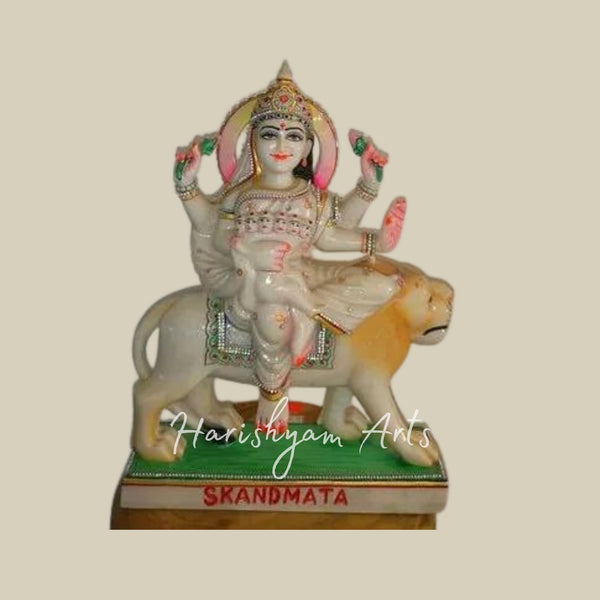
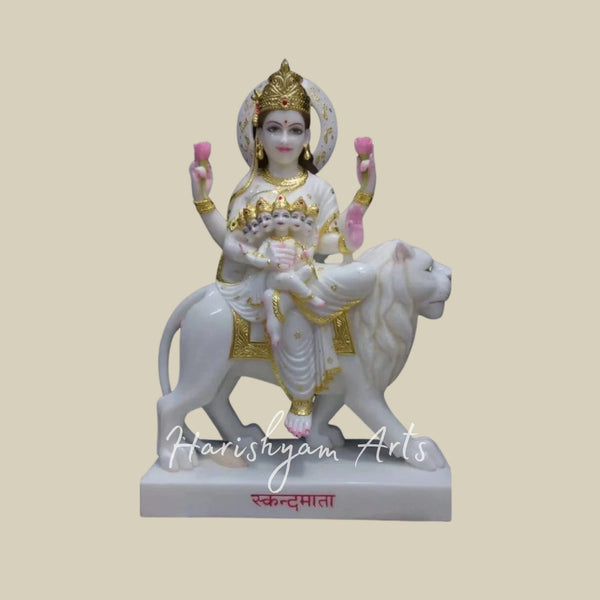
The Marble Skandmata Maa Statue collection by Harishyam Arts presents the fifth form of Navadurga through the timeless beauty of finely handcrafted Indian marble sculpture. Maa Skandmata is revered as the divine mother of Skanda, also known as Lord Kartikeya, and represents the deeply compassionate, nurturing, and protective aspect of Goddess Parvati. Traditionally worshipped on the fifth day of Navratri, she is depicted with four arms, seated upon a lotus and associated with the majestic lion, while lovingly holding her young son Skanda. Her form beautifully expresses the idea that true strength is not only found in power and courage but also in motherly love, protection, wisdom, compassion, nurturing, and selfless care. A finely carved Marble Skandmata Maa Murti captures this exceptional combination of maternal tenderness and divine strength through carefully developed facial expressions, lotus flowers, traditional ornaments, flowing garments, the child Skanda, and the powerful yet graceful lion. At Harishyam Arts, every sculpture is created by experienced artisans using traditional marble-carving techniques, careful hand detailing, refined polishing, and strict quality standards to create a devotional masterpiece suitable for home temples, family shrines, Navratri worship, temples, spiritual spaces, meditation areas, and larger architectural installations.
Maa Skandmata – The Fifth Form of Navadurga
Maa Skandmata is traditionally recognized as the fifth form of Navadurga and is worshipped on the fifth day of Navratri.
Her name combines Skanda, another name for Lord Kartikeya, with Mata, meaning mother. She is therefore revered as the Divine Mother in her form as the mother of Skanda.
Her place within the Navadurga sequence carries a beautiful spiritual message. After the creative energy represented by Maa Kushmanda, Skandmata represents the responsibility of nurturing, protecting, and guiding the life that has been created.
Her form demonstrates that motherhood itself is a profound expression of Shakti. She protects with tenderness, nurtures with compassion, and possesses the strength necessary to safeguard those under her care.
The Maternal Form of Goddess Parvati
Skandmata represents Goddess Parvati in her role as the mother of Lord Kartikeya.
Unlike some warrior forms of Durga that emphasize weapons and fierce protection, Skandmata's visual identity centers on motherhood and divine affection.
The child seated in her lap is therefore not simply a decorative element. He is an essential part of the iconography and gives the sculpture its unique emotional character.
A Marble Skandmata Statue captures this relationship through the carefully carved interaction between mother and child, creating a devotional sculpture that feels both majestic and deeply intimate.
Skandmata and Lord Kartikeya
Lord Skanda, or Kartikeya, is traditionally recognized as the son of Shiva and Parvati. In the form of Skandmata, the Goddess is represented lovingly holding her divine child.
Kartikeya is traditionally associated with courage, leadership, protection, and divine strength. His presence on the mother's lap creates a meaningful contrast between youthful divine potential and the protective power of motherhood.
The sculpture therefore represents two interconnected forms of strength: the power of the divine mother and the potential of the divine child.
For devotees, a Marble Skandmata Maa Murti can symbolize the importance of nurturing qualities such as courage, wisdom, confidence, discipline, and compassion.
The Four-Armed Form of Skandmata
Skandmata is traditionally depicted with four arms, creating a graceful and balanced composition.
Two hands commonly hold lotus flowers, while another hand supports or holds the infant Skanda and another may be shown in a blessing or protective gesture.
This arrangement gives the sculpture a softer and more harmonious character than the heavily armed warrior forms of certain other Navadurga manifestations.
For marble artisans, however, the simplicity of the composition demands exceptional precision. The face, hands, child, lotus flowers, ornaments, and garments all become highly visible and therefore require careful proportion and detailing.
The Lotus and Its Symbolism
The lotus is one of the defining attributes associated with Maa Skandmata.
Traditionally, the lotus represents purity, spiritual awakening, beauty, grace, and transcendence. Its presence complements the maternal character of the Goddess and adds an elegant floral element to the sculpture.
In marble, lotus flowers require delicate carving because each petal needs to be clearly defined while maintaining sufficient structural strength.
Harishyam Arts artisans carefully shape the petals and layered form of the lotus so that it appears natural and balanced within the Goddess's hands.
Skandmata as Padmasana Devi
Because Maa Skandmata is traditionally depicted seated upon a lotus, she is also associated with the name Padmasana Devi.
The lotus seat gives her sculpture a distinctive sense of grace and serenity.
When carved in marble, the lotus base becomes an important structural and decorative component. The petals must be arranged symmetrically while supporting the weight of the Goddess.
For larger sculptures, the lotus can be developed with multiple layers of petals and carefully carved depth, creating a strong visual foundation for the entire murti.
The Lion and Its Meaning
The lion is traditionally associated with Skandmata as her vahana.
It represents strength, courage, confidence, protection, and divine authority.
The presence of the lion creates an interesting contrast with the gentle mother-and-child relationship at the center of the sculpture. While Skandmata expresses compassion and tenderness, the lion communicates the powerful protective energy that surrounds her.
A detailed Marble Skandmata Statue with Lion requires the artisan to balance the soft appearance of the Goddess with the muscular strength and expressive character of the animal.
The lion's face, mane, paws, body, and posture can all receive detailed hand carving, particularly in larger custom sculptures.
The Peaceful Face of Maa Skandmata
The face of Skandmata is traditionally characterized by serenity, compassion, and maternal warmth.
Her expression should convey the calm confidence of a mother who protects and guides her child.
This makes facial carving especially important. The eyes, eyebrows, lips, cheeks, and forehead must be carefully proportioned to create a peaceful expression without making the face appear emotionless.
At Harishyam Arts, artisans gradually refine the facial features to create an expression that feels gentle, dignified, and spiritually uplifting.
The Divine Child in Her Lap
The representation of young Skanda is one of the most distinctive features of a Marble Skandmata Maa Statue.
The child must be proportioned carefully in relation to the Goddess so that the mother-and-child relationship appears natural and harmonious.
Depending on the selected iconographic tradition, Skanda may be represented as an infant with distinctive youthful features, and some traditional representations emphasize his six-faced identity.
Because the child is positioned close to the Goddess, the sculptor must carefully coordinate the hands, arms, clothing, facial expressions, and body proportions of both figures.
This attention to detail gives the completed sculpture a sense of tenderness that distinguishes Skandmata from other forms of Navadurga.
Traditional Crown and Ornaments
Maa Skandmata's maternal appearance is complemented by traditional royal ornaments and a beautifully carved crown.
Depending on the design, the sculpture can feature necklaces, earrings, bangles, armlets, waist ornaments, anklets, and other traditional jewelry.
These details are carefully carved into the marble to create depth and visual richness.
Harishyam Arts artisans ensure that the ornamentation enhances rather than overwhelms the peaceful character of the Goddess.
Traditional Garments and Drapery
The garments of Skandmata are represented with flowing folds that create movement and softness within the marble.
The artisan carefully carves the fabric around the body, arms, and legs while maintaining a natural relationship between the Goddess and the child.
Fine garment detailing can be increased for larger commissions, allowing customers to choose between a relatively simple devotional style and a more elaborate royal presentation.
Handcrafted Marble Skandmata Sculpture
Creating a handcrafted Marble Skandmata Maa Statue requires considerable attention to proportion and emotional expression.
The process begins with selecting suitable marble based on the size, composition, and complexity of the intended sculpture.
The artisan first establishes the primary form of the Goddess, lotus, lion, and child before gradually developing the face, arms, hands, garments, ornaments, crown, lotus petals, and finer details.
Because the mother and child form the emotional center of the sculpture, their positioning must be carefully refined.
After the main carving is completed, the entire sculpture is smoothed and polished before undergoing detailed quality inspection.
Carefully Selected Marble
The quality of marble plays an important role in creating a refined Marble Skandmata Murti.
The stone must be suitable for both larger structural areas and delicate details such as fingers, lotus petals, facial features, jewelry, garments, and the child's features.
Harishyam Arts selects marble according to the sculpture's intended dimensions, design complexity, structural requirements, and installation environment.
The naturally luminous appearance of polished marble complements Skandmata's peaceful and maternal character, giving the completed sculpture an elegant devotional presence.
Marble Skandmata Statues in Multiple Sizes
Harishyam Arts offers Marble Skandmata Statues in different sizes, allowing customers to choose a murti according to their space, devotional requirements, and architectural setting.
Compact sculptures are suitable for home mandirs, prayer rooms, personal shrines, meditation areas, and Navratri displays.
Medium-sized statues can become prominent devotional pieces within larger home temples, spiritual centers, family prayer rooms, and dedicated worship spaces.
Large sculptures can be commissioned for temples, spiritual institutions, luxury residences, cultural spaces, and architectural installations.
Available sizes can include 6 inches, 8 inches, 12 inches, 18 inches, 24 inches, 30 inches, 36 inches, and 48 inches, with larger custom-made Marble Skandmata Statues available for temple and architectural projects.
Custom Marble Skandmata Maa Statues
Harishyam Arts offers custom Marble Skandmata Maa Statues for customers who require specific dimensions, iconography, posture, detailing, or finishing.
Customization can include the overall height and width, Goddess posture, lotus seat, lion design, child Skanda's position and appearance, facial expression, crown, jewelry, garments, pedestal, carving depth, and level of ornamental detailing.
Customers can request a simple and serene representation or commission a more elaborate sculpture featuring detailed jewelry, layered lotus petals, richly carved garments, and a highly detailed lion.
For temple projects, the complete composition can be designed according to the dimensions of the sanctum, altar, niche, entrance, or Navadurga installation.
Marble Skandmata for Navratri
Maa Skandmata is traditionally worshipped on the fifth day of Navratri, known as Panchami.
A Marble Skandmata statue for Navratri provides a permanent devotional representation that can remain part of a home temple or spiritual environment throughout the year.
For devotees who worship all nine forms of Navadurga, a handcrafted Skandmata murti can also become an important part of a complete Navadurga collection.
Her association with motherhood, protection, compassion, and nurturing makes her particularly meaningful during a festival dedicated to the worship of the Divine Mother.
Marble Skandmata for Home Temples
A Marble Skandmata idol for home temple can bring a warm and peaceful devotional presence to a family prayer space.
Her mother-and-child form makes the sculpture particularly meaningful for families who value the ideals of care, protection, affection, guidance, and family harmony.
Smaller sculptures can fit naturally within compact mandirs, while larger murtis can serve as the central focus of a spacious prayer room.
The polished surface of natural marble complements traditional wooden temples, carved architectural details, lamps, flowers, and other devotional elements.
Marble Skandmata for Temples and Spiritual Spaces
A Marble Skandmata statue for temple can be created as an individual deity sculpture or as part of a complete Navadurga installation.
For temple commissions, the size and proportions of the Goddess, child, lion, lotus, and pedestal need to be carefully coordinated with the surrounding architecture.
Harishyam Arts can create custom Skandmata sculptures for temples, spiritual institutions, private shrines, community devotional spaces, and other religious environments.
Large installations can be developed with attention to structural stability, transportation, finishing, and installation requirements.
Skandmata and the Strength of Motherhood
The central spiritual message of Maa Skandmata is that motherly love itself is a form of strength.
Her sculpture does not rely on a dramatic warrior posture to communicate power. Instead, her strength is expressed through the protective way she holds her child while simultaneously sitting upon the powerful lion.
This combination of tenderness and authority makes her a particularly meaningful representation of the Divine Mother.
A Marble Skandmata Maa Murti can therefore serve as a reminder of the strength found in compassion, responsibility, patience, and unconditional care.
Symbolism of Protection and Nurturing
Skandmata is traditionally associated with maternal protection and nurturing.
Her image can represent the desire to protect what is precious, guide younger generations, and create an environment of love and security.
The child Skanda in her lap represents divine potential being nurtured under the protection of the mother.
The lion represents the strength required to safeguard that potential.
Together, these elements create a powerful symbolic composition of love, protection, courage, nurturing, wisdom, and divine motherhood.
Vastu and Placement Considerations
Maa Skandmata is traditionally represented in devotional environments such as home temples, family shrines, temples, Navdurga installations, and spiritual spaces.
Vastu practices may vary according to regional customs, family traditions, architectural arrangements, and individual beliefs. Therefore, placement should be considered according to the complete devotional environment rather than following one universal instruction.
Customers who wish to follow specific Vastu principles can consult a qualified Vastu practitioner for guidance based on their particular property and prayer space.
For temple installations, placement, installation, consecration, and worship practices should follow the relevant religious tradition and guidance of appropriate temple authorities.
A Meaningful Devotional Gift
A Marble Skandmata statue makes a thoughtful devotional gift for families and devotees connected with Navdurga, Navratri, Goddess Parvati, or Lord Kartikeya.
It can be considered for housewarmings, Navratri celebrations, religious occasions, family milestones, new prayer spaces, temple inaugurations, and other meaningful spiritual events.
Because her form represents motherhood, protection, compassion, and family care, the sculpture can carry a particularly personal meaning when gifted to parents, families, or devotees beginning a new chapter in life.
Refined Marble Polishing and Finishing
The final polishing process enhances the natural brightness and smoothness of the marble while preserving the fine details developed by the artisan.
Special care is given to the face, hands, child's features, lotus petals, jewelry, garments, crown, lion, and pedestal.
The polished finish allows the natural character of the marble to remain visible while giving the sculpture a refined and graceful appearance.
For custom projects, the finishing approach can be selected according to the customer's preferred aesthetic and the environment in which the sculpture will be installed.
Artisan Expertise at Harishyam Arts
Creating a detailed Marble Skandmata Maa sculpture requires more than technical stone carving. The artisan must understand the emotional relationship between the Goddess and young Skanda while maintaining the traditional proportions and iconography of the form.
Harishyam Arts artisans combine time-honored Indian marble-carving traditions with careful hand detailing and refined finishing.
Particular attention is given to the facial expression, mother-and-child composition, lotus, lion, hands, ornaments, garments, and overall balance.
Every sculpture is approached patiently so that the finished work expresses both the spiritual identity and artistic elegance of Maa Skandmata.
Quality Checks and Craftsmanship Standards
Every Marble Skandmata sculpture undergoes detailed inspection throughout the production process.
Artisans review the proportions, facial expression, arms, hands, child Skanda, lotus, lion, crown, ornaments, garments, pedestal, surface quality, polishing, and overall stability.
For larger custom sculptures, additional checks are performed for dimensions, structural strength, transportation requirements, finishing consistency, and installation suitability.
These quality-control practices help Harishyam Arts maintain high craftsmanship standards across compact devotional murtis and large temple commissions.
Why Choose Harishyam Arts for Marble Skandmata Statues?
Harishyam Arts combines traditional Indian marble craftsmanship with experienced artisans, carefully selected stone, detailed hand carving, customization, and refined finishing standards.
Our Marble Skandmata Statues are created for customers who appreciate the spiritual significance of the fifth Navadurga as well as the artistry of authentic handcrafted marble sculpture.
Every murti receives careful attention to the defining features of Maa Skandmata, including her serene maternal expression, four arms, lotus flowers, child Skanda, lotus seat, traditional ornaments, garments centerpiece, or a large custom sculpture for a temple or spiritual institution, Harishyam Arts approaches every creation with patience, precision, and respect for traditional craftsmanship loving relationship with young Skanda, graceful lotus symbolism, peaceful expression, and or large architectural project, Harishyam Arts creates each Marble Skandmata sculpture through skilled hand carving, careful detailing, refined polishing, and thorough quality inspection, and lion.
Whether you require a compact sculpture for a home mandir, a Navratri devotional murti, a family shrine centerpiece, or a large custom sculpture for a temple or spiritual institution, Harishyam Arts approaches every creation with patience, precision, and respect for traditional craftsmanship.
Explore the Marble Skandmata Collection
The Marble Skandmata collection by Harishyam Arts brings together the tenderness of divine motherhood and the strength of Shakti with the enduring beauty of handcrafted Indian marble.
As the fifth form of Navadurga, Maa Skandmata represents the nurturing and protective power that follows creation. Her loving relationship with young Skanda, graceful lotus symbolism, peaceful expression, and powerful lion create a distinctive devotional form filled with meaning.
Choose from different sizes and levels of detailing, or commission a custom Marble Skandmata Maa Statue according to your preferred dimensions, posture, child Skanda design, lion, lotus seat, crown, jewelry, garments, pedestal, carving style, and finish.
From a home mandir and family shrine to a Navratri installation, temple, spiritual center, or large architectural project, Harishyam Arts creates each Marble Skandmata sculpture through skilled hand carving, careful detailing, refined polishing, and thorough quality inspection—creating a lasting expression of maternal love, protection, compassion, divine strength, and India's rich marble sculptural heritage.


