
Harishyam Arts Blog
Mandir Direction in Home: Pooja Room Vastu Tips for Spiritual Harmony
By Lakshay Sharma | On 27 January, 2024 | Views
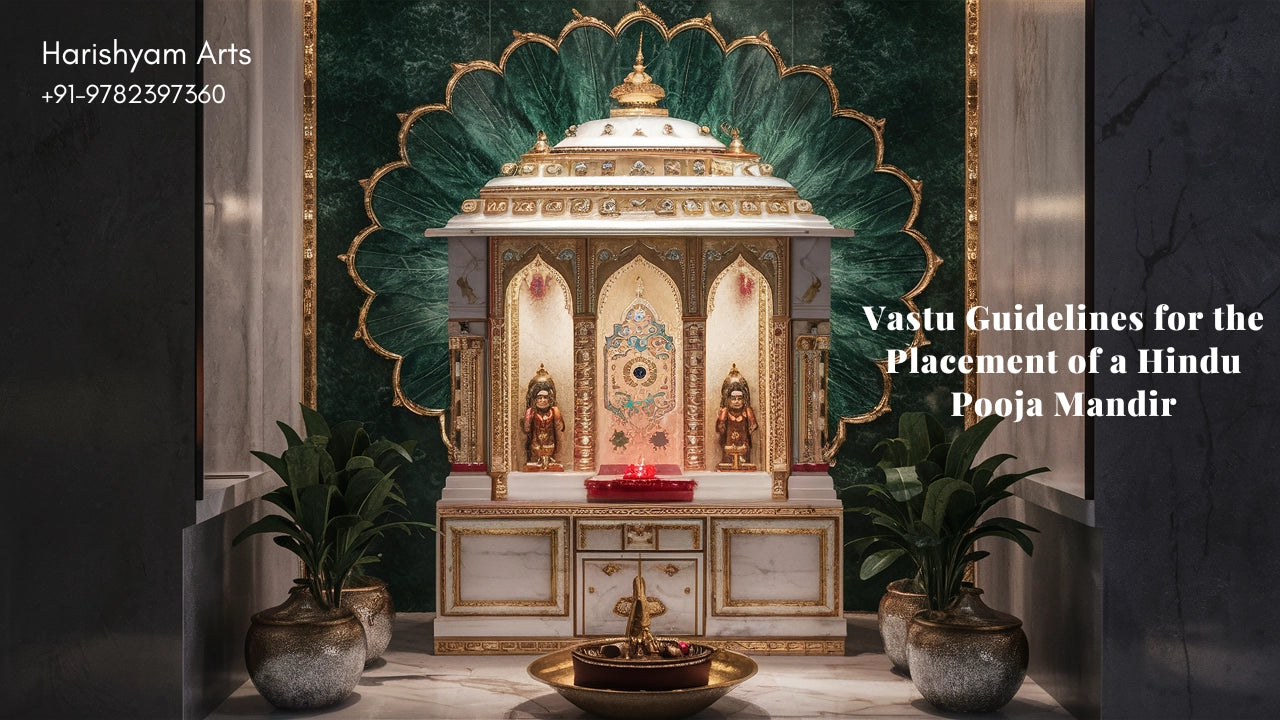
Creating a dedicated space for worship, often referred to as a "Pooja room" or "Mandir," holds great significance in Indian homes. It's not just a physical corner but a sacred realm where one connects with the divine. The arrangement and orientation of the Pooja room have a direct impact on the energy flow within your home. In this article, we'll explore comprehensive Mandir direction in home Vastu tips, guiding you towards setting up a Pooja room that radiates positive energy and spiritual harmony.
Mandir Direction in Home: Pooja Room Vastu Tips
A well-designed Pooja room not only adds a touch of spirituality but also influences the overall energy of your home. Let's delve into the essential Vastu tips to consider while determining the Mandir direction in your home:
Ideal Placement of Pooja Room
Position the Pooja room in the northeast or east direction of your home. These directions are considered highly auspicious, as they allow the morning sun's positive energies to enter the space. Avoid placing the Pooja room in the south direction, as it may lead to negative energies.
Choosing the Right Wall Colors
Opt for serene and calming colors like white, light yellow, or pastel shades for the Pooja room's walls. These colors enhance the meditative atmosphere, promoting tranquility and focus during prayers.
Sacred Geometry and Design
Incorporate sacred geometry into the design of your Pooja room. Circular or octagonal shapes are recommended, as they symbolize completeness and unity. Avoid irregular shapes or designs that create negative energy pockets.
Altar Placement
Place the main deity's idol or image on a clean, wooden altar. Ensure that the idols are positioned at least an inch away from the wall. This allows energy to flow freely around them. Also, avoid placing the idols in a way that they face each other.
Illumination
Natural light is crucial for the positive energy flow in the Pooja room. Install a small window or use soft lighting that mimics natural sunlight. Avoid harsh or dim lighting, as it can disrupt the serene ambiance.
Storage and Organization
Keep the Pooja room clutter-free and organized. Use separate shelves or cabinets to store religious books, incense sticks, and prayer items. Clutter can hinder the flow of positive energy.
Use of Sacred Symbols
Adorn the Pooja room with sacred symbols like Om, Swastik, or the lotus. These symbols carry profound spiritual meanings and radiate positive vibrations.
Fragrance and Incense
Lighting incense sticks or using natural fragrances like sandalwood, camphor, or jasmine enhances the sanctity of the space. The subtle aroma creates an inviting ambiance for prayer and meditation.
Vastu-Compliant Materials
Choose natural materials like wood and marble for constructing the altar and other furnishings in the Pooja room. Avoid materials like plastic and synthetic fabrics, as they can disrupt the energy balance.
Sacred Sounds
Play soft, instrumental music or chants in the background during prayers. The soothing sounds create an environment conducive to meditation and introspection.
Fresh Air Circulation
Ensure proper ventilation in the Pooja room to maintain a constant flow of fresh air. Good air circulation prevents the accumulation of stagnant energy.
Position of Offerings
While offering prayers, stand or sit facing the east or north direction. This aligns you with the Earth's magnetic field and enhances the connection with higher energies.
Incorporating Water Element
Consider placing a small water feature or a bowl of fresh water in the Pooja room. The water element represents purity and amplifies positive energy.
Regular Cleansing and Maintenance
Keep the Pooja room clean and well-maintained. Dust and dirt can accumulate negative energy over time. Regular cleaning ensures a sacred and vibrant atmosphere.
Minimalism and Simplicity
Embrace a minimalist approach to the Pooja room's decor. Overly extravagant decorations can overwhelm the spiritual essence of the space.
Family Participation
Involve the entire family in prayers and rituals. This collective participation not only strengthens family bonds but also infuses the Pooja room with shared positive energies.
Harmonizing with Five Elements
Incorporate representations of the five elements – earth, water, fire, air, and space – in the Pooja room. This holistic approach ensures balance and harmony within the space.
Positive Intentions
Approach the Pooja room with sincerity and positive intentions. Your thoughts and emotions have a significant impact on the energy vibrations within the space.
Connecting with Nature
Place fresh flowers, plants, or even a small indoor plant in the Pooja room. Nature's presence amplifies the space's energy and connects you with the natural world.
Significance of Bell
Hang a bell near the entrance of the Pooja room. Ringing the bell before and after prayers helps in clearing negative energies and inviting positive vibrations.
Ritual of Lighting Diyas
Lighting traditional oil lamps or diyas during prayers not only pays homage to the divine but also brings warmth and a sense of spiritual purity.
Personalized Touch
Add personal touches to the Pooja room that resonate with your beliefs and spiritual journey. Customizing the space enhances your connection with the divine.
Enhanced Focus with Mandala
Consider placing a mandala or a sacred geometric pattern beneath the altar. Mandala meditation aids in enhancing focus and deepening your spiritual practice.
Energy-Cleansing Techniques
Periodically perform energy-cleansing rituals in the Pooja room. Smudging with sage, camphor, or salt helps in dispelling stagnant energy.
Invoking Positivity with Mantras
Chanting positive mantras or prayers daily infuses the Pooja room with high-frequency vibrations, fostering a spiritually uplifting environment.
FAQs
Q.1 How does the placement of the Pooja room affect home energy?
Ans: Placing the Pooja room in the right direction channels positive energy throughout your home, creating a harmonious atmosphere.
Q.2 Can I use artificial lighting in the Pooja room?
Ans: While natural light is preferred, you can use soft artificial lighting that mimics sunlight for an inviting ambiance.
Q.3 What materials are best for the Pooja room altar?
Ans: Opt for natural materials like wood or marble, as they resonate well with positive energies.
Q.4 How often should I cleanse the Pooja room's energy?
Ans: Performing energy-cleansing rituals every fortnight or during significant religious events is advisable.
Q.5 Can I combine the Pooja room with another space?
Ans: It's best to have a dedicated Pooja room to maintain the purity and sanctity of the space.
Q.6 Is it necessary to chant mantras daily?
Ans: Daily chanting of mantras enhances the spiritual ambiance, but you can choose a frequency that suits your practice.
Conclusion
Creating a Pooja room aligned with Vastu principles is an endeavor that goes beyond aesthetics. It's about fostering a space where spirituality thrives, and positive energies envelop your home. By following these tips of vastu for temple at home, you can establish a Pooja room that serves as a sanctuary of tranquility, devotion, and harmony.
At Harishyam Arts, we specialize in designing Pooja Rooms that are meticulously optimized according to Vaastu principles. Our expertise lies in creating sacred spaces that align with the traditional and architectural tenets of Vaastu, ensuring a harmonious and balanced environment for your spiritual practices.
Lakshay Sharma
I’m Lakshay Sharma, a writer with a deep passion for Hindu mythology, Vastu Shastra, and home interiors. I enjoy exploring the rich traditions of Hindu gods and goddesses, sharing insights into Vastu principles, and offering guidance on creating sacred spaces like Puja Mandirs. Through my writing, I aim to inspire harmony and spiritual well-being, blending traditional knowledge with modern perspectives.
Harishyam Arts | Jaipur
Related Blogs

Bhagavad Gita Chapter 4 Verse 35 Meaning in Hindi and English
Lakshay Sharma | June 13, 2026
Bhagavad Gita Chapter 4 Verse 35 reveals the transformative power...
Read More...
Bhagavad Gita Chapter 4 Verse 34 Meaning in Hindi and English
Lakshay Sharma | June 13, 2026
Bhagavad Gita Chapter 4 Verse 34 is one of the most influential verses on the ...
Read More...
Bhagavad Gita Chapter 4 Verse 33 Meaning in Hindi and English
Lakshay Sharma | June 13, 2026
Bhagavad Gita Chapter 4 Verse 33 marks a turning point in Lord Krishna’s teach...
Read More...
Bhagavad Gita Chapter 4 Verse 32 Meaning in Hindi and English
Lakshay Sharma | June 13, 2026
Bhagavad Gita Chapter 4 Verse 32 concludes Lord Krishna’s discussion on the va...
Read More...
Bhagavad Gita Chapter 4 Verse 31 Meaning in Hindi and English
Lakshay Sharma | June 12, 2026
Bhagavad Gita Chapter 4 Verse 31 highlights the immense importance of <...
Read More...
Bhagavad Gita Chapter 4 Verse 30 Meaning in Hindi and English
Lakshay Sharma | June 12, 2026
Bhagavad Gita Chapter 4 Verse 30 continues Lord Krishna’s discussion on the di...
Read More...
Bhagavad Gita Chapter 4 Verse 29 Meaning in Hindi and English
Lakshay Sharma | June 12, 2026
Bhagavad Gita Chapter 4 Verse 29 continues Lord Krishna’s explanation of the d...
Read More...
Bhagavad Gita Chapter 4 Verse 28 Meaning in Hindi and English
Lakshay Sharma | June 12, 2026
Bhagavad Gita Chapter 4 Verse 28 continues Lord Krishna’s explanation of the m...
Read More...
Bhagavad Gita Chapter 4 Verse 27 Meaning in Hindi and English
Lakshay Sharma | June 12, 2026
Bhagavad Gita Chapter 4 Verse 27 continues Lord Krishna’s discourse on the var...
Read More...
Bhagavad Gita Chapter 4 Verse 25 Meaning in Hindi & English
Lakshay Sharma | June 12, 2026
Bhagavad Gita Chapter 4 Verse 25 marks the beginning of Lord Krishna's detaile...
Read More...
Bhagavad Gita Chapter 4 Verse 24 Meaning in Hindi & English
Lakshay Sharma | June 12, 2026
Bhagavad Gita Chapter 4 Verse 24 is one of the most profound and philosophical...
Read More...
Bhagavad Gita Chapter 4 Verse 23 Meaning in Hindi & English
Lakshay Sharma | June 12, 2026
Bhagavad Gita Chapter 4 Verse 23 continues Lord Krishna's profound teachings o...
Read More...
Bhagavad Gita Chapter 4 Verse 22 Meaning in Hindi & English
Lakshay Sharma | June 12, 2026
Bhagavad Gita Chapter 4 Verse 22 presents one of the clearest descriptions of ...
Read More...
Bhagavad Gita Chapter 4 Verse 21 Meaning in Hindi and English
Lakshay Sharma | June 12, 2026
Bhagavad Gita Chapter 4 Verse 21 further elaborates on the qualities of a true...
Read More...
Bhagavad Gita Chapter 4 Verse 20 Meaning in Hindi and English
Lakshay Sharma | June 12, 2026
Bhagavad Gita Chapter 4 Verse 20 continues Lord Krishna’s profound explanation...
Read More...
Bhagavad Gita Chapter 4 Verse 19 Meaning in Hindi and English
Lakshay Sharma | June 12, 2026
Bhagavad Gita Chapter 4 Verse 19 describes the qualities of a truly enlightene...
Read More...
Bhagavad Gita Chapter 4 Verse 18 Meaning in Hindi and English
Lakshay Sharma | June 12, 2026
Bhagavad Gita Chapter 4 Verse 18 presents one of the most profound and paradox...
Read More...
Bhagavad Gita Chapter 4 Verse 17 Meaning in Hindi and English
Lakshay Sharma | June 12, 2026
Bhagavad Gita Chapter 4 Verse 17 continues Lord Krishna’s profound teaching on...
Read More...
Bhagavad Gita Chapter 4 Verse 15 Meaning in Hindi & English
Lakshay Sharma | June 12, 2026
Bhagavad Gita Chapter 4 Verse 15 builds upon Krishna's teaching about detached...
Read More...
Bhagavad Gita Chapter 4 Verse 14 Meaning in Hindi & English
Lakshay Sharma | June 12, 2026
Bhagavad Gita Chapter 4 Verse 14 continues Lord Krishna's explanation of His d...
Read More...
Bhagavad Gita Chapter 4 Verse 13 Meaning in Hindi & English
Lakshay Sharma | June 12, 2026
Bhagavad Gita Chapter 4 Verse 13 is one of the most discussed verses in the Bh...
Read More...
Bhagavad Gita Chapter 4 Verse 12 Meaning in Hindi & English
Lakshay Sharma | June 12, 2026
Bhagavad Gita Chapter 4 Verse 12 explains why many people worship various deit...
Read More...
Bhagavad Gita Chapter 4 Verse 11 Meaning in Hindi & English
Lakshay Sharma | June 12, 2026
Bhagavad Gita Chapter 4 Verse 11 is one of the most inclusive and universal te...
Read More...
Bhagavad Gita Chapter 4 Verse 10 Meaning in Hindi & English
Lakshay Sharma | June 12, 2026
Bhagavad Gita Chapter 4 Verse 10 reveals the qualities and spiritual practices...
Read More...
Shankh, Chakra & Tilak in Mandir: Their Significance, Placement, and Benefits Explained
Lakshay Sharma | June 12, 2026
Indian temples are not just places of worship; they are centers of spiritual e...
Read More...
Bhagavad Gita Chapter 4 Verse 9 Meaning in Hindi & English
Lakshay Sharma | June 11, 2026
Bhagavad Gita Chapter 4 Verse 9 is one of the most celebrated verses in the Bh...
Read More...
Bhagavad Gita Chapter 4 Verse 8 Meaning in Hindi and English
Lakshay Sharma | June 11, 2026
Bhagavad Gita Chapter 4 Verse 8 is the continuation of Lord Krishna's declarat...
Read More...
Bhagavad Gita Chapter 4 Verse 7 Meaning in Hindi and English
Lakshay Sharma | June 11, 2026
Bhagavad Gita Chapter 4 Verse 7 is one of the most famous and widely quoted ve...
Read More...
Bhagavad Gita Chapter 4 Verse 6 Meaning in Hindi and English
Lakshay Sharma | June 11, 2026
Bhagavad Gita Chapter 4 Verse 6 is one of the most profound...
Read More...
Bhagavad Gita Chapter 4 Verse 5 Meaning in Hindi and English
Lakshay Sharma | June 11, 2026
Bhagavad Gita Chapter 4 Verse 5 contains Lord Krishna's response to Arjuna's q...
Read More...
Bhagavad Gita Chapter 4 Verse 4 Meaning in Hindi and English
Lakshay Sharma | June 11, 2026
Bhagavad Gita Chapter 4 Verse 4 presents an important question from Arjuna. Af...
Read More...
Bhagavad Gita Chapter 4 Verse 3 Meaning in Hindi and English
Lakshay Sharma | June 11, 2026
Bhagavad Gita Chapter 4 Verse 3 is a significant verse where Lord Krishna reve...
Read More...
Bhagavad Gita Chapter 4 Verse 2 Meaning in Hindi and English
Lakshay Sharma | June 11, 2026
Bhagavad Gita Chapter 4 Verse 2 continues Lord Krishna's explanation of the an...
Read More...
Bhagavad Gita Chapter 4 Verse 1 Meaning in Hindi and English
Lakshay Sharma | June 11, 2026
Bhagavad Gita Chapter 4 Verse 1 marks the beginning of the fourth chapter, kno...
Read More...
Bhagavad Gita Chapter 3 Verse 43 Meaning in Hindi & English
Lakshay Sharma | June 11, 2026
Bhagavad Gita Chapter 3 Verse 43 is the concluding verse of Chapter 3 (Karma Y...
Read More...
Bhagavad Gita Chapter 3 Verse 42 Meaning in Hindi & English
Lakshay Sharma | June 11, 2026
Bhagavad Gita Chapter 3 Verse 42 is one of the most profound verses in the Bha...
Read More...
Bhagavad Gita Chapter 3 Verse 33 Meaning in Hindi & English
Lakshay Sharma | June 11, 2026
Bhagavad Gita Chapter 3 Verse 33 addresses a fundamental aspect of human behav...
Read More...
Bhagavad Gita Chapter 3 Verse 32 Meaning in Hindi & English
Lakshay Sharma | June 11, 2026
Bhagavad Gita Chapter 3 Verse 32 serves as a warning from Lord Krishna about t...
Read More...
Bhagavad Gita Chapter 3 Verse 31 Meaning in Hindi & English
Lakshay Sharma | June 11, 2026
Bhagavad Gita Chapter 3 Verse 31 highlights the importance of fai...
Read More...
Bhagavad Gita Chapter 3 Verse 30 Meaning in Hindi & English
Lakshay Sharma | June 11, 2026
Bhagavad Gita Chapter 3 Verse 30 is one of the most powerful teachings on Read More...

Bhagavad Gita Chapter 3 Verse 29 Meaning in Hindi & English
Lakshay Sharma | June 11, 2026
Bhagavad Gita Chapter 3 Verse 29 continues Lord Krishna's discussion about the...
Read More...
Bhagavad Gita Chapter 3 Verse 28 Meaning in Hindi & English
Lakshay Sharma | June 11, 2026
Bhagavad Gita Chapter 3 Verse 28 continues Lord Krishna's profound explanation...
Read More...
Why Brass Statues Are Considered Symbols of Strength, Prosperity, and Divine Energy
Lakshay Sharma | June 11, 2026
Brass statues have held a special place in homes, temples, and cultural tradit...
Read More...
Bhagavad Gita Chapter 3 Verse 27 Meaning in Hindi & English
Lakshay Sharma | June 10, 2026
Bhagavad Gita Chapter 3 Verse 27 presents one of the most profound philosophic...
Read More...
Bhagavad Gita Chapter 3 Verse 26 Meaning in Hindi And English
Lakshay Sharma | June 10, 2026
Bhagavad Gita Chapter 3 Verse 26 contains a profound lesson on leadership, tea...
Read More...
Bhagavad Gita Chapter 3 Verse 41 Meaning in Hindi and English
Lakshay Sharma | June 10, 2026
Bhagavad Gita Chapter 3 Verse 41 is Lord Krishna's practical instruction for o...
Read More...
Bhagavad Gita Chapter 3 Verse 40 Meaning in Hindi and English
Lakshay Sharma | June 10, 2026
Bhagavad Gita Chapter 3 Verse 40 continues Lord Krishna's explanation of desir...
Read More...
Bhagavad Gita Chapter 3 Verse 39 Meaning in Hindi and English
Lakshay Sharma | June 10, 2026
Bhagavad Gita Chapter 3 Verse 39 continues Lord Krishna's explanation about de...
Read More...
Bhagavad Gita Chapter 3 Verse 38 Meaning in Hindi and English
Lakshay Sharma | June 10, 2026
Bhagavad Gita Chapter 3 Verse 38 continues Lord Krishna's explanation about de...
Read More...
Bhagavad Gita Chapter 3 Verse 37 Meaning in Hindi and English
Lakshay Sharma | June 10, 2026
Bhagavad Gita Chapter 3 Verse 37 contains Lord Krishna's direct answer to Arju...
Read More...


