
Harishyam Arts Blog
Understanding the Difference Between Handmade and Machine-Made Brass Statues
By Lakshay Sharma | On 16 October, 2025 | Views
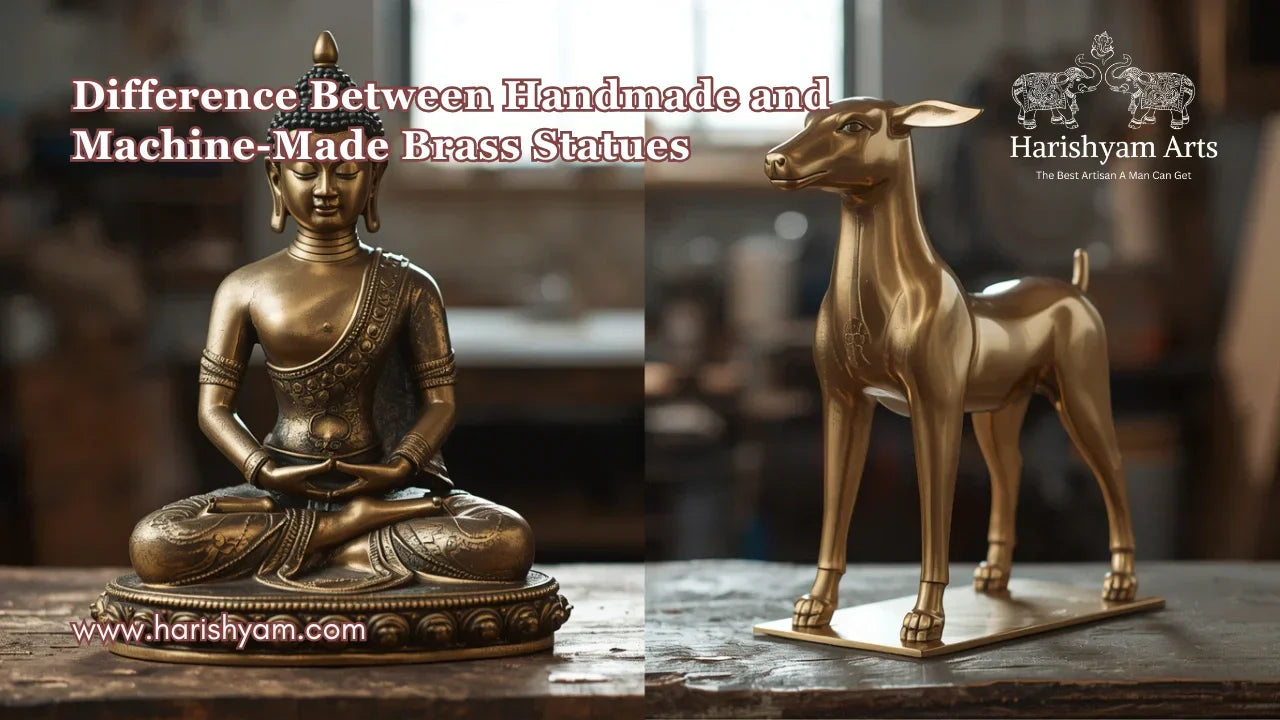
Brass statues have been a cornerstone of spiritual and decorative art for centuries. Whether adorning a home temple or living space, brass idols bring elegance, cultural significance, and timeless charm. However, when it comes to purchasing a brass statue, one of the most common dilemmas buyers face is choosing between handmade and machine-made brass statues. Understanding the differences can help you make an informed choice.
Comparison of Handmade and Machine-Made Brass Statues
The primary difference between handmade and machine-made brass statues lies in the craftsmanship, detailing, and uniqueness.
|
Feature |
Handmade Brass Statue |
Machine-Made Brass Statue |
|
Craftsmanship |
Created by skilled artisans using traditional techniques such as lost-wax casting; often involves hours of meticulous work |
Produced using molds and machines; faster production with standardized patterns |
|
Detailing |
Highly detailed and intricate; unique imperfections that add charm and authenticity |
Uniform and consistent; may lack the fine detailing and artistic depth |
|
Uniqueness |
Each piece is one-of-a-kind due to human touch |
Identical copies are produced; less uniqueness |
|
Price |
Generally higher due to labor-intensive process |
More affordable due to mass production |
|
Cultural & Spiritual Value |
High cultural and spiritual significance; revered in rituals |
Suitable for decoration and basic worship; may lack artisanal value |
How to Identify a Handmade Brass Statue
Spotting a handmade brass statue requires attention to detail and knowledge of traditional crafting signs. Here are some tips:
-
Look for Fine Details – Check facial expressions, jewelry patterns, and textures.
-
Irregularities Are Normal – Slight asymmetry or tool marks are a good sign of authenticity.
-
Weight & Finish – Handmade brass statues feel heavier and have a natural finish.
-
Check the Base – The bottom may have casting marks or minor imperfections.
-
Sound Test – Lightly tapping the statue can reveal a deeper, resonant sound typical of handmade brass.
Why Choose Handmade Over Machine-Made?
-
Authenticity & Heritage – Owning a handmade brass statue is like owning a piece of history and culture.
-
Spiritual Significance – Handmade statues are believed to carry positive energy and are often preferred for rituals.
-
Longevity – Handmade brass statues are generally more durable and can be passed down generations.
For those looking to enhance their home temple décor or invest in exquisite Krishna statues, choosing handmade brass can add both aesthetic and spiritual value.
Characteristics of Handmade Brass Statues
-
Intricate Detailing – Handmade statues feature fine carvings and elaborate designs that showcase the artisan’s skill.
-
Unique & One-of-a-Kind – Each statue has slight differences, making every piece unique.
-
Irregularities – Small asymmetries, tool marks, or tiny imperfections are common and add authenticity.
-
Natural Finish – Typically has a matte or subtle polished finish that feels organic.
-
Weight & Density – Handmade brass often feels heavier due to solid casting methods.
-
Cultural & Spiritual Value – Handmade pieces are considered more auspicious for rituals and spiritual purposes.
Characteristics of Machine-Made Brass Statues
-
Uniformity – Produced in molds, machine-made statues are identical with consistent shapes and patterns.
-
Faster Production – Mass-produced efficiently, making them more affordable.
-
Smooth & Glossy Finish – Usually polished uniformly, giving a modern look but less authentic feel.
-
Less Intricate Detailing – Designs are simpler and may lack the fine artistry of handmade pieces.
-
Lightweight – Often less dense than handmade statues due to thinner casting or hollow sections.
-
Primarily Decorative – While usable for worship, they are generally preferred for home décor or gifting.
Conclusion
Choosing between handmade and machine-made brass statues depends on your priorities—whether it’s intricate craftsmanship, spiritual significance, or affordability. Handmade brass statues from Harishyam Arts stand out for their unique detailing, cultural value, and durability, making them ideal for home temples and meaningful décor. Machine-made statues, while more uniform and budget-friendly, are suitable for decorative purposes and basic worship.
By understanding the characteristics of each type and knowing how to identify genuine handmade pieces, you can make an informed choice that enriches your space with both beauty and positive energy. Explore the exquisite collection of handmade brass statues at Harishyam Arts to find the perfect idol for your home, rituals, or gifting needs.
FAQs
Q1Are handmade brass statues more expensive than machine-made ones?
Ans: Yes, handmade brass statues are usually more expensive due to the skilled labor and time involved.
Q2. Can machine-made brass statues be used for rituals?
Ans: Yes, they can be used for basic worship, but handmade statues are preferred for spiritual authenticity.
Q3. How can I ensure a brass statue is genuinely handmade?
Ans: Look for fine details, slight irregularities, a natural finish, tool marks on the base, and a deeper resonant sound when tapped.
Q4. Do handmade brass statues last longer than machine-made ones?
Ans: Typically, yes. Handmade brass statues are denser, more durable, and can last for generations with proper care.
Q5. Can I buy handmade brass statues online?
Ans: Absolutely! Reputable online platforms like Harishyam Arts offer authentic handmade brass statues with safe delivery, including international shipping.

Lakshay Sharma
I’m Lakshay Sharma, a writer with a deep passion for Hindu mythology, Vastu Shastra, and home interiors. I enjoy exploring the rich traditions of Hindu gods and goddesses, sharing insights into Vastu principles, and offering guidance on creating sacred spaces like Puja Mandirs. Through my writing, I aim to inspire harmony and spiritual well-being, blending traditional knowledge with modern perspectives.
Harishyam Arts | Jaipur
Related Blogs

Bhagavad Gita Chapter 4 Verse 42 Meaning in Hindi and English
Lakshay Sharma | June 16, 2026
Bhagavad Gita Chapter 4 Verse 42 is the concluding verse of Chapt...
Read More...
Bhagavad Gita Chapter 4 Verse 41 Meaning in Hindi and English
Lakshay Sharma | June 16, 2026
Bhagavad Gita Chapter 4 Verse 41 reveals the state of a person who has attaine...
Read More...
Bhagavad Gita Chapter 4 Verse 39 Meaning in Hindi and English
Lakshay Sharma | June 16, 2026
Bhagavad Gita Chapter 4 Verse 39 beautifully explains the qualiti...
Read More...
Bhagavad Gita Chapter 4 Verse 38 Meaning in Hindi and English
Lakshay Sharma | June 16, 2026
Bhagavad Gita Chapter 4 Verse 38 is one of the most celebrated verses on the g...
Read More...
Bhagavad Gita Chapter 4 Verse 37 Meaning in Hindi and English
Lakshay Sharma | June 16, 2026
Bhagavad Gita Chapter 4 Verse 37 uses a powerful metaphor to describe the tran...
Read More...
Bhagavad Gita Chapter 4 Verse 36 Meaning in Hindi and English
Lakshay Sharma | June 16, 2026
Bhagavad Gita Chapter 4 Verse 36 is one of the most reassuring verses in the G...
Read More...
Powerful Lord Ganesha Mantras to Remove Obstacles in Life
Lakshay Sharma | June 15, 2026
In Hindu spirituality, Lord Ganesha is worshipped as the remover of obstacles,...
Read More...
Bhagavad Gita Chapter 4 Verse 40 Meaning in Hindi and English
Lakshay Sharma | June 15, 2026
Bhagavad Gita Chapter 4 Verse 40 serves as a profound warning about the obstac...
Read More...
Why White Marble Mandirs Are Associated with Purity, Peace, and Divine Energy
Lakshay Sharma | June 14, 2026
In Indian culture and spiritual traditions, temples are not just places of wor...
Read More...
Bhagavad Gita Chapter 4 Verse 35 Meaning in Hindi and English
Lakshay Sharma | June 13, 2026
Bhagavad Gita Chapter 4 Verse 35 reveals the transformative power...
Read More...
Bhagavad Gita Chapter 4 Verse 34 Meaning in Hindi and English
Lakshay Sharma | June 13, 2026
Bhagavad Gita Chapter 4 Verse 34 is one of the most influential verses on the ...
Read More...
Bhagavad Gita Chapter 4 Verse 33 Meaning in Hindi and English
Lakshay Sharma | June 13, 2026
Bhagavad Gita Chapter 4 Verse 33 marks a turning point in Lord Krishna’s teach...
Read More...
Bhagavad Gita Chapter 4 Verse 32 Meaning in Hindi and English
Lakshay Sharma | June 13, 2026
Bhagavad Gita Chapter 4 Verse 32 concludes Lord Krishna’s discussion on the va...
Read More...
Bhagavad Gita Chapter 4 Verse 31 Meaning in Hindi and English
Lakshay Sharma | June 12, 2026
Bhagavad Gita Chapter 4 Verse 31 highlights the immense importance of <...
Read More...
Bhagavad Gita Chapter 4 Verse 30 Meaning in Hindi and English
Lakshay Sharma | June 12, 2026
Bhagavad Gita Chapter 4 Verse 30 continues Lord Krishna’s discussion on the di...
Read More...
Bhagavad Gita Chapter 4 Verse 29 Meaning in Hindi and English
Lakshay Sharma | June 12, 2026
Bhagavad Gita Chapter 4 Verse 29 continues Lord Krishna’s explanation of the d...
Read More...
Bhagavad Gita Chapter 4 Verse 28 Meaning in Hindi and English
Lakshay Sharma | June 12, 2026
Bhagavad Gita Chapter 4 Verse 28 continues Lord Krishna’s explanation of the m...
Read More...
Bhagavad Gita Chapter 4 Verse 27 Meaning in Hindi and English
Lakshay Sharma | June 12, 2026
Bhagavad Gita Chapter 4 Verse 27 continues Lord Krishna’s discourse on the var...
Read More...
Bhagavad Gita Chapter 4 Verse 25 Meaning in Hindi & English
Lakshay Sharma | June 12, 2026
Bhagavad Gita Chapter 4 Verse 25 marks the beginning of Lord Krishna's detaile...
Read More...
Bhagavad Gita Chapter 4 Verse 24 Meaning in Hindi & English
Lakshay Sharma | June 12, 2026
Bhagavad Gita Chapter 4 Verse 24 is one of the most profound and philosophical...
Read More...
Bhagavad Gita Chapter 4 Verse 23 Meaning in Hindi & English
Lakshay Sharma | June 12, 2026
Bhagavad Gita Chapter 4 Verse 23 continues Lord Krishna's profound teachings o...
Read More...
Bhagavad Gita Chapter 4 Verse 22 Meaning in Hindi & English
Lakshay Sharma | June 12, 2026
Bhagavad Gita Chapter 4 Verse 22 presents one of the clearest descriptions of ...
Read More...
Bhagavad Gita Chapter 4 Verse 21 Meaning in Hindi and English
Lakshay Sharma | June 12, 2026
Bhagavad Gita Chapter 4 Verse 21 further elaborates on the qualities of a true...
Read More...
Bhagavad Gita Chapter 4 Verse 20 Meaning in Hindi and English
Lakshay Sharma | June 12, 2026
Bhagavad Gita Chapter 4 Verse 20 continues Lord Krishna’s profound explanation...
Read More...
Bhagavad Gita Chapter 4 Verse 19 Meaning in Hindi and English
Lakshay Sharma | June 12, 2026
Bhagavad Gita Chapter 4 Verse 19 describes the qualities of a truly enlightene...
Read More...
Bhagavad Gita Chapter 4 Verse 18 Meaning in Hindi and English
Lakshay Sharma | June 12, 2026
Bhagavad Gita Chapter 4 Verse 18 presents one of the most profound and paradox...
Read More...
Bhagavad Gita Chapter 4 Verse 17 Meaning in Hindi and English
Lakshay Sharma | June 12, 2026
Bhagavad Gita Chapter 4 Verse 17 continues Lord Krishna’s profound teaching on...
Read More...
Bhagavad Gita Chapter 4 Verse 15 Meaning in Hindi & English
Lakshay Sharma | June 12, 2026
Bhagavad Gita Chapter 4 Verse 15 builds upon Krishna's teaching about detached...
Read More...
Bhagavad Gita Chapter 4 Verse 14 Meaning in Hindi & English
Lakshay Sharma | June 12, 2026
Bhagavad Gita Chapter 4 Verse 14 continues Lord Krishna's explanation of His d...
Read More...
Bhagavad Gita Chapter 4 Verse 13 Meaning in Hindi & English
Lakshay Sharma | June 12, 2026
Bhagavad Gita Chapter 4 Verse 13 is one of the most discussed verses in the Bh...
Read More...
Bhagavad Gita Chapter 4 Verse 12 Meaning in Hindi & English
Lakshay Sharma | June 12, 2026
Bhagavad Gita Chapter 4 Verse 12 explains why many people worship various deit...
Read More...
Bhagavad Gita Chapter 4 Verse 11 Meaning in Hindi & English
Lakshay Sharma | June 12, 2026
Bhagavad Gita Chapter 4 Verse 11 is one of the most inclusive and universal te...
Read More...
Bhagavad Gita Chapter 4 Verse 10 Meaning in Hindi & English
Lakshay Sharma | June 12, 2026
Bhagavad Gita Chapter 4 Verse 10 reveals the qualities and spiritual practices...
Read More...
Shankh, Chakra & Tilak in Mandir: Their Significance, Placement, and Benefits Explained
Lakshay Sharma | June 12, 2026
Indian temples are not just places of worship; they are centers of spiritual e...
Read More...
Bhagavad Gita Chapter 4 Verse 9 Meaning in Hindi & English
Lakshay Sharma | June 11, 2026
Bhagavad Gita Chapter 4 Verse 9 is one of the most celebrated verses in the Bh...
Read More...
Bhagavad Gita Chapter 4 Verse 8 Meaning in Hindi and English
Lakshay Sharma | June 11, 2026
Bhagavad Gita Chapter 4 Verse 8 is the continuation of Lord Krishna's declarat...
Read More...
Bhagavad Gita Chapter 4 Verse 7 Meaning in Hindi and English
Lakshay Sharma | June 11, 2026
Bhagavad Gita Chapter 4 Verse 7 is one of the most famous and widely quoted ve...
Read More...
Bhagavad Gita Chapter 4 Verse 6 Meaning in Hindi and English
Lakshay Sharma | June 11, 2026
Bhagavad Gita Chapter 4 Verse 6 is one of the most profound...
Read More...
Bhagavad Gita Chapter 4 Verse 5 Meaning in Hindi and English
Lakshay Sharma | June 11, 2026
Bhagavad Gita Chapter 4 Verse 5 contains Lord Krishna's response to Arjuna's q...
Read More...
Bhagavad Gita Chapter 4 Verse 4 Meaning in Hindi and English
Lakshay Sharma | June 11, 2026
Bhagavad Gita Chapter 4 Verse 4 presents an important question from Arjuna. Af...
Read More...
Bhagavad Gita Chapter 4 Verse 3 Meaning in Hindi and English
Lakshay Sharma | June 11, 2026
Bhagavad Gita Chapter 4 Verse 3 is a significant verse where Lord Krishna reve...
Read More...
Bhagavad Gita Chapter 4 Verse 2 Meaning in Hindi and English
Lakshay Sharma | June 11, 2026
Bhagavad Gita Chapter 4 Verse 2 continues Lord Krishna's explanation of the an...
Read More...
Bhagavad Gita Chapter 4 Verse 1 Meaning in Hindi and English
Lakshay Sharma | June 11, 2026
Bhagavad Gita Chapter 4 Verse 1 marks the beginning of the fourth chapter, kno...
Read More...
Bhagavad Gita Chapter 3 Verse 43 Meaning in Hindi & English
Lakshay Sharma | June 11, 2026
Bhagavad Gita Chapter 3 Verse 43 is the concluding verse of Chapter 3 (Karma Y...
Read More...
Bhagavad Gita Chapter 3 Verse 42 Meaning in Hindi & English
Lakshay Sharma | June 11, 2026
Bhagavad Gita Chapter 3 Verse 42 is one of the most profound verses in the Bha...
Read More...
Bhagavad Gita Chapter 3 Verse 33 Meaning in Hindi & English
Lakshay Sharma | June 11, 2026
Bhagavad Gita Chapter 3 Verse 33 addresses a fundamental aspect of human behav...
Read More...
Bhagavad Gita Chapter 3 Verse 32 Meaning in Hindi & English
Lakshay Sharma | June 11, 2026
Bhagavad Gita Chapter 3 Verse 32 serves as a warning from Lord Krishna about t...
Read More...
Bhagavad Gita Chapter 3 Verse 31 Meaning in Hindi & English
Lakshay Sharma | June 11, 2026
Bhagavad Gita Chapter 3 Verse 31 highlights the importance of fai...
Read More...
Bhagavad Gita Chapter 3 Verse 30 Meaning in Hindi & English
Lakshay Sharma | June 11, 2026
Bhagavad Gita Chapter 3 Verse 30 is one of the most powerful teachings on Read More...

Bhagavad Gita Chapter 3 Verse 29 Meaning in Hindi & English
Lakshay Sharma | June 11, 2026
Bhagavad Gita Chapter 3 Verse 29 continues Lord Krishna's discussion about the...
Read More...


