
Harishyam Arts Blog
How to Identify a Real Habur Stone? A Complete Guide
By Lakshay Sharma | On 08 October, 2025 | Views
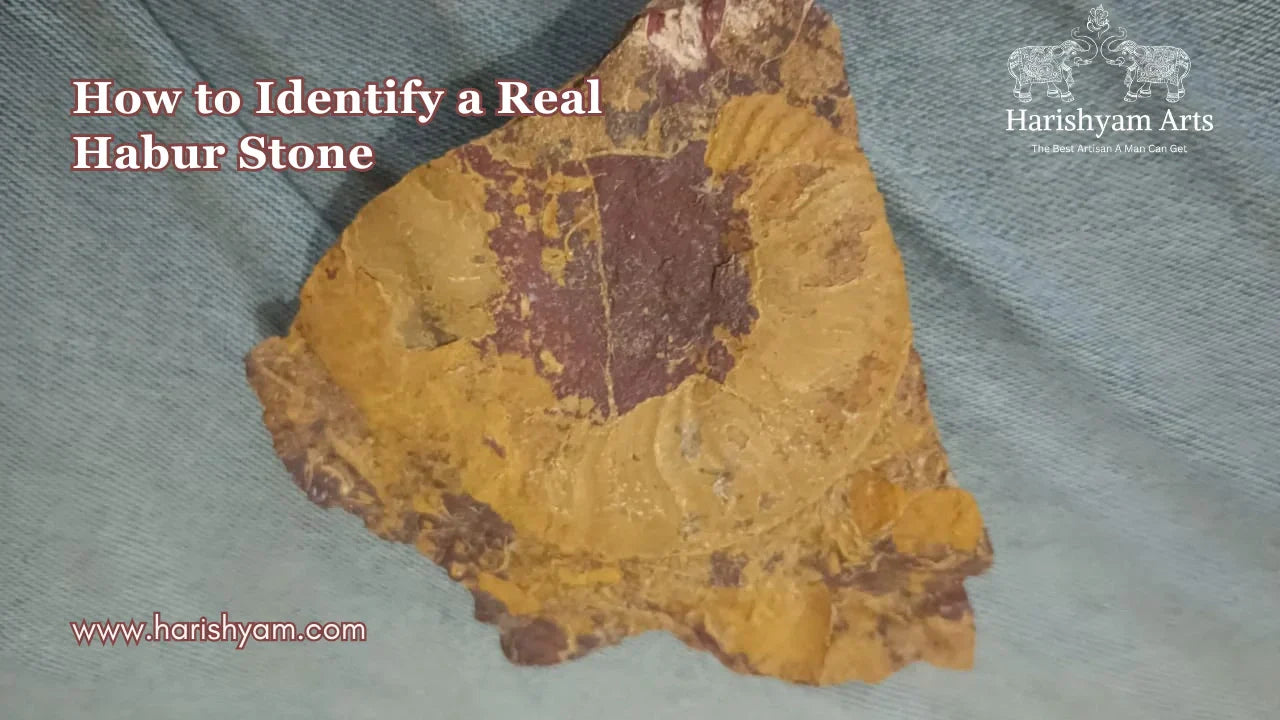
Habur stone, known for its mysterious ability to turn milk into curd naturally, is one of Rajasthan's most fascinating natural treasures. Revered for its health benefits, historical significance, and beautiful fossil patterns, genuine Habur stone comes almost exclusively from the region near Jaisalmer. Unfortunately, its increasing popularity means imitations are common. This guide will help you confidently identify an authentic Habur stone, understand foolproof tests, recognize common fakes, and find trustworthy sources.
Key Physical Features of Genuine Habur Stone
-
Fossil-Rich Texture: Authentic Habur limestone contains abundant fossil remains—tiny shells or calligraphic fossil streaks embedded visibly in the stone, a sign of its prehistoric marine origin.
-
Natural Color and Pattern: Real Habur stone is typically reddish-brown with unique dark or black fossilized line textures. These patterns are irregular and cannot be artificially duplicated perfectly.
-
Porosity and Coolness: The stone feels cool to the touch due to its unique mineral composition and has a slightly rough, porous surface, unlike smooth or polished fakes.
-
Heaviness: Habur limestone is denser than ordinary decorative stones of comparable size.
How to Test Habur Stone at Home (Non-Damaging Methods)
-
Visual Inspection: Closely examine for fossil trails—tiny shells, spiral marks, or dark veins are a must. Steer clear of evenly colored, flawless stones.
-
Curdling Test: Place lukewarm milk (no curd starter) in a Habur stone bowl or cup—let it sit covered for 12–14 hours at room temperature. Authentic stone will naturally curdle the milk, producing thick, mildly tangy curd due to native amino acids. Imitations do not show this property.
-
Touch and Weight: Genuine Habur is heavier than it looks and will retain a cool feel for longer, even when held.
Which Lab Tests Confirm Habur Limestone Authenticity?
-
Petrographic & Fossil Analysis: Thin-section microscopy reveals embedded fossil content, a hallmark of genuine Habur stone from Jaisalmer.
-
Scanning Electron Microscopy (SEM): Exposes microcavities and unique fossil markers.
-
FTIR (Fourier Transform Infrared Spectroscopy): Detects the presence of special amino acids—phenyl alanine, riftafen tyrosine—responsible for the unique curdling property of authentic stone.
-
Chemical Assays: Confirm high calcium carbonate with brown ferruginous clay content unique to the Habur region.
-
X-Ray Diffraction (XRD): Distinguishes mineral content and fossil structure.
What Are Common Fakes and How to Spot Them Visually?
-
Smooth or Polished Stones: Fake Habur stones often have an unnaturally smooth finish with uniform color, lacking the unique fossil marks or natural imperfections of the real stone.
-
Limestone Replicas: Some counterfeiters use ordinary limestone painted or etched with patterns. Check for real embedded fossils, not superficial paint or etchings.
-
Imitation Weights: Fakes are often lighter, glossier, or may not feel as cool for extended periods.
-
No Curdling Effect: The simplest home test: fake stones, even if visually similar, will not curdle milk without starter culture.
Where to Source Verified Habur Stone in Jaisalmer
Verified Habur Stone products can be reliably sourced from Harishyam Arts, a trusted name specializing in authentic fossil-rich Habur stone items. We source Habur stones directly from the Jaisalmer region, ensuring genuine quality and provenance.
We offer a wide range of Habur Stone products including drinkware, utensils, and decorative pieces, all backed by authenticity certifications. We guarantee carefully inspected and laboratory-tested Habur stones, making them a preferred choice for customers seeking genuine fossil limestone with traditional and wellness benefits. Choosing Harishyam Arts ensures peace of mind when purchasing real Habur Stone products sourced from the heritage region.
Conclusion
Habur Stone is a rare fossil-rich limestone from Jaisalmer, Rajasthan, known for its unique appearance featuring embedded marine fossils and earthy textures formed over millions of years.
Genuine Habur Stone can be identified through visible fossil patterns, a naturally cool and rough surface, and its ability to curdle milk without additives, a home test reflecting its bioactive minerals. Scientific lab tests such as petrographic analysis, FTIR, SEM, and XRD provide conclusive proof of authenticity by confirming the stone’s unique mineral and organic composition. Counterfeit stones often lack fossils, are too smooth or glossy, and fail these tests.
For authentic purchases, trusted suppliers like Harishyam Arts offer certified Habur Stone products directly sourced from Jaisalmer, ensuring quality and genuine heritage. This stone is prized not only for its distinctive beauty but also for its traditional medicinal and spiritual benefits.
FAQ’s
1. What is Habur Stone and where does it originate?
Ans: Habur Stone, also known as Haburia Bhata, is a fossil-rich, naturally occurring limestone originating from the Habur region near Jaisalmer in Rajasthan, India. Formed millions of years ago from fossilized marine life, it holds cultural, historical, and spiritual significance due to its unique mineral composition and embedded fossils.
2. What are the health and wellness benefits associated with Habur Stone?
Ans: Habur Stone is valued for its grounding and healing properties. It is believed to support digestion, enhance immunity, relieve joint pain, and regulate blood pressure when used in utensils or drinkware. Its unique mineral and microbial content contribute to these traditional habur stone health benefits, making it a popular choice in holistic wellness practices.
3. How does drinking water from Habur Stone drinkware benefit health?
Ans: Water stored or consumed from Habur Stone vessels is believed to absorb beneficial minerals and probiotics naturally present in the stone. This enhances gut health, aids digestion, and contributes to overall well-being by providing calmness and mineral balance that traditional plastic or metal containers lack.
Also Read: Health Benefits of Drinking Water from Habur Stone Glass
4. What traditional and cultural significance does Habur Stone hold?
Ans: Beyond its physical characteristics, Habur Stone has deep roots in Indian cultural and spiritual traditions. It has been used in Ayurvedic rituals, temple practices, and vastu shastra for centuries. The stone is thought to neutralize negative energies, promote spiritual alignment, and support purification during religious and wellness ceremonies.
5. How can one distinguish genuine Habur Stone from counterfeit products?
Ans: Authentic Habur Stone exhibits visible fossil patterns, rough earthy texture, and natural color variations with embedded shell markings. It passes home tests like the natural curd formation test with milk. Counterfeit stones usually lack fossil patterns, feel artificially smooth or glossy, and fail key tests. Verified sellers provide certifications or lab-tested proof of authenticity.

Lakshay Sharma
I’m Lakshay Sharma, a writer with a deep passion for Hindu mythology, Vastu Shastra, and home interiors. I enjoy exploring the rich traditions of Hindu gods and goddesses, sharing insights into Vastu principles, and offering guidance on creating sacred spaces like Puja Mandirs. Through my writing, I aim to inspire harmony and spiritual well-being, blending traditional knowledge with modern perspectives.
Harishyam Arts | Jaipur
Related Blogs

Bhagavad Gita Chapter 4 Verse 42 Meaning in Hindi and English
Lakshay Sharma | June 16, 2026
Bhagavad Gita Chapter 4 Verse 42 is the concluding verse of Chapt...
Read More...
Bhagavad Gita Chapter 4 Verse 41 Meaning in Hindi and English
Lakshay Sharma | June 16, 2026
Bhagavad Gita Chapter 4 Verse 41 reveals the state of a person who has attaine...
Read More...
Bhagavad Gita Chapter 4 Verse 39 Meaning in Hindi and English
Lakshay Sharma | June 16, 2026
Bhagavad Gita Chapter 4 Verse 39 beautifully explains the qualiti...
Read More...
Bhagavad Gita Chapter 4 Verse 38 Meaning in Hindi and English
Lakshay Sharma | June 16, 2026
Bhagavad Gita Chapter 4 Verse 38 is one of the most celebrated verses on the g...
Read More...
Bhagavad Gita Chapter 4 Verse 37 Meaning in Hindi and English
Lakshay Sharma | June 16, 2026
Bhagavad Gita Chapter 4 Verse 37 uses a powerful metaphor to describe the tran...
Read More...
Bhagavad Gita Chapter 4 Verse 36 Meaning in Hindi and English
Lakshay Sharma | June 16, 2026
Bhagavad Gita Chapter 4 Verse 36 is one of the most reassuring verses in the G...
Read More...
Powerful Lord Ganesha Mantras to Remove Obstacles in Life
Lakshay Sharma | June 15, 2026
In Hindu spirituality, Lord Ganesha is worshipped as the remover of obstacles,...
Read More...
Bhagavad Gita Chapter 4 Verse 40 Meaning in Hindi and English
Lakshay Sharma | June 15, 2026
Bhagavad Gita Chapter 4 Verse 40 serves as a profound warning about the obstac...
Read More...
Why White Marble Mandirs Are Associated with Purity, Peace, and Divine Energy
Lakshay Sharma | June 14, 2026
In Indian culture and spiritual traditions, temples are not just places of wor...
Read More...
Bhagavad Gita Chapter 4 Verse 35 Meaning in Hindi and English
Lakshay Sharma | June 13, 2026
Bhagavad Gita Chapter 4 Verse 35 reveals the transformative power...
Read More...
Bhagavad Gita Chapter 4 Verse 34 Meaning in Hindi and English
Lakshay Sharma | June 13, 2026
Bhagavad Gita Chapter 4 Verse 34 is one of the most influential verses on the ...
Read More...
Bhagavad Gita Chapter 4 Verse 33 Meaning in Hindi and English
Lakshay Sharma | June 13, 2026
Bhagavad Gita Chapter 4 Verse 33 marks a turning point in Lord Krishna’s teach...
Read More...
Bhagavad Gita Chapter 4 Verse 32 Meaning in Hindi and English
Lakshay Sharma | June 13, 2026
Bhagavad Gita Chapter 4 Verse 32 concludes Lord Krishna’s discussion on the va...
Read More...
Bhagavad Gita Chapter 4 Verse 31 Meaning in Hindi and English
Lakshay Sharma | June 12, 2026
Bhagavad Gita Chapter 4 Verse 31 highlights the immense importance of <...
Read More...
Bhagavad Gita Chapter 4 Verse 30 Meaning in Hindi and English
Lakshay Sharma | June 12, 2026
Bhagavad Gita Chapter 4 Verse 30 continues Lord Krishna’s discussion on the di...
Read More...
Bhagavad Gita Chapter 4 Verse 29 Meaning in Hindi and English
Lakshay Sharma | June 12, 2026
Bhagavad Gita Chapter 4 Verse 29 continues Lord Krishna’s explanation of the d...
Read More...
Bhagavad Gita Chapter 4 Verse 28 Meaning in Hindi and English
Lakshay Sharma | June 12, 2026
Bhagavad Gita Chapter 4 Verse 28 continues Lord Krishna’s explanation of the m...
Read More...
Bhagavad Gita Chapter 4 Verse 27 Meaning in Hindi and English
Lakshay Sharma | June 12, 2026
Bhagavad Gita Chapter 4 Verse 27 continues Lord Krishna’s discourse on the var...
Read More...
Bhagavad Gita Chapter 4 Verse 25 Meaning in Hindi & English
Lakshay Sharma | June 12, 2026
Bhagavad Gita Chapter 4 Verse 25 marks the beginning of Lord Krishna's detaile...
Read More...
Bhagavad Gita Chapter 4 Verse 24 Meaning in Hindi & English
Lakshay Sharma | June 12, 2026
Bhagavad Gita Chapter 4 Verse 24 is one of the most profound and philosophical...
Read More...
Bhagavad Gita Chapter 4 Verse 23 Meaning in Hindi & English
Lakshay Sharma | June 12, 2026
Bhagavad Gita Chapter 4 Verse 23 continues Lord Krishna's profound teachings o...
Read More...
Bhagavad Gita Chapter 4 Verse 22 Meaning in Hindi & English
Lakshay Sharma | June 12, 2026
Bhagavad Gita Chapter 4 Verse 22 presents one of the clearest descriptions of ...
Read More...
Bhagavad Gita Chapter 4 Verse 21 Meaning in Hindi and English
Lakshay Sharma | June 12, 2026
Bhagavad Gita Chapter 4 Verse 21 further elaborates on the qualities of a true...
Read More...
Bhagavad Gita Chapter 4 Verse 20 Meaning in Hindi and English
Lakshay Sharma | June 12, 2026
Bhagavad Gita Chapter 4 Verse 20 continues Lord Krishna’s profound explanation...
Read More...
Bhagavad Gita Chapter 4 Verse 19 Meaning in Hindi and English
Lakshay Sharma | June 12, 2026
Bhagavad Gita Chapter 4 Verse 19 describes the qualities of a truly enlightene...
Read More...
Bhagavad Gita Chapter 4 Verse 18 Meaning in Hindi and English
Lakshay Sharma | June 12, 2026
Bhagavad Gita Chapter 4 Verse 18 presents one of the most profound and paradox...
Read More...
Bhagavad Gita Chapter 4 Verse 17 Meaning in Hindi and English
Lakshay Sharma | June 12, 2026
Bhagavad Gita Chapter 4 Verse 17 continues Lord Krishna’s profound teaching on...
Read More...
Bhagavad Gita Chapter 4 Verse 15 Meaning in Hindi & English
Lakshay Sharma | June 12, 2026
Bhagavad Gita Chapter 4 Verse 15 builds upon Krishna's teaching about detached...
Read More...
Bhagavad Gita Chapter 4 Verse 14 Meaning in Hindi & English
Lakshay Sharma | June 12, 2026
Bhagavad Gita Chapter 4 Verse 14 continues Lord Krishna's explanation of His d...
Read More...
Bhagavad Gita Chapter 4 Verse 13 Meaning in Hindi & English
Lakshay Sharma | June 12, 2026
Bhagavad Gita Chapter 4 Verse 13 is one of the most discussed verses in the Bh...
Read More...
Bhagavad Gita Chapter 4 Verse 12 Meaning in Hindi & English
Lakshay Sharma | June 12, 2026
Bhagavad Gita Chapter 4 Verse 12 explains why many people worship various deit...
Read More...
Bhagavad Gita Chapter 4 Verse 11 Meaning in Hindi & English
Lakshay Sharma | June 12, 2026
Bhagavad Gita Chapter 4 Verse 11 is one of the most inclusive and universal te...
Read More...
Bhagavad Gita Chapter 4 Verse 10 Meaning in Hindi & English
Lakshay Sharma | June 12, 2026
Bhagavad Gita Chapter 4 Verse 10 reveals the qualities and spiritual practices...
Read More...
Shankh, Chakra & Tilak in Mandir: Their Significance, Placement, and Benefits Explained
Lakshay Sharma | June 12, 2026
Indian temples are not just places of worship; they are centers of spiritual e...
Read More...
Bhagavad Gita Chapter 4 Verse 9 Meaning in Hindi & English
Lakshay Sharma | June 11, 2026
Bhagavad Gita Chapter 4 Verse 9 is one of the most celebrated verses in the Bh...
Read More...
Bhagavad Gita Chapter 4 Verse 8 Meaning in Hindi and English
Lakshay Sharma | June 11, 2026
Bhagavad Gita Chapter 4 Verse 8 is the continuation of Lord Krishna's declarat...
Read More...
Bhagavad Gita Chapter 4 Verse 7 Meaning in Hindi and English
Lakshay Sharma | June 11, 2026
Bhagavad Gita Chapter 4 Verse 7 is one of the most famous and widely quoted ve...
Read More...
Bhagavad Gita Chapter 4 Verse 6 Meaning in Hindi and English
Lakshay Sharma | June 11, 2026
Bhagavad Gita Chapter 4 Verse 6 is one of the most profound...
Read More...
Bhagavad Gita Chapter 4 Verse 5 Meaning in Hindi and English
Lakshay Sharma | June 11, 2026
Bhagavad Gita Chapter 4 Verse 5 contains Lord Krishna's response to Arjuna's q...
Read More...
Bhagavad Gita Chapter 4 Verse 4 Meaning in Hindi and English
Lakshay Sharma | June 11, 2026
Bhagavad Gita Chapter 4 Verse 4 presents an important question from Arjuna. Af...
Read More...
Bhagavad Gita Chapter 4 Verse 3 Meaning in Hindi and English
Lakshay Sharma | June 11, 2026
Bhagavad Gita Chapter 4 Verse 3 is a significant verse where Lord Krishna reve...
Read More...
Bhagavad Gita Chapter 4 Verse 2 Meaning in Hindi and English
Lakshay Sharma | June 11, 2026
Bhagavad Gita Chapter 4 Verse 2 continues Lord Krishna's explanation of the an...
Read More...
Bhagavad Gita Chapter 4 Verse 1 Meaning in Hindi and English
Lakshay Sharma | June 11, 2026
Bhagavad Gita Chapter 4 Verse 1 marks the beginning of the fourth chapter, kno...
Read More...
Bhagavad Gita Chapter 3 Verse 43 Meaning in Hindi & English
Lakshay Sharma | June 11, 2026
Bhagavad Gita Chapter 3 Verse 43 is the concluding verse of Chapter 3 (Karma Y...
Read More...
Bhagavad Gita Chapter 3 Verse 42 Meaning in Hindi & English
Lakshay Sharma | June 11, 2026
Bhagavad Gita Chapter 3 Verse 42 is one of the most profound verses in the Bha...
Read More...
Bhagavad Gita Chapter 3 Verse 33 Meaning in Hindi & English
Lakshay Sharma | June 11, 2026
Bhagavad Gita Chapter 3 Verse 33 addresses a fundamental aspect of human behav...
Read More...
Bhagavad Gita Chapter 3 Verse 32 Meaning in Hindi & English
Lakshay Sharma | June 11, 2026
Bhagavad Gita Chapter 3 Verse 32 serves as a warning from Lord Krishna about t...
Read More...
Bhagavad Gita Chapter 3 Verse 31 Meaning in Hindi & English
Lakshay Sharma | June 11, 2026
Bhagavad Gita Chapter 3 Verse 31 highlights the importance of fai...
Read More...
Bhagavad Gita Chapter 3 Verse 30 Meaning in Hindi & English
Lakshay Sharma | June 11, 2026
Bhagavad Gita Chapter 3 Verse 30 is one of the most powerful teachings on Read More...

Bhagavad Gita Chapter 3 Verse 29 Meaning in Hindi & English
Lakshay Sharma | June 11, 2026
Bhagavad Gita Chapter 3 Verse 29 continues Lord Krishna's discussion about the...
Read More...


