
Harishyam Arts Blog
Why Lord Shiva is Called the Mahadeva – The Supreme God
By Lakshay Sharma | On 23 October, 2025 | Views
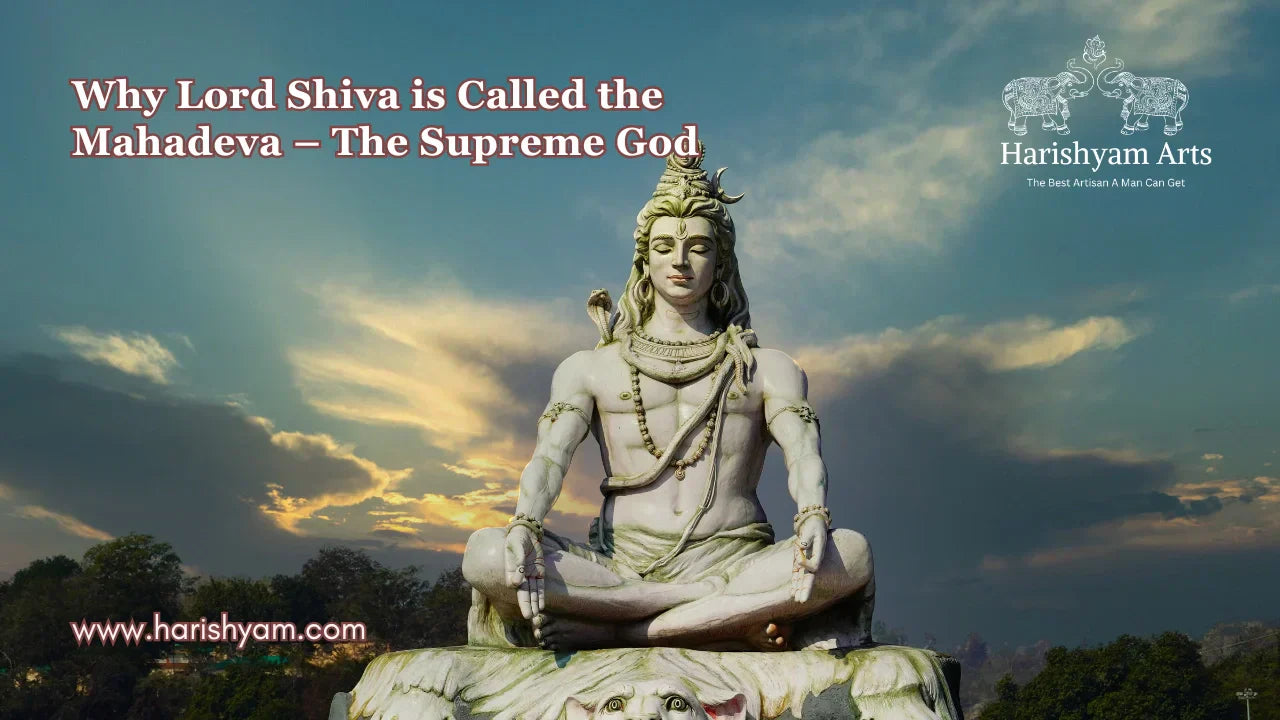
Hinduism, one of the world’s oldest religions, has a rich pantheon of deities, each representing unique aspects of life and the universe. Among them, Lord Shiva holds a special place as Mahadeva, meaning the “Great God” or Supreme God. But why exactly is Shiva called Mahadeva? Let’s explore the spiritual, philosophical, and symbolic reasons behind this revered title.
Who is Shiva?
Lord Shiva is one of the principal deities of Hinduism, revered as the destroyer and transformer within the Trimurti—the trinity that includes Brahma (creator) and Vishnu (preserver).
Shiva represents the ultimate reality, the eternal consciousness, and is often depicted in a meditative pose, symbolizing supreme control over mind and matter. He is worshipped in multiple forms:
-
Shiva Lingam – representing cosmic energy and formless divinity
-
Nataraja – the Lord of Dance, symbolizing cosmic rhythm
-
Meditative Yogi – embodying peace, asceticism, and spiritual mastery
Shiva’s devotees seek spiritual liberation, inner peace, and protection from negative energies through devotion and meditation.
What is the Meaning of Mahadeva?
The term Mahadeva comes from Sanskrit:
-
Maha – “Great” or “Supreme”
-
Deva – “God” or “Divine Being”
Thus, Mahadeva literally means “The Greatest God” or “Supreme God”. While many deities exist in Hinduism, Mahadeva represents the ultimate, all-encompassing divine force that governs creation, preservation, and destruction.
Symbolic Significance of Mahadeva
-
Supremacy and Omnipotence: Mahadeva symbolizes the absolute power over the universe. Unlike other gods, he oversees the entire cosmic cycle.
-
Transformation and Liberation: As the destroyer of ignorance, ego, and illusions, Mahadeva embodies spiritual transformation, guiding devotees toward moksha (liberation).
-
Unity of Opposites: Mahadeva represents balance—fierce yet benevolent, ascetic yet householder, meditative yet dynamic.
-
Transcendence Beyond Form: Mahadeva highlights Shiva’s supreme nature beyond human comprehension, existing in both form (Shiva) and formless consciousness.
-
Cosmic Order: With his trident, third eye, and crescent moon, Mahadeva symbolizes the harmony of creation, preservation, and destruction, the cycles of time, and the spiritual path for humanity.
Between Shiva and Mahadeva
While often used interchangeably, there is a subtle distinction:
-
Shiva: Refers to the approachable deity worshipped in temples and through rituals. He embodies qualities like compassion, asceticism, and devotion.
-
Mahadeva: Emphasizes Shiva’s supreme, cosmic, and ultimate aspect. It denotes his all-encompassing power, beyond human understanding.
In essence, Shiva is the personal god, while Mahadeva reflects the universal, infinite consciousness.
Shiva as the Lord of Destruction and Transformation
Shiva’s role as the destroyer is not negative; it represents transformation and renewal. He destroys ignorance, ego, and illusions, paving the way for spiritual growth. This transcendent power is why he is revered as Mahadeva, the Supreme God.
The Symbolism of Lord Shiva
Shiva is depicted with several symbols that reinforce his supreme status:
-
Trident (Trishul): Represents creation, preservation, and destruction.
-
Third Eye: Symbolizes spiritual knowledge and the ability to destroy evil.
-
Crescent Moon: Signifies control over time and emotions.
-
River Ganga: Denotes purity and sustenance for all life.
-
Meditative Pose: Demonstrates supreme control over mind and body.
Each attribute reflects a cosmic principle, emphasizing why Shiva is revered as Mahadeva.
Shiva in the Trinity (Trimurti)
In Hinduism, the Trimurti consists of:
-
Brahma – the Creator
-
Vishnu – the Preserver
-
Shiva – the Destroyer
While creation and preservation are temporary, destruction allows transformation and new creation. Shiva’s role in this eternal cycle highlights his supreme, transcendent nature as Mahadeva.
Devotional Significance – Why Worship Shiva as Mahadeva
Millions of devotees worship Lord Shiva for:
-
Spiritual liberation (Moksha)
-
Cleansing of sins
-
Inner strength and peace
-
Protection from negative energies
Temples, rituals, and festivals like Maha Shivaratri celebrate his supreme power and cosmic significance.
Philosophical Perspective
According to Shaivism, Shiva is not just a deity but the eternal consciousness, the formless essence from which everything originates and ultimately dissolves. This concept emphasizes why he is called Mahadeva, the absolute, limitless, and eternal principle of the universe.
FAQs – Why Shiva is Called Mahadeva
Q1: What does Mahadeva mean?
Ans:Mahadeva means “Great God” or “Supreme God,” signifying Lord Shiva’s transcendence over all deities.
Q2: Who is Shiva?
Ans: Shiva is a principal Hindu deity, known as the destroyer and transformer, worshipped for spiritual growth and protection.
Q3: What is the difference between Shiva and Mahadeva?
Ans: Shiva is the approachable deity; Mahadeva emphasizes his supreme, cosmic, and absolute nature.
Q4: Why is Shiva called the destroyer?
Ans: Shiva destroys ignorance, ego, and negative energies to allow spiritual renewal and transformation.
Q5: How is Shiva worshipped as Mahadeva?
Ans: Through rituals, prayers, meditation, and festivals like Maha Shivaratri to seek spiritual blessings.
Conclusion
Lord Shiva, the Mahadeva, represents the ultimate truth, cosmic power, and spiritual transformation. Understanding the difference between Shiva and Mahadeva helps devotees appreciate both his approachable and supreme aspects. Worshipping Shiva guides one toward inner strength, wisdom, and liberation.
Bring the divine energy of Mahadeva into your home with marble Shiva idols and statues from Harishyam Arts.

Lakshay Sharma
I’m Lakshay Sharma, a writer with a deep passion for Hindu mythology, Vastu Shastra, and home interiors. I enjoy exploring the rich traditions of Hindu gods and goddesses, sharing insights into Vastu principles, and offering guidance on creating sacred spaces like Puja Mandirs. Through my writing, I aim to inspire harmony and spiritual well-being, blending traditional knowledge with modern perspectives.
Harishyam Arts | Jaipur
Related Blogs

Bhagavad Gita Chapter 4 Verse 31 Meaning in Hindi and English
Lakshay Sharma | June 12, 2026
Bhagavad Gita Chapter 4 Verse 31 highlights the immense importance of <...
Read More...
Bhagavad Gita Chapter 4 Verse 30 Meaning in Hindi and English
Lakshay Sharma | June 12, 2026
Bhagavad Gita Chapter 4 Verse 30 continues Lord Krishna’s discussion on the di...
Read More...
Bhagavad Gita Chapter 4 Verse 29 Meaning in Hindi and English
Lakshay Sharma | June 12, 2026
Bhagavad Gita Chapter 4 Verse 29 continues Lord Krishna’s explanation of the d...
Read More...
Bhagavad Gita Chapter 4 Verse 28 Meaning in Hindi and English
Lakshay Sharma | June 12, 2026
Bhagavad Gita Chapter 4 Verse 28 continues Lord Krishna’s explanation of the m...
Read More...
Bhagavad Gita Chapter 4 Verse 27 Meaning in Hindi and English
Lakshay Sharma | June 12, 2026
Bhagavad Gita Chapter 4 Verse 27 continues Lord Krishna’s discourse on the var...
Read More...
Bhagavad Gita Chapter 4 Verse 25 Meaning in Hindi & English
Lakshay Sharma | June 12, 2026
Bhagavad Gita Chapter 4 Verse 25 marks the beginning of Lord Krishna's detaile...
Read More...
Bhagavad Gita Chapter 4 Verse 24 Meaning in Hindi & English
Lakshay Sharma | June 12, 2026
Bhagavad Gita Chapter 4 Verse 24 is one of the most profound and philosophical...
Read More...
Bhagavad Gita Chapter 4 Verse 23 Meaning in Hindi & English
Lakshay Sharma | June 12, 2026
Bhagavad Gita Chapter 4 Verse 23 continues Lord Krishna's profound teachings o...
Read More...
Bhagavad Gita Chapter 4 Verse 22 Meaning in Hindi & English
Lakshay Sharma | June 12, 2026
Bhagavad Gita Chapter 4 Verse 22 presents one of the clearest descriptions of ...
Read More...
Bhagavad Gita Chapter 4 Verse 21 Meaning in Hindi and English
Lakshay Sharma | June 12, 2026
Bhagavad Gita Chapter 4 Verse 21 further elaborates on the qualities of a true...
Read More...
Bhagavad Gita Chapter 4 Verse 20 Meaning in Hindi and English
Lakshay Sharma | June 12, 2026
Bhagavad Gita Chapter 4 Verse 20 continues Lord Krishna’s profound explanation...
Read More...
Bhagavad Gita Chapter 4 Verse 19 Meaning in Hindi and English
Lakshay Sharma | June 12, 2026
Bhagavad Gita Chapter 4 Verse 19 describes the qualities of a truly enlightene...
Read More...
Bhagavad Gita Chapter 4 Verse 18 Meaning in Hindi and English
Lakshay Sharma | June 12, 2026
Bhagavad Gita Chapter 4 Verse 18 presents one of the most profound and paradox...
Read More...
Bhagavad Gita Chapter 4 Verse 17 Meaning in Hindi and English
Lakshay Sharma | June 12, 2026
Bhagavad Gita Chapter 4 Verse 17 continues Lord Krishna’s profound teaching on...
Read More...
Bhagavad Gita Chapter 4 Verse 15 Meaning in Hindi & English
Lakshay Sharma | June 12, 2026
Bhagavad Gita Chapter 4 Verse 15 builds upon Krishna's teaching about detached...
Read More...
Bhagavad Gita Chapter 4 Verse 14 Meaning in Hindi & English
Lakshay Sharma | June 12, 2026
Bhagavad Gita Chapter 4 Verse 14 continues Lord Krishna's explanation of His d...
Read More...
Bhagavad Gita Chapter 4 Verse 13 Meaning in Hindi & English
Lakshay Sharma | June 12, 2026
Bhagavad Gita Chapter 4 Verse 13 is one of the most discussed verses in the Bh...
Read More...
Bhagavad Gita Chapter 4 Verse 12 Meaning in Hindi & English
Lakshay Sharma | June 12, 2026
Bhagavad Gita Chapter 4 Verse 12 explains why many people worship various deit...
Read More...
Bhagavad Gita Chapter 4 Verse 11 Meaning in Hindi & English
Lakshay Sharma | June 12, 2026
Bhagavad Gita Chapter 4 Verse 11 is one of the most inclusive and universal te...
Read More...
Bhagavad Gita Chapter 4 Verse 10 Meaning in Hindi & English
Lakshay Sharma | June 12, 2026
Bhagavad Gita Chapter 4 Verse 10 reveals the qualities and spiritual practices...
Read More...
Shankh, Chakra & Tilak in Mandir: Their Significance, Placement, and Benefits Explained
Lakshay Sharma | June 12, 2026
Indian temples are not just places of worship; they are centers of spiritual e...
Read More...
Bhagavad Gita Chapter 4 Verse 9 Meaning in Hindi & English
Lakshay Sharma | June 11, 2026
Bhagavad Gita Chapter 4 Verse 9 is one of the most celebrated verses in the Bh...
Read More...
Bhagavad Gita Chapter 4 Verse 8 Meaning in Hindi and English
Lakshay Sharma | June 11, 2026
Bhagavad Gita Chapter 4 Verse 8 is the continuation of Lord Krishna's declarat...
Read More...
Bhagavad Gita Chapter 4 Verse 7 Meaning in Hindi and English
Lakshay Sharma | June 11, 2026
Bhagavad Gita Chapter 4 Verse 7 is one of the most famous and widely quoted ve...
Read More...
Bhagavad Gita Chapter 4 Verse 6 Meaning in Hindi and English
Lakshay Sharma | June 11, 2026
Bhagavad Gita Chapter 4 Verse 6 is one of the most profound...
Read More...
Bhagavad Gita Chapter 4 Verse 5 Meaning in Hindi and English
Lakshay Sharma | June 11, 2026
Bhagavad Gita Chapter 4 Verse 5 contains Lord Krishna's response to Arjuna's q...
Read More...
Bhagavad Gita Chapter 4 Verse 4 Meaning in Hindi and English
Lakshay Sharma | June 11, 2026
Bhagavad Gita Chapter 4 Verse 4 presents an important question from Arjuna. Af...
Read More...
Bhagavad Gita Chapter 4 Verse 3 Meaning in Hindi and English
Lakshay Sharma | June 11, 2026
Bhagavad Gita Chapter 4 Verse 3 is a significant verse where Lord Krishna reve...
Read More...
Bhagavad Gita Chapter 4 Verse 2 Meaning in Hindi and English
Lakshay Sharma | June 11, 2026
Bhagavad Gita Chapter 4 Verse 2 continues Lord Krishna's explanation of the an...
Read More...
Bhagavad Gita Chapter 4 Verse 1 Meaning in Hindi and English
Lakshay Sharma | June 11, 2026
Bhagavad Gita Chapter 4 Verse 1 marks the beginning of the fourth chapter, kno...
Read More...
Bhagavad Gita Chapter 3 Verse 43 Meaning in Hindi & English
Lakshay Sharma | June 11, 2026
Bhagavad Gita Chapter 3 Verse 43 is the concluding verse of Chapter 3 (Karma Y...
Read More...
Bhagavad Gita Chapter 3 Verse 42 Meaning in Hindi & English
Lakshay Sharma | June 11, 2026
Bhagavad Gita Chapter 3 Verse 42 is one of the most profound verses in the Bha...
Read More...
Bhagavad Gita Chapter 3 Verse 33 Meaning in Hindi & English
Lakshay Sharma | June 11, 2026
Bhagavad Gita Chapter 3 Verse 33 addresses a fundamental aspect of human behav...
Read More...
Bhagavad Gita Chapter 3 Verse 32 Meaning in Hindi & English
Lakshay Sharma | June 11, 2026
Bhagavad Gita Chapter 3 Verse 32 serves as a warning from Lord Krishna about t...
Read More...
Bhagavad Gita Chapter 3 Verse 31 Meaning in Hindi & English
Lakshay Sharma | June 11, 2026
Bhagavad Gita Chapter 3 Verse 31 highlights the importance of fai...
Read More...
Bhagavad Gita Chapter 3 Verse 30 Meaning in Hindi & English
Lakshay Sharma | June 11, 2026
Bhagavad Gita Chapter 3 Verse 30 is one of the most powerful teachings on Read More...

Bhagavad Gita Chapter 3 Verse 29 Meaning in Hindi & English
Lakshay Sharma | June 11, 2026
Bhagavad Gita Chapter 3 Verse 29 continues Lord Krishna's discussion about the...
Read More...
Bhagavad Gita Chapter 3 Verse 28 Meaning in Hindi & English
Lakshay Sharma | June 11, 2026
Bhagavad Gita Chapter 3 Verse 28 continues Lord Krishna's profound explanation...
Read More...
Why Brass Statues Are Considered Symbols of Strength, Prosperity, and Divine Energy
Lakshay Sharma | June 11, 2026
Brass statues have held a special place in homes, temples, and cultural tradit...
Read More...
Bhagavad Gita Chapter 3 Verse 27 Meaning in Hindi & English
Lakshay Sharma | June 10, 2026
Bhagavad Gita Chapter 3 Verse 27 presents one of the most profound philosophic...
Read More...
Bhagavad Gita Chapter 3 Verse 26 Meaning in Hindi And English
Lakshay Sharma | June 10, 2026
Bhagavad Gita Chapter 3 Verse 26 contains a profound lesson on leadership, tea...
Read More...
Bhagavad Gita Chapter 3 Verse 41 Meaning in Hindi and English
Lakshay Sharma | June 10, 2026
Bhagavad Gita Chapter 3 Verse 41 is Lord Krishna's practical instruction for o...
Read More...
Bhagavad Gita Chapter 3 Verse 40 Meaning in Hindi and English
Lakshay Sharma | June 10, 2026
Bhagavad Gita Chapter 3 Verse 40 continues Lord Krishna's explanation of desir...
Read More...
Bhagavad Gita Chapter 3 Verse 39 Meaning in Hindi and English
Lakshay Sharma | June 10, 2026
Bhagavad Gita Chapter 3 Verse 39 continues Lord Krishna's explanation about de...
Read More...
Bhagavad Gita Chapter 3 Verse 38 Meaning in Hindi and English
Lakshay Sharma | June 10, 2026
Bhagavad Gita Chapter 3 Verse 38 continues Lord Krishna's explanation about de...
Read More...
Bhagavad Gita Chapter 3 Verse 37 Meaning in Hindi and English
Lakshay Sharma | June 10, 2026
Bhagavad Gita Chapter 3 Verse 37 contains Lord Krishna's direct answer to Arju...
Read More...
Bhagavad Gita Chapter 3 Verse 36 Meaning in Hindi and English
Lakshay Sharma | June 10, 2026
Bhagavad Gita Chapter 3 Verse 36 marks the beginning of one of the most import...
Read More...
Bhagavad Gita Chapter 3 Verse 35 Meaning in Hindi and English
Lakshay Sharma | June 10, 2026
Bhagavad Gita Chapter 3 Verse 35 is one of the most famous verses in the entir...
Read More...
Bhagavad Gita Chapter 3 Verse 34 Meaning in Hindi and English
Lakshay Sharma | June 10, 2026
Bhagavad Gita Chapter 3 Verse 34 is a profound teaching on contro...
Read More...
Bhagavad Gita Chapter 3 Verse 25 Meaning in Hindi and English
Lakshay Sharma | June 10, 2026


