
Harishyam Arts Blog
Dome or No Dome? Choosing the Right Design for Your Home Temple
By Lakshay Sharma | On 21 October, 2025 | Views
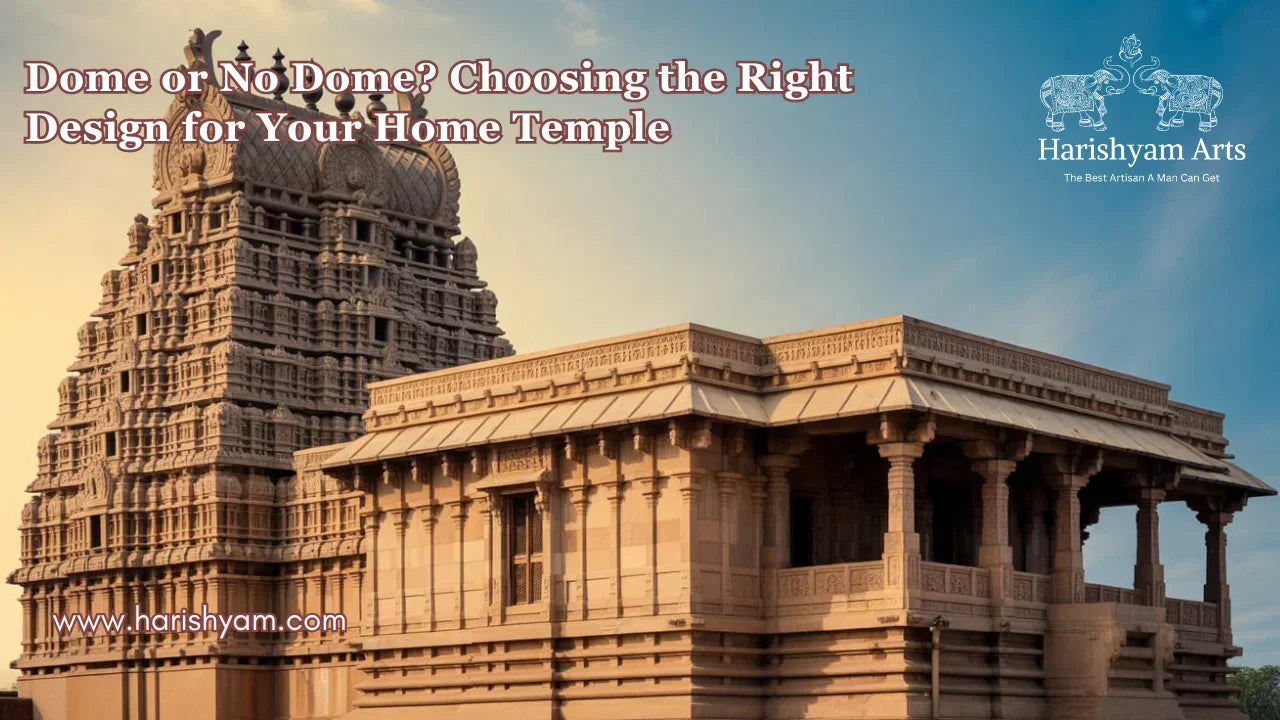
Creating a sacred space at home is a spiritual investment, and the design of your home temple (mandir) plays a crucial role in enhancing positive energy. One of the most debated questions among devotees and interior enthusiasts is: Should your home temple have a dome or a flat roof? This guide will help you make the right choice by exploring traditional wisdom, modern trends, and practical design considerations for wooden, marble, and Corian mandirs.
Should Home Temple Have a Dome as per Vastu?
According to Vastu Shastra, a dome-shaped roof in a mandir symbolizes the celestial sphere and divine energy. It is believed to amplify positive vibrations, bringing peace, prosperity, and spiritual well-being to the household. While flat-roof temples are also acceptable, a dome is considered auspicious, especially for spaces where meditation and daily worship are performed.
Benefits of Having a Dome in Home Mandir
-
Spiritual Elevation: Domes represent the connection between earth and sky, helping channel divine energy.
-
Aesthetic Appeal: A dome instantly elevates the elegance of wooden, marble, or Corian mandirs.
-
Enhanced Acoustics: Domes naturally amplify sound, which is perfect for chanting, bells, and devotional music.
-
Symbolic Significance: In Hindu culture, domes are symbolic of the universe and divine consciousness.
Difference Between Dome and Flat Roof Temple Design
|
Feature |
Dome Mandir |
Flat Roof Mandir |
|
Spiritual Significance |
High, channels divine energy |
Moderate, simpler energy flow |
|
Aesthetic Appeal |
Traditional, majestic |
Minimalistic, modern |
|
Material Options |
Wood, Marble, Corian |
Wood, Marble, Corian |
|
Construction Complexity |
More complex |
Easier |
Modern vs Traditional Temple Dome Design Ideas
-
Traditional Domes: Intricate carvings, tiered layers, often seen in marble or wooden mandirs.
-
Modern Domes: Sleek, minimal, sometimes made with Corian for a contemporary look.
-
Combination Styles: Traditional motifs with modern materials like Corian or blended wood and marble for a fusion appeal.
Ideal Mandir Design for Home as per Vastu Shastra
-
Placement: Ideally in the northeast corner of the house for maximum positivity.
-
Height: Slightly elevated platform is recommended.
-
Orientation: Facing east or west is considered auspicious.
-
Material Choice:
-
Teak Wooden Mandir: Durable, warm, easy to carve for domes.
-
White Marble Mandir: Elegant, traditional, stays cool, ideal for intricate dome work.
-
Backlit Corian Mandir: Modern, lightweight, customizable designs, and easy maintenance.
FAQs – Choosing the Right Design for Your Home Temple
Q1. Should a home temple have a dome according to Vastu?
Ans: Yes, according to Vastu Shastra, having a dome in your home temple is highly auspicious. It helps attract positive energy, peace, and prosperity. The dome represents the connection between the devotee and divine energy, symbolizing the cosmic link between heaven and earth.
Q2. What are the benefits of adding a dome to a home mandir?
Ans: A dome enhances the divine aura of your home temple. It improves spiritual vibrations, amplifies sound during prayers, and adds grandeur to the design. Whether your mandir is made of wood, marble, or Corian, a dome brings beauty, energy balance, and traditional elegance to your sacred space.
Q3. Which is better for home temples – dome or flat roof design?
Ans: Both designs have their appeal. Dome temples are traditional, spiritually powerful, and visually majestic. Flat roof temples suit modern interiors and smaller spaces. If Vastu and devotion are priorities, choose a dome; if simplicity and minimalism matter, a flat roof design may be ideal.
Q4. What are the Vastu guidelines for temple dome design at home?
Ans: According to Vastu, domes should be rounded, centered above the deity, and not touch the ceiling. The mandir should face east or northeast, symbolizing divine light and prosperity. A properly designed dome helps maintain energy flow, creating a peaceful and positive environment in your home.
Q5. How to choose the right dome design for your home mandir?
Ans: Consider your home’s space, ceiling height, and décor style. Choose carved wooden domes for traditional homes, marble domes for grandeur, and Corian domes for minimalist designs. Always ensure alignment with Vastu Shastra for direction, shape, and placement to enhance positive energy and aesthetics.
Q5. How to Clean a Wooden Mandir at Home?
Ans: To clean a wooden mandir, gently dust daily with a soft, dry cloth. Once a week, wipe with a slightly damp microfiber cloth. Avoid harsh chemicals or excess water to protect the wood polish. For deep cleaning, use natural oils like lemon or coconut oil to maintain shine and fragrance.
How to Choose the Right Home Temple Design
-
Assess the available space and ceiling height for a dome.
-
Decide on material: Wooden for warmth and tradition, marble for elegance, Corian for modern minimalist style.
-
Consider maintenance: Marble and Corian are easier to clean than wooden mandirs in humid conditions.
-
Align with Vastu guidelines for home mandir for orientation and placement.
Temple Dome Meaning and Importance in Hindu Culture
In Hindu architecture, the dome (or Shikhara) represents Mount Meru, the mythical mountain considered the axis of the universe. It is a reminder of divine presence and spiritual ascent. A dome also serves as a symbolic canopy, signifying protection, sanctity, and the celestial abode of the deities.
Buying Online? Tips from Harishyam Arts
When buying a home temple online, especially from trusted platforms like Harishyam Arts, consider these points:
-
Check dimensions carefully.
-
Confirm the material and finish.
-
Read reviews for quality and durability.
-
Ensure the temple suits your home’s Vastu requirements.
Conclusion
Whether you choose a dome or a flat-top temple depends on your space, budget, and aesthetic preference. Dome temples bring a traditional, spiritual vibe, while no-dome temples fit modern interiors seamlessly. The key is to create a sacred space that inspires devotion and tranquility
Choosing whether to have a dome or a flat roof for your home temple depends on space, material, and personal preference, but incorporating a dome as per Vastu Shastra adds both spiritual and aesthetic value. Whether you choose a wooden, marble, or Corian mandir, a dome elevates the sacred experience, making your home a true sanctuary of peace and devotion.

Lakshay Sharma
I’m Lakshay Sharma, a writer with a deep passion for Hindu mythology, Vastu Shastra, and home interiors. I enjoy exploring the rich traditions of Hindu gods and goddesses, sharing insights into Vastu principles, and offering guidance on creating sacred spaces like Puja Mandirs. Through my writing, I aim to inspire harmony and spiritual well-being, blending traditional knowledge with modern perspectives.
Harishyam Arts | Jaipur
Related Blogs

Bhagavad Gita Chapter 2 Verse 21 Meaning in Hindi & English
Lakshay Sharma | June 04, 2026
After revealing that the soul is unborn, eternal, and indestructible in the pr...
Read More...
Bhagavad Gita Chapter 2 Verse 22 Meaning in Hindi & English
Lakshay Sharma | June 04, 2026
Bhagavad Gita Chapter 2 Verse 22 contains one of the most famous and beautiful...
Read More...
Bhagavad Gita Chapter 2 Verse 20 Meaning in Hindi & English
Lakshay Sharma | June 04, 2026
Bhagavad Gita Chapter 2 Verse 20 is one of the most famous and profound verses...
Read More...
Bhagavad Gita Chapter 2 Verse 19 Meaning in Hindi & English
Lakshay Sharma | June 04, 2026
As Lord Krishna continues to reveal the eternal nature of the soul, He now add...
Read More...
Bhagavad Gita Chapter 2 Verse 18 Meaning in Hindi & English
Lakshay Sharma | June 04, 2026
After explaining the indestructible nature of the soul in the previous verse, ...
Read More...
Bhagavad Gita Chapter 2 Verse 17 Meaning in Hindi & English
Lakshay Sharma | June 04, 2026
After establishing the distinction between the eternal (Sat) and the temporary...
Read More...
Bhagavad Gita Chapter 2 Verse 16 Meaning in Hindi & English
Lakshay Sharma | June 04, 2026
As Lord Krishna continues to guide the grief-stricken Arjuna, He now introduce...
Read More...
Bhagavad Gita Chapter 2 Verse 15 Meaning in Hindi & English
Lakshay Sharma | June 04, 2026
After teaching Arjuna that pleasure and pain are temporary experiences arising...
Read More...
Bhagavad Gita Chapter 2 Verse 23 Meaning in Hindi & English
Lakshay Sharma | June 04, 2026
As Lord Krishna continues to explain the eternal and indestructible nature of ...
Read More...
The Unique Glow Effect in Corian Mandirs and Its Spiritual Ambience
Lakshay Sharma | June 04, 2026
In modern home temple design, Corian mandirs have become a symbol of elegance,...
Read More...
Bhagavad Gita Chapter 2 Verse 63 Meaning in Hindi & English
Lakshay Sharma | June 04, 2026
Bhagavad Gita Chapter 2 Verse 63 continues the powerful psychological teaching...
Read More...
Bhagavad Gita Chapter 2 Verse 62 Meaning in Hindi & English
Lakshay Sharma | June 04, 2026
Bhagavad Gita Chapter 2 Verse 62 is one of the most psychologically insightful...
Read More...
Bhagavad Gita Chapter 2 Verse 61 Meaning in Hindi And English
Lakshay Sharma | June 04, 2026

Bhagavad Gita Chapter 2 Verse 60 Meaning in Hindi And English
Lakshay Sharma | June 04, 2026
Bhagavad Gita Chapter 2 Verse 60 continues Lord Krishna's profo...
Read More...
Bhagavad Gita Chapter 2 Verse 59 Meaning in Hindi & English
Lakshay Sharma | June 04, 2026
Bhagavad Gita Chapter 2 Verse 59 continues Lord Krishna's explanation of sense...
Read More...
Bhagavad Gita Chapter 2 Verse 58 Meaning in Hindi And English
Lakshay Sharma | June 04, 2026
Bhagavad Gita Chapter 2 Verse 58 continues Lord Krishna's descr...
Read More...
Bhagavad Gita Chapter 2 Verse 57 Meaning in Hindi And English
Lakshay Sharma | June 04, 2026
In Bhagavad Gita Chapter 2 Verse 56, Lord Krishna explained that a person of steady wisdom rem...
Read More...
Bhagavad Gita Chapter 2 Verse 56 Meaning in Hindi And English
Lakshay Sharma | June 04, 2026
In Bhagavad Gita Chapter 2 Verse 55, Lord Krishna explained that a person of steady wisdom (St...
Read More...
Bhagavad Gita Chapter 2 Verse 55 Meaning in Hindi And English
Lakshay Sharma | June 04, 2026
Bhagavad Gita Chapter 2 Verse 55 is one of the most significant verses in the entire Bhagavad ...
Read More...
Bhagavad Gita Chapter 2 Verse 54 Meaning in Hindi And English
Lakshay Sharma | June 04, 2026
Bhagavad Gita Chapter 2 Verse 54 marks the beginning of one of the most important discussions ...
Read More...
Bhagavad Gita Chapter 2 Verse 53 Meaning in Hindi and English
Lakshay Sharma | June 04, 2026
Bhagavad Gita Chapter 2 Verse 53 describes the state of a person whose mind ha...
Read More...
Bhagavad Gita Chapter 2 Verse 52 Meaning in Hindi and English
Lakshay Sharma | June 04, 2026
Bhagavad Gita Chapter 2 Verse 52 marks a significant turning point in Lord Kri...
Read More...
Bhagavad Gita Chapter 2 Verse 51 Meaning in Hindi and English
Lakshay Sharma | June 04, 2026
Bhagavad Gita Chapter 2 Verse 51 continues Lord Krishna's teaching on Karma Yo...
Read More...
Bhagavad Gita Chapter 2 Verse 50 Meaning in Hindi and English
Lakshay Sharma | June 04, 2026
Bhagavad Gita Chapter 2 Verse 50 explains the extraordinary power of

Bhagavad Gita Chapter 2 Verse 49 Meaning in Hindi and English
Lakshay Sharma | June 04, 2026
Bhagavad Gita Chapter 2 Verse 49 continues Lord Krishna’s teaching on Karma Yo...
Read More...
Bhagavad Gita Chapter 2 Verse 48 Meaning in Hindi and English
Lakshay Sharma | June 04, 2026
Bhagavad Gita Chapter 2 Verse 48 is one of the most profound teachings on Read More...

Bhagavad Gita Chapter 2 Verse 47 Meaning in Hindi and English
Lakshay Sharma | June 04, 2026
Bhagavad Gita Chapter 2 Verse 47 is one of the most famous and widely quoted v...
Read More...
Bhagavad Gita Chapter 2 Verse 46 Meaning in Hindi and English
Lakshay Sharma | June 04, 2026
Bhagavad Gita Chapter 2 Verse 46 presents a profound teaching about spiritual ...
Read More...
Bhagavad Gita Chapter 2 Verse 45 Meaning in Hindi & English
Lakshay Sharma | June 03, 2026
Bhagavad Gita Chapter 2 Verse 45 is one of the most profound teachings in the ...
Read More...
Bhagavad Gita Chapter 2 Verse 44 Meaning in Hindi & English
Lakshay Sharma | June 03, 2026
In the previous verses, Lord Krishna explained how attachment to ritualistic r...
Read More...
Bhagavad Gita Chapter 2 Verse 43 Meaning in Hindi & English
Lakshay Sharma | June 03, 2026
In the previous verse, Lord Krishna warned Arjuna about those who become capti...
Read More...
Bhagavad Gita Chapter 2 Verse 42 Meaning in Hindi & English
Lakshay Sharma | June 03, 2026
Bhagavad Gita Chapter 2 Verse 42 marks the beginning of Lord Krishna's critiqu...
Read More...
Bhagavad Gita Chapter 2 Verse 41 Meaning in Hindi & English
Lakshay Sharma | June 03, 2026
Bhagavad Gita Chapter 2 Verse 41 introduces one of the most important qualitie...
Read More...
Bhagavad Gita Chapter 2 Verse 40 Meaning in Hindi & English
Lakshay Sharma | June 03, 2026
Bhagavad Gita Chapter 2 Verse 40 is one of the most encouraging verses in the ...
Read More...
Bhagavad Gita Chapter 2 Verse 39 Meaning in Hindi And English
Lakshay Sharma | June 03, 2026
Bhagavad Gita Chapter 2 Verse 39 marks a major turning point in Lord Krishna's...
Read More...
Why Marble Is Considered the Most Sacred Stone for Hindu Moortis
Lakshay Sharma | June 03, 2026
In Hindu culture, moortis (idols or divine statues) are not merely decorative ...
Read More...
Bhagavad Gita Chapter 2 Verse 30 Meaning in Hindi & English
Lakshay Sharma | June 02, 2026
Bhagavad Gita Chapter 2 Verse 30 serves as the conclusion of Lord Krishna's pr...
Read More...
Bhagavad Gita Chapter 2 Verse 29 Meaning in Hindi & English
Lakshay Sharma | June 02, 2026
After explaining that the soul is eternal, invisible, unmanifest before birth,...
Read More...
Bhagavad Gita Chapter 2 Verse 28 Meaning in Hindi & English
Lakshay Sharma | June 02, 2026
After explaining that birth and death are inevitable, Lord Krishna now reveals...
Read More...
Bhagavad Gita Chapter 2 Verse 27 Meaning in Hindi & English
Lakshay Sharma | June 02, 2026
In the previous verse, Lord Krishna explained that even if one believes the so...
Read More...
Bhagavad Gita Chapter 2 Verse 26 Meaning in Hindi & English
Lakshay Sharma | June 02, 2026
After extensively explaining the eternal, indestructible, and unchanging natur...
Read More...
Bhagavad Gita Chapter 2 Verse 25 Meaning in Hindi & English
Lakshay Sharma | June 02, 2026
After describing the soul as indestructible, eternal, and beyond the influence...
Read More...
Bhagavad Gita Chapter 2 Verse 24 Meaning in Hindi & English
Lakshay Sharma | June 02, 2026
In the previous verse, Lord Krishna explained that the soul cannot be cut by w...
Read More...
The Hidden Stories and Symbolism Behind Traditional Hand-Carved Furniture
Lakshay Sharma | June 02, 2026
Furniture is more than just a functional object placed inside a home. In many ...
Read More...
Bhagavad Gita Chapter 2 Verse 14 Meaning in Hindi and English
Lakshay Sharma | June 01, 2026
Bhagavad Gita Chapter 2 Verse 14 teaches one of the most practical lessons in ...
Read More...
Bhagavad Gita Chapter 2 Verse 13 Meaning in Hindi and English
Lakshay Sharma | June 01, 2026
Bhagavad Gita Chapter 2 Verse 13 is one of the most quoted and profound verses...
Read More...
Bhagavad Gita Chapter 2 Verse 12 Meaning in Hindi and English
Lakshay Sharma | June 01, 2026
Bhagavad Gita Chapter 2 Verse 12 is one of the foundational verses of the Bhagavad G...
Read More...
Bhagavad Gita Chapter 2 Verse 11 Meaning in Hindi and English
Lakshay Sharma | June 01, 2026
Bhagavad Gita Chapter 2 Verse 11 is one of the most significant verses in the ...
Read More...
Bhagavad Gita Chapter 2 Verse 10 Meaning in Hindi and English
Lakshay Sharma | June 01, 2026
Bhagavad Gita Chapter 2 Verse 10 marks a turning point in the sacred dialogue ...
Read More...
Bhagavad Gita Chapter 2 Verse 9 Meaning in Hindi and English
Lakshay Sharma | June 01, 2026
Bhagavad Gita Chapter 2 Verse 9 marks a significant moment in the dialogue bet...
Read More...
Secure and Fast shipping world wide

Priority Customer Support

Every Product is handcrafted in-house

Building Timeless Divine Temples and Idols Since 1979
- Choosing a selection results in a full page refresh.
- Opens in a new window.