
Harishyam Arts Blog
Which Direction Should God Face in Home Pooja Room?
By Lakshay Sharma | On 12 February, 2024 | Views
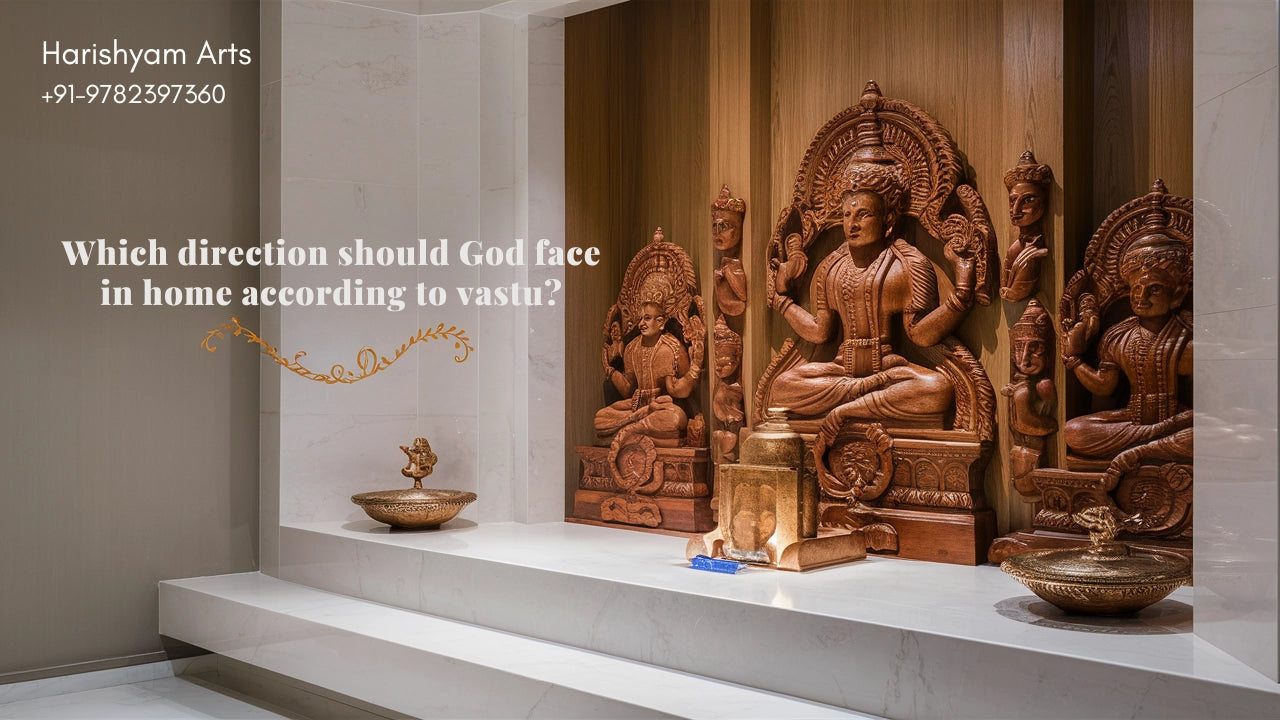
In Hindu culture, a home pooja room holds immense spiritual significance as a place of worship and connection with the divine. One essential aspect of setting up a sacred space is determining the direction in which the deity idols should face. This article, brought to you by Harishyam Arts, explores the various directions—south, east, west, and north—in which gods can face and the reasons behind each choice.
Which is the Best God Facing Direction in Hinduism?
The orientation of hindu gods / goddess idols within a pooja room is a topic of deep spiritual consideration. It is believed that the energies and vibrations of the deities influence the atmosphere of the room and the spiritual connection of the devotees. Let's explore the different directions and their implications:
Can God Face South Direction?
Placing deity facing the south direction is less common but not unheard of in Hindu rituals. While the east direction is preferred for its association with the rising sun and positivity, south-facing deities are sometimes permitted based on the attributes of specific gods. Devotees who follow this practice often have personal or regional reasons for doing so.
Can God Face East Direction?
The east direction is widely regarded as the most auspicious for placing the marble statue. East-facing deities are believed to receive the first rays of the rising sun, symbolizing enlightenment and new beginnings. This alignment is thought to infuse the pooja room with divine energy, fostering a serene atmosphere for worship and meditation.
Can God Face West Direction?
Placing moortis facing the west direction is generally less common and less favored. West-facing deities are believed to disrupt the flow of positive energy in the space. However, there are instances in which certain deities are intentionally placed facing west due to their mythology or regional traditions.
Can God Face North Direction?
North-facing deities are relatively uncommon, but they are not unheard of in Hindu practices. North is associated with the realm of Kubera, the god of wealth, and placing deities facing this direction is believed to attract prosperity and abundance. Devotees who follow this practice often do so with the intention of inviting financial well-being into their homes.
Expert Insights: Navigating Tradition and Spirituality
The direction in which marble gods stautes should face is an intricate blend of tradition, spirituality, and personal beliefs. While there are recommended directions, it's important to understand that devotion and intention supersede strict rules. Here are some insights to consider:
The Significance of Tradition
Traditional practices often carry a deep cultural and spiritual significance. While exploring different directions, it's advisable to be aware of your family's or community's traditions to ensure respect for ancestral wisdom.
Seeking Guidance from Elders
Consulting with elders and experienced family members can provide valuable insights into the preferred direction for deity idols. Their wisdom can shed light on regional practices and beliefs that might influence your decision.
Personal Connection and Intuition
Ultimately, the connection you feel with a particular direction matters. If a specific direction resonates with you on a spiritual level, it's worth considering, provided it aligns with the essence of the deity and the intention of your worship.
Frequently Asked Questions
Q.1 Is there a recommended direction for multiple deities?
Ans: Placing the presiding or central deity facing east is common, while other deities can be arranged based on tradition and family customs.
Q.2 What if I'm unsure about the preferred direction?
Ans: Seek advice from priests or experts who can offer insights based on scriptures, rituals, and regional practices.
Q.3 Can the same deity face different directions in different households?
Ans: Yes, variations in deity orientation can occur based on family traditions, regional customs, and personal beliefs.
Q.4 Are there specific mantras for consecrating the direction of deity idols?
Ans: Yes, there are rituals and mantras for deity consecration. Consulting a priest ensures the process is conducted correctly.
Q.5 Can I combine directions for different deity idols?
Ans: Combining directions should be done with caution, as it could affect the energy dynamics within the pooja room. Seek guidance for harmonious placement.
Q.6 Can I change the direction of the idol later?
Ans: Yes, you can reorient the deity idol as your spiritual journey evolves. Just ensure you do so with respect and the right rituals.
Conclusion
Selecting the right direction for deity idols in your home pooja room is a blend of tradition, spirituality, and personal resonance. Whether you choose east, south, west, or north-facing arrangements, remember that the intention behind your worship matters most. By honoring tradition, seeking guidance, and following your heart, you can create a sacred space that nourishes your spiritual journey.

Lakshay Sharma
I’m Lakshay Sharma, a writer with a deep passion for Hindu mythology, Vastu Shastra, and home interiors. I enjoy exploring the rich traditions of Hindu gods and goddesses, sharing insights into Vastu principles, and offering guidance on creating sacred spaces like Puja Mandirs. Through my writing, I aim to inspire harmony and spiritual well-being, blending traditional knowledge with modern perspectives.
Harishyam Arts | Jaipur
Related Blogs

Bhagavad Gita Chapter 2 Verse 21 Meaning in Hindi & English
Lakshay Sharma | June 04, 2026
After revealing that the soul is unborn, eternal, and indestructible in the pr...
Read More...
Bhagavad Gita Chapter 2 Verse 22 Meaning in Hindi & English
Lakshay Sharma | June 04, 2026
Bhagavad Gita Chapter 2 Verse 22 contains one of the most famous and beautiful...
Read More...
Bhagavad Gita Chapter 2 Verse 20 Meaning in Hindi & English
Lakshay Sharma | June 04, 2026
Bhagavad Gita Chapter 2 Verse 20 is one of the most famous and profound verses...
Read More...
Bhagavad Gita Chapter 2 Verse 19 Meaning in Hindi & English
Lakshay Sharma | June 04, 2026
As Lord Krishna continues to reveal the eternal nature of the soul, He now add...
Read More...
Bhagavad Gita Chapter 2 Verse 18 Meaning in Hindi & English
Lakshay Sharma | June 04, 2026
After explaining the indestructible nature of the soul in the previous verse, ...
Read More...
Bhagavad Gita Chapter 2 Verse 17 Meaning in Hindi & English
Lakshay Sharma | June 04, 2026
After establishing the distinction between the eternal (Sat) and the temporary...
Read More...
Bhagavad Gita Chapter 2 Verse 16 Meaning in Hindi & English
Lakshay Sharma | June 04, 2026
As Lord Krishna continues to guide the grief-stricken Arjuna, He now introduce...
Read More...
Bhagavad Gita Chapter 2 Verse 15 Meaning in Hindi & English
Lakshay Sharma | June 04, 2026
After teaching Arjuna that pleasure and pain are temporary experiences arising...
Read More...
Bhagavad Gita Chapter 2 Verse 23 Meaning in Hindi & English
Lakshay Sharma | June 04, 2026
As Lord Krishna continues to explain the eternal and indestructible nature of ...
Read More...
The Unique Glow Effect in Corian Mandirs and Its Spiritual Ambience
Lakshay Sharma | June 04, 2026
In modern home temple design, Corian mandirs have become a symbol of elegance,...
Read More...
Bhagavad Gita Chapter 2 Verse 63 Meaning in Hindi & English
Lakshay Sharma | June 04, 2026
Bhagavad Gita Chapter 2 Verse 63 continues the powerful psychological teaching...
Read More...
Bhagavad Gita Chapter 2 Verse 62 Meaning in Hindi & English
Lakshay Sharma | June 04, 2026
Bhagavad Gita Chapter 2 Verse 62 is one of the most psychologically insightful...
Read More...
Bhagavad Gita Chapter 2 Verse 61 Meaning in Hindi And English
Lakshay Sharma | June 04, 2026

Bhagavad Gita Chapter 2 Verse 60 Meaning in Hindi And English
Lakshay Sharma | June 04, 2026
Bhagavad Gita Chapter 2 Verse 60 continues Lord Krishna's profo...
Read More...
Bhagavad Gita Chapter 2 Verse 59 Meaning in Hindi & English
Lakshay Sharma | June 04, 2026
Bhagavad Gita Chapter 2 Verse 59 continues Lord Krishna's explanation of sense...
Read More...
Bhagavad Gita Chapter 2 Verse 58 Meaning in Hindi And English
Lakshay Sharma | June 04, 2026
Bhagavad Gita Chapter 2 Verse 58 continues Lord Krishna's descr...
Read More...
Bhagavad Gita Chapter 2 Verse 57 Meaning in Hindi And English
Lakshay Sharma | June 04, 2026
In Bhagavad Gita Chapter 2 Verse 56, Lord Krishna explained that a person of steady wisdom rem...
Read More...
Bhagavad Gita Chapter 2 Verse 56 Meaning in Hindi And English
Lakshay Sharma | June 04, 2026
In Bhagavad Gita Chapter 2 Verse 55, Lord Krishna explained that a person of steady wisdom (St...
Read More...
Bhagavad Gita Chapter 2 Verse 55 Meaning in Hindi And English
Lakshay Sharma | June 04, 2026
Bhagavad Gita Chapter 2 Verse 55 is one of the most significant verses in the entire Bhagavad ...
Read More...
Bhagavad Gita Chapter 2 Verse 54 Meaning in Hindi And English
Lakshay Sharma | June 04, 2026
Bhagavad Gita Chapter 2 Verse 54 marks the beginning of one of the most important discussions ...
Read More...
Bhagavad Gita Chapter 2 Verse 53 Meaning in Hindi and English
Lakshay Sharma | June 04, 2026
Bhagavad Gita Chapter 2 Verse 53 describes the state of a person whose mind ha...
Read More...
Bhagavad Gita Chapter 2 Verse 52 Meaning in Hindi and English
Lakshay Sharma | June 04, 2026
Bhagavad Gita Chapter 2 Verse 52 marks a significant turning point in Lord Kri...
Read More...
Bhagavad Gita Chapter 2 Verse 51 Meaning in Hindi and English
Lakshay Sharma | June 04, 2026
Bhagavad Gita Chapter 2 Verse 51 continues Lord Krishna's teaching on Karma Yo...
Read More...
Bhagavad Gita Chapter 2 Verse 50 Meaning in Hindi and English
Lakshay Sharma | June 04, 2026
Bhagavad Gita Chapter 2 Verse 50 explains the extraordinary power of

Bhagavad Gita Chapter 2 Verse 49 Meaning in Hindi and English
Lakshay Sharma | June 04, 2026
Bhagavad Gita Chapter 2 Verse 49 continues Lord Krishna’s teaching on Karma Yo...
Read More...
Bhagavad Gita Chapter 2 Verse 48 Meaning in Hindi and English
Lakshay Sharma | June 04, 2026
Bhagavad Gita Chapter 2 Verse 48 is one of the most profound teachings on Read More...

Bhagavad Gita Chapter 2 Verse 47 Meaning in Hindi and English
Lakshay Sharma | June 04, 2026
Bhagavad Gita Chapter 2 Verse 47 is one of the most famous and widely quoted v...
Read More...
Bhagavad Gita Chapter 2 Verse 46 Meaning in Hindi and English
Lakshay Sharma | June 04, 2026
Bhagavad Gita Chapter 2 Verse 46 presents a profound teaching about spiritual ...
Read More...
Bhagavad Gita Chapter 2 Verse 45 Meaning in Hindi & English
Lakshay Sharma | June 03, 2026
Bhagavad Gita Chapter 2 Verse 45 is one of the most profound teachings in the ...
Read More...
Bhagavad Gita Chapter 2 Verse 44 Meaning in Hindi & English
Lakshay Sharma | June 03, 2026
In the previous verses, Lord Krishna explained how attachment to ritualistic r...
Read More...
Bhagavad Gita Chapter 2 Verse 43 Meaning in Hindi & English
Lakshay Sharma | June 03, 2026
In the previous verse, Lord Krishna warned Arjuna about those who become capti...
Read More...
Bhagavad Gita Chapter 2 Verse 42 Meaning in Hindi & English
Lakshay Sharma | June 03, 2026
Bhagavad Gita Chapter 2 Verse 42 marks the beginning of Lord Krishna's critiqu...
Read More...
Bhagavad Gita Chapter 2 Verse 41 Meaning in Hindi & English
Lakshay Sharma | June 03, 2026
Bhagavad Gita Chapter 2 Verse 41 introduces one of the most important qualitie...
Read More...
Bhagavad Gita Chapter 2 Verse 40 Meaning in Hindi & English
Lakshay Sharma | June 03, 2026
Bhagavad Gita Chapter 2 Verse 40 is one of the most encouraging verses in the ...
Read More...
Bhagavad Gita Chapter 2 Verse 39 Meaning in Hindi And English
Lakshay Sharma | June 03, 2026
Bhagavad Gita Chapter 2 Verse 39 marks a major turning point in Lord Krishna's...
Read More...
Why Marble Is Considered the Most Sacred Stone for Hindu Moortis
Lakshay Sharma | June 03, 2026
In Hindu culture, moortis (idols or divine statues) are not merely decorative ...
Read More...
Bhagavad Gita Chapter 2 Verse 30 Meaning in Hindi & English
Lakshay Sharma | June 02, 2026
Bhagavad Gita Chapter 2 Verse 30 serves as the conclusion of Lord Krishna's pr...
Read More...
Bhagavad Gita Chapter 2 Verse 29 Meaning in Hindi & English
Lakshay Sharma | June 02, 2026
After explaining that the soul is eternal, invisible, unmanifest before birth,...
Read More...
Bhagavad Gita Chapter 2 Verse 28 Meaning in Hindi & English
Lakshay Sharma | June 02, 2026
After explaining that birth and death are inevitable, Lord Krishna now reveals...
Read More...
Bhagavad Gita Chapter 2 Verse 27 Meaning in Hindi & English
Lakshay Sharma | June 02, 2026
In the previous verse, Lord Krishna explained that even if one believes the so...
Read More...
Bhagavad Gita Chapter 2 Verse 26 Meaning in Hindi & English
Lakshay Sharma | June 02, 2026
After extensively explaining the eternal, indestructible, and unchanging natur...
Read More...
Bhagavad Gita Chapter 2 Verse 25 Meaning in Hindi & English
Lakshay Sharma | June 02, 2026
After describing the soul as indestructible, eternal, and beyond the influence...
Read More...
Bhagavad Gita Chapter 2 Verse 24 Meaning in Hindi & English
Lakshay Sharma | June 02, 2026
In the previous verse, Lord Krishna explained that the soul cannot be cut by w...
Read More...
The Hidden Stories and Symbolism Behind Traditional Hand-Carved Furniture
Lakshay Sharma | June 02, 2026
Furniture is more than just a functional object placed inside a home. In many ...
Read More...
Bhagavad Gita Chapter 2 Verse 14 Meaning in Hindi and English
Lakshay Sharma | June 01, 2026
Bhagavad Gita Chapter 2 Verse 14 teaches one of the most practical lessons in ...
Read More...
Bhagavad Gita Chapter 2 Verse 13 Meaning in Hindi and English
Lakshay Sharma | June 01, 2026
Bhagavad Gita Chapter 2 Verse 13 is one of the most quoted and profound verses...
Read More...
Bhagavad Gita Chapter 2 Verse 12 Meaning in Hindi and English
Lakshay Sharma | June 01, 2026
Bhagavad Gita Chapter 2 Verse 12 is one of the foundational verses of the Bhagavad G...
Read More...
Bhagavad Gita Chapter 2 Verse 11 Meaning in Hindi and English
Lakshay Sharma | June 01, 2026
Bhagavad Gita Chapter 2 Verse 11 is one of the most significant verses in the ...
Read More...
Bhagavad Gita Chapter 2 Verse 10 Meaning in Hindi and English
Lakshay Sharma | June 01, 2026
Bhagavad Gita Chapter 2 Verse 10 marks a turning point in the sacred dialogue ...
Read More...
Bhagavad Gita Chapter 2 Verse 9 Meaning in Hindi and English
Lakshay Sharma | June 01, 2026
Bhagavad Gita Chapter 2 Verse 9 marks a significant moment in the dialogue bet...
Read More...
Secure and Fast shipping world wide

Priority Customer Support

Every Product is handcrafted in-house

Building Timeless Divine Temples and Idols Since 1979
- Choosing a selection results in a full page refresh.
- Opens in a new window.