
Harishyam Arts Blog
Why Lord Shiva is Called the Mahadeva – The Supreme God
By Lakshay Sharma | On 23 October, 2025 | Views
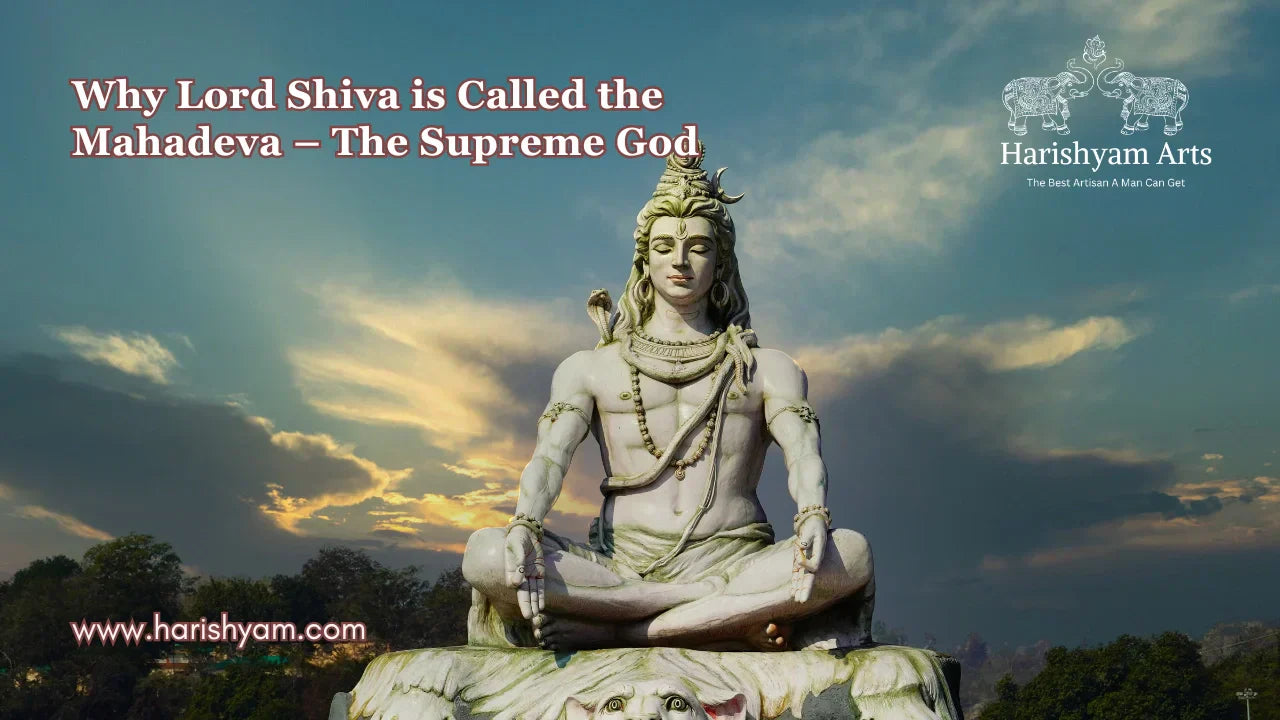
Hinduism, one of the world’s oldest religions, has a rich pantheon of deities, each representing unique aspects of life and the universe. Among them, Lord Shiva holds a special place as Mahadeva, meaning the “Great God” or Supreme God. But why exactly is Shiva called Mahadeva? Let’s explore the spiritual, philosophical, and symbolic reasons behind this revered title.
Who is Shiva?
Lord Shiva is one of the principal deities of Hinduism, revered as the destroyer and transformer within the Trimurti—the trinity that includes Brahma (creator) and Vishnu (preserver).
Shiva represents the ultimate reality, the eternal consciousness, and is often depicted in a meditative pose, symbolizing supreme control over mind and matter. He is worshipped in multiple forms:
-
Shiva Lingam – representing cosmic energy and formless divinity
-
Nataraja – the Lord of Dance, symbolizing cosmic rhythm
-
Meditative Yogi – embodying peace, asceticism, and spiritual mastery
Shiva’s devotees seek spiritual liberation, inner peace, and protection from negative energies through devotion and meditation.
What is the Meaning of Mahadeva?
The term Mahadeva comes from Sanskrit:
-
Maha – “Great” or “Supreme”
-
Deva – “God” or “Divine Being”
Thus, Mahadeva literally means “The Greatest God” or “Supreme God”. While many deities exist in Hinduism, Mahadeva represents the ultimate, all-encompassing divine force that governs creation, preservation, and destruction.
Symbolic Significance of Mahadeva
-
Supremacy and Omnipotence: Mahadeva symbolizes the absolute power over the universe. Unlike other gods, he oversees the entire cosmic cycle.
-
Transformation and Liberation: As the destroyer of ignorance, ego, and illusions, Mahadeva embodies spiritual transformation, guiding devotees toward moksha (liberation).
-
Unity of Opposites: Mahadeva represents balance—fierce yet benevolent, ascetic yet householder, meditative yet dynamic.
-
Transcendence Beyond Form: Mahadeva highlights Shiva’s supreme nature beyond human comprehension, existing in both form (Shiva) and formless consciousness.
-
Cosmic Order: With his trident, third eye, and crescent moon, Mahadeva symbolizes the harmony of creation, preservation, and destruction, the cycles of time, and the spiritual path for humanity.
Between Shiva and Mahadeva
While often used interchangeably, there is a subtle distinction:
-
Shiva: Refers to the approachable deity worshipped in temples and through rituals. He embodies qualities like compassion, asceticism, and devotion.
-
Mahadeva: Emphasizes Shiva’s supreme, cosmic, and ultimate aspect. It denotes his all-encompassing power, beyond human understanding.
In essence, Shiva is the personal god, while Mahadeva reflects the universal, infinite consciousness.
Shiva as the Lord of Destruction and Transformation
Shiva’s role as the destroyer is not negative; it represents transformation and renewal. He destroys ignorance, ego, and illusions, paving the way for spiritual growth. This transcendent power is why he is revered as Mahadeva, the Supreme God.
The Symbolism of Lord Shiva
Shiva is depicted with several symbols that reinforce his supreme status:
-
Trident (Trishul): Represents creation, preservation, and destruction.
-
Third Eye: Symbolizes spiritual knowledge and the ability to destroy evil.
-
Crescent Moon: Signifies control over time and emotions.
-
River Ganga: Denotes purity and sustenance for all life.
-
Meditative Pose: Demonstrates supreme control over mind and body.
Each attribute reflects a cosmic principle, emphasizing why Shiva is revered as Mahadeva.
Shiva in the Trinity (Trimurti)
In Hinduism, the Trimurti consists of:
-
Brahma – the Creator
-
Vishnu – the Preserver
-
Shiva – the Destroyer
While creation and preservation are temporary, destruction allows transformation and new creation. Shiva’s role in this eternal cycle highlights his supreme, transcendent nature as Mahadeva.
Devotional Significance – Why Worship Shiva as Mahadeva
Millions of devotees worship Lord Shiva for:
-
Spiritual liberation (Moksha)
-
Cleansing of sins
-
Inner strength and peace
-
Protection from negative energies
Temples, rituals, and festivals like Maha Shivaratri celebrate his supreme power and cosmic significance.
Philosophical Perspective
According to Shaivism, Shiva is not just a deity but the eternal consciousness, the formless essence from which everything originates and ultimately dissolves. This concept emphasizes why he is called Mahadeva, the absolute, limitless, and eternal principle of the universe.
FAQs – Why Shiva is Called Mahadeva
Q1: What does Mahadeva mean?
Ans:Mahadeva means “Great God” or “Supreme God,” signifying Lord Shiva’s transcendence over all deities.
Q2: Who is Shiva?
Ans: Shiva is a principal Hindu deity, known as the destroyer and transformer, worshipped for spiritual growth and protection.
Q3: What is the difference between Shiva and Mahadeva?
Ans: Shiva is the approachable deity; Mahadeva emphasizes his supreme, cosmic, and absolute nature.
Q4: Why is Shiva called the destroyer?
Ans: Shiva destroys ignorance, ego, and negative energies to allow spiritual renewal and transformation.
Q5: How is Shiva worshipped as Mahadeva?
Ans: Through rituals, prayers, meditation, and festivals like Maha Shivaratri to seek spiritual blessings.
Conclusion
Lord Shiva, the Mahadeva, represents the ultimate truth, cosmic power, and spiritual transformation. Understanding the difference between Shiva and Mahadeva helps devotees appreciate both his approachable and supreme aspects. Worshipping Shiva guides one toward inner strength, wisdom, and liberation.
Bring the divine energy of Mahadeva into your home with marble Shiva idols and statues from Harishyam Arts.

Lakshay Sharma
I’m Lakshay Sharma, a writer with a deep passion for Hindu mythology, Vastu Shastra, and home interiors. I enjoy exploring the rich traditions of Hindu gods and goddesses, sharing insights into Vastu principles, and offering guidance on creating sacred spaces like Puja Mandirs. Through my writing, I aim to inspire harmony and spiritual well-being, blending traditional knowledge with modern perspectives.
Harishyam Arts | Jaipur
Related Blogs

The Symbolic Meaning of the Lotus in Hindu Tradition
Lakshay Sharma | June 05, 2026
The lotus flower holds a sacred and timeless place in Hindu tradition. Known f...
Read More...
Bhagavad Gita Chapter 2 Verse 21 Meaning in Hindi & English
Lakshay Sharma | June 04, 2026
After revealing that the soul is unborn, eternal, and indestructible in the pr...
Read More...
Bhagavad Gita Chapter 2 Verse 22 Meaning in Hindi & English
Lakshay Sharma | June 04, 2026
Bhagavad Gita Chapter 2 Verse 22 contains one of the most famous and beautiful...
Read More...
Bhagavad Gita Chapter 2 Verse 20 Meaning in Hindi & English
Lakshay Sharma | June 04, 2026
Bhagavad Gita Chapter 2 Verse 20 is one of the most famous and profound verses...
Read More...
Bhagavad Gita Chapter 2 Verse 19 Meaning in Hindi & English
Lakshay Sharma | June 04, 2026
As Lord Krishna continues to reveal the eternal nature of the soul, He now add...
Read More...
Bhagavad Gita Chapter 2 Verse 18 Meaning in Hindi & English
Lakshay Sharma | June 04, 2026
After explaining the indestructible nature of the soul in the previous verse, ...
Read More...
Bhagavad Gita Chapter 2 Verse 17 Meaning in Hindi & English
Lakshay Sharma | June 04, 2026
After establishing the distinction between the eternal (Sat) and the temporary...
Read More...
Bhagavad Gita Chapter 2 Verse 16 Meaning in Hindi & English
Lakshay Sharma | June 04, 2026
As Lord Krishna continues to guide the grief-stricken Arjuna, He now introduce...
Read More...
Bhagavad Gita Chapter 2 Verse 15 Meaning in Hindi & English
Lakshay Sharma | June 04, 2026
After teaching Arjuna that pleasure and pain are temporary experiences arising...
Read More...
Bhagavad Gita Chapter 2 Verse 23 Meaning in Hindi & English
Lakshay Sharma | June 04, 2026
As Lord Krishna continues to explain the eternal and indestructible nature of ...
Read More...
The Unique Glow Effect in Corian Mandirs and Its Spiritual Ambience
Lakshay Sharma | June 04, 2026
In modern home temple design, Corian mandirs have become a symbol of elegance,...
Read More...
Bhagavad Gita Chapter 2 Verse 63 Meaning in Hindi & English
Lakshay Sharma | June 04, 2026
Bhagavad Gita Chapter 2 Verse 63 continues the powerful psychological teaching...
Read More...
Bhagavad Gita Chapter 2 Verse 62 Meaning in Hindi & English
Lakshay Sharma | June 04, 2026
Bhagavad Gita Chapter 2 Verse 62 is one of the most psychologically insightful...
Read More...
Bhagavad Gita Chapter 2 Verse 61 Meaning in Hindi And English
Lakshay Sharma | June 04, 2026

Bhagavad Gita Chapter 2 Verse 60 Meaning in Hindi And English
Lakshay Sharma | June 04, 2026
Bhagavad Gita Chapter 2 Verse 60 continues Lord Krishna's profo...
Read More...
Bhagavad Gita Chapter 2 Verse 59 Meaning in Hindi & English
Lakshay Sharma | June 04, 2026
Bhagavad Gita Chapter 2 Verse 59 continues Lord Krishna's explanation of sense...
Read More...
Bhagavad Gita Chapter 2 Verse 58 Meaning in Hindi And English
Lakshay Sharma | June 04, 2026
Bhagavad Gita Chapter 2 Verse 58 continues Lord Krishna's descr...
Read More...
Bhagavad Gita Chapter 2 Verse 57 Meaning in Hindi And English
Lakshay Sharma | June 04, 2026
In Bhagavad Gita Chapter 2 Verse 56, Lord Krishna explained that a person of steady wisdom rem...
Read More...
Bhagavad Gita Chapter 2 Verse 56 Meaning in Hindi And English
Lakshay Sharma | June 04, 2026
In Bhagavad Gita Chapter 2 Verse 55, Lord Krishna explained that a person of steady wisdom (St...
Read More...
Bhagavad Gita Chapter 2 Verse 55 Meaning in Hindi And English
Lakshay Sharma | June 04, 2026
Bhagavad Gita Chapter 2 Verse 55 is one of the most significant verses in the entire Bhagavad ...
Read More...
Bhagavad Gita Chapter 2 Verse 54 Meaning in Hindi And English
Lakshay Sharma | June 04, 2026
Bhagavad Gita Chapter 2 Verse 54 marks the beginning of one of the most important discussions ...
Read More...
Bhagavad Gita Chapter 2 Verse 53 Meaning in Hindi and English
Lakshay Sharma | June 04, 2026
Bhagavad Gita Chapter 2 Verse 53 describes the state of a person whose mind ha...
Read More...
Bhagavad Gita Chapter 2 Verse 52 Meaning in Hindi and English
Lakshay Sharma | June 04, 2026
Bhagavad Gita Chapter 2 Verse 52 marks a significant turning point in Lord Kri...
Read More...
Bhagavad Gita Chapter 2 Verse 51 Meaning in Hindi and English
Lakshay Sharma | June 04, 2026
Bhagavad Gita Chapter 2 Verse 51 continues Lord Krishna's teaching on Karma Yo...
Read More...
Bhagavad Gita Chapter 2 Verse 50 Meaning in Hindi and English
Lakshay Sharma | June 04, 2026
Bhagavad Gita Chapter 2 Verse 50 explains the extraordinary power of

Bhagavad Gita Chapter 2 Verse 49 Meaning in Hindi and English
Lakshay Sharma | June 04, 2026
Bhagavad Gita Chapter 2 Verse 49 continues Lord Krishna’s teaching on Karma Yo...
Read More...
Bhagavad Gita Chapter 2 Verse 48 Meaning in Hindi and English
Lakshay Sharma | June 04, 2026
Bhagavad Gita Chapter 2 Verse 48 is one of the most profound teachings on Read More...

Bhagavad Gita Chapter 2 Verse 47 Meaning in Hindi and English
Lakshay Sharma | June 04, 2026
Bhagavad Gita Chapter 2 Verse 47 is one of the most famous and widely quoted v...
Read More...
Bhagavad Gita Chapter 2 Verse 46 Meaning in Hindi and English
Lakshay Sharma | June 04, 2026
Bhagavad Gita Chapter 2 Verse 46 presents a profound teaching about spiritual ...
Read More...
Bhagavad Gita Chapter 2 Verse 45 Meaning in Hindi & English
Lakshay Sharma | June 03, 2026
Bhagavad Gita Chapter 2 Verse 45 is one of the most profound teachings in the ...
Read More...
Bhagavad Gita Chapter 2 Verse 44 Meaning in Hindi & English
Lakshay Sharma | June 03, 2026
In the previous verses, Lord Krishna explained how attachment to ritualistic r...
Read More...
Bhagavad Gita Chapter 2 Verse 43 Meaning in Hindi & English
Lakshay Sharma | June 03, 2026
In the previous verse, Lord Krishna warned Arjuna about those who become capti...
Read More...
Bhagavad Gita Chapter 2 Verse 42 Meaning in Hindi & English
Lakshay Sharma | June 03, 2026
Bhagavad Gita Chapter 2 Verse 42 marks the beginning of Lord Krishna's critiqu...
Read More...
Bhagavad Gita Chapter 2 Verse 41 Meaning in Hindi & English
Lakshay Sharma | June 03, 2026
Bhagavad Gita Chapter 2 Verse 41 introduces one of the most important qualitie...
Read More...
Bhagavad Gita Chapter 2 Verse 40 Meaning in Hindi & English
Lakshay Sharma | June 03, 2026
Bhagavad Gita Chapter 2 Verse 40 is one of the most encouraging verses in the ...
Read More...
Bhagavad Gita Chapter 2 Verse 39 Meaning in Hindi And English
Lakshay Sharma | June 03, 2026
Bhagavad Gita Chapter 2 Verse 39 marks a major turning point in Lord Krishna's...
Read More...
Why Marble Is Considered the Most Sacred Stone for Hindu Moortis
Lakshay Sharma | June 03, 2026
In Hindu culture, moortis (idols or divine statues) are not merely decorative ...
Read More...
Bhagavad Gita Chapter 2 Verse 30 Meaning in Hindi & English
Lakshay Sharma | June 02, 2026
Bhagavad Gita Chapter 2 Verse 30 serves as the conclusion of Lord Krishna's pr...
Read More...
Bhagavad Gita Chapter 2 Verse 29 Meaning in Hindi & English
Lakshay Sharma | June 02, 2026
After explaining that the soul is eternal, invisible, unmanifest before birth,...
Read More...
Bhagavad Gita Chapter 2 Verse 28 Meaning in Hindi & English
Lakshay Sharma | June 02, 2026
After explaining that birth and death are inevitable, Lord Krishna now reveals...
Read More...
Bhagavad Gita Chapter 2 Verse 27 Meaning in Hindi & English
Lakshay Sharma | June 02, 2026
In the previous verse, Lord Krishna explained that even if one believes the so...
Read More...
Bhagavad Gita Chapter 2 Verse 26 Meaning in Hindi & English
Lakshay Sharma | June 02, 2026
After extensively explaining the eternal, indestructible, and unchanging natur...
Read More...
Bhagavad Gita Chapter 2 Verse 25 Meaning in Hindi & English
Lakshay Sharma | June 02, 2026
After describing the soul as indestructible, eternal, and beyond the influence...
Read More...
Bhagavad Gita Chapter 2 Verse 24 Meaning in Hindi & English
Lakshay Sharma | June 02, 2026
In the previous verse, Lord Krishna explained that the soul cannot be cut by w...
Read More...
The Hidden Stories and Symbolism Behind Traditional Hand-Carved Furniture
Lakshay Sharma | June 02, 2026
Furniture is more than just a functional object placed inside a home. In many ...
Read More...
Bhagavad Gita Chapter 2 Verse 14 Meaning in Hindi and English
Lakshay Sharma | June 01, 2026
Bhagavad Gita Chapter 2 Verse 14 teaches one of the most practical lessons in ...
Read More...
Bhagavad Gita Chapter 2 Verse 13 Meaning in Hindi and English
Lakshay Sharma | June 01, 2026
Bhagavad Gita Chapter 2 Verse 13 is one of the most quoted and profound verses...
Read More...
Bhagavad Gita Chapter 2 Verse 12 Meaning in Hindi and English
Lakshay Sharma | June 01, 2026
Bhagavad Gita Chapter 2 Verse 12 is one of the foundational verses of the Bhagavad G...
Read More...
Bhagavad Gita Chapter 2 Verse 11 Meaning in Hindi and English
Lakshay Sharma | June 01, 2026
Bhagavad Gita Chapter 2 Verse 11 is one of the most significant verses in the ...
Read More...
Bhagavad Gita Chapter 2 Verse 10 Meaning in Hindi and English
Lakshay Sharma | June 01, 2026
Bhagavad Gita Chapter 2 Verse 10 marks a turning point in the sacred dialogue ...
Read More...
Secure and Fast shipping world wide

Priority Customer Support

Every Product is handcrafted in-house

Building Timeless Divine Temples and Idols Since 1979
- Choosing a selection results in a full page refresh.
- Opens in a new window.