
Harishyam Arts Blog
The Story of Goddess Saraswati: The Embodiment of Wisdom and Knowledge
By Lakshay Sharma | On 26 October, 2025 | Views
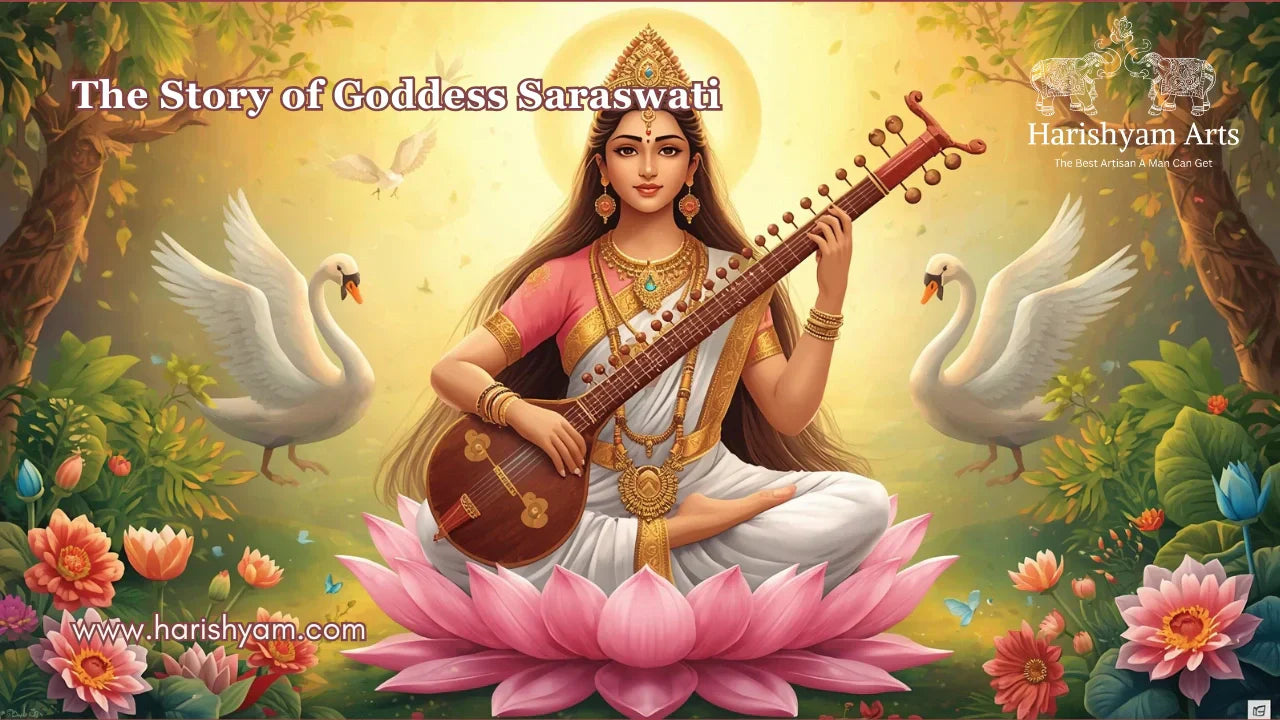
Among the many deities of the Hindu pantheon, Maa Saraswati holds a unique and sacred place. She is the Goddess of Wisdom, Knowledge, Music, and Arts, and the divine energy that transforms ignorance into enlightenment. Her blessings are sought by students, artists, and seekers of truth.
At Harishyam Arts, we honor this divine embodiment through our handcrafted brass Saraswati idols, made with devotion and artistry to bring knowledge and peace to every home.
Who is Goddess Saraswati?
Maa Saraswati is one of the Tridevi, alongside Goddess Lakshmi and Goddess Parvati. She is the consort of Lord Brahma, the creator of the universe, and is believed to have given speech, music, and intellect to the world.
Her name is derived from the Sanskrit word “Saras” meaning “flow,” and “Wati” meaning “she who has.” Thus, Saraswati represents the continuous flow of wisdom and learning, guiding humanity toward truth and enlightenment.
The Divine Story of Maa Saraswati
According to ancient Hindu scriptures, when the universe was first created, it was silent and void. Lord Brahma desired to bring order and meaning to this creation. From his divine energy emerged a radiant goddess — Saraswati, holding a veena, scriptures, and a rosary.
She filled the world with sound, melody, and the power of expression. Her voice became the source of all knowledge, language, and art.
With her guidance, Lord Brahma began the act of creation — thus, Maa Saraswati became the source of knowledge that shaped existence itself.
In another tale, when ignorance spread across the universe, Saraswati descended to restore light and intellect. Her wisdom conquered darkness, reminding all that true power lies in knowledge, not wealth or might.
Symbolism of Maa Saraswati
Every element associated with Maa Saraswati holds spiritual meaning:
-
White attire: Represents purity, truth, and simplicity.
-
Veena: Symbol of balance between emotion and intellect.
-
Books (Vedas): The eternal source of divine knowledge.
-
Lotus seat: Detachment and spiritual awakening.
-
Swan (Hamsa): Discrimination between truth and illusion.
Together, these symbols teach that knowledge, when guided by purity and wisdom, leads to liberation.
Why Worship Maa Saraswati?
Worshipping Goddess Saraswati invites clarity, focus, and peace of mind. She blesses devotees with creativity, intelligence, and eloquence.
-
Ideal for students, writers, musicians, and teachers.
-
Enhances concentration and learning power.
-
Brings harmony and inspiration to your surroundings.
Keeping a marble Saraswati mata idol at home or in your study room helps attract divine energy, promoting learning and peace.
Pooja Rituals to Honor Maa Saraswati
Performing Saraswati Pooja brings wisdom and success in education and arts.
Here’s a simple ritual:
-
Clean the area and the idol with a soft cloth.
-
Place the idol on a white cloth facing east.
-
Offer white flowers, fruits, and sandalwood paste.
-
Chant the mantra – “Om Aim Saraswatyai Namah.”
-
Meditate while seeking her blessings for clarity and wisdom.
Special prayers are performed on Vasant Panchami, the sacred festival dedicated to Goddess Saraswati.
Why Choose a Maa Saraswati Statues from Harishyam Arts
At Harishyam Arts, every Saraswati idol is a true work of art — lovingly handcrafted by skilled Indian artisans with devotion, precision, and care.
✨ Our Saraswati statues feature:
-
Premium materials include marble, brass, and wooden saraswati maa statues ensuring beauty, strength, and timeless appeal.
-
Exquisite craftsmanship with fine detailing that reflects divine grace and serenity.
-
Variety of designs — from traditional to contemporary — perfect for homes, schools, offices, and temples.
-
Worldwide shipping with secure and convenient online ordering.
Each idol from Harishyam Arts radiates spiritual energy and artistic excellence, making it a perfect addition to your sacred space or place of learning.
FAQs about Goddess Saraswati and Brass Idols
Q1. Why is Maa Saraswati called the Goddess of Wisdom?\
Ans: She symbolizes the power of knowledge, speech, and learning. Her teachings inspire clarity, creativity, and enlightenment in all who seek her blessings.
Q2. What are the benefits of keeping a Saraswati idol at home?
Ans: It enhances focus, memory, and peace of mind. Students and artists benefit greatly, as it brings success in education, arts, and music.
Q3. Where should I place the Saraswati idol in my home?
Ans: The idol should face east or northeast, ideally in your study room or temple. This direction attracts positivity and mental clarity.
Q4. When is the best time to worship Maa Saraswati?
Ans: Vasant Panchami is the most auspicious day. However, regular prayers on Thursdays are also highly beneficial.
Q5. Why choose a brass Saraswati idol over other materials?
Ans: Brass conducts positive spiritual energy and symbolizes purity. It’s durable, radiant, and ideal for pooja or decoration.
Q6. How can I identify a pure brass idol?
Ans: A genuine brass idol feels heavier, has a warm golden hue, and produces a metallic sound when tapped gently.
Conclusion
The story of Maa Saraswati teaches that true beauty lies in wisdom, knowledge, and self-awareness. Her blessings bring enlightenment, creativity, and inner peace.
Bring home the divine presence of Saraswati with handcrafted idols from Harishyam Arts — a symbol of art, devotion, and eternal knowledge. Let her light guide your thoughts and your home toward purity and purpose.

Lakshay Sharma
I’m Lakshay Sharma, a writer with a deep passion for Hindu mythology, Vastu Shastra, and home interiors. I enjoy exploring the rich traditions of Hindu gods and goddesses, sharing insights into Vastu principles, and offering guidance on creating sacred spaces like Puja Mandirs. Through my writing, I aim to inspire harmony and spiritual well-being, blending traditional knowledge with modern perspectives.
Harishyam Arts | Jaipur
Related Blogs

Bhagavad Gita Chapter 3 Verse 27 Meaning in Hindi & English
Lakshay Sharma | June 10, 2026
Bhagavad Gita Chapter 3 Verse 27 presents one of the most profound philosophic...
Read More...
Bhagavad Gita Chapter 3 Verse 26 Meaning in Hindi And English
Lakshay Sharma | June 10, 2026
Bhagavad Gita Chapter 3 Verse 26 contains a profound lesson on leadership, tea...
Read More...
Bhagavad Gita Chapter 3 Verse 41 Meaning in Hindi and English
Lakshay Sharma | June 10, 2026
Bhagavad Gita Chapter 3 Verse 41 is Lord Krishna's practical instruction for o...
Read More...
Bhagavad Gita Chapter 3 Verse 40 Meaning in Hindi and English
Lakshay Sharma | June 10, 2026
Bhagavad Gita Chapter 3 Verse 40 continues Lord Krishna's explanation of desir...
Read More...
Bhagavad Gita Chapter 3 Verse 39 Meaning in Hindi and English
Lakshay Sharma | June 10, 2026
Bhagavad Gita Chapter 3 Verse 39 continues Lord Krishna's explanation about de...
Read More...
Bhagavad Gita Chapter 3 Verse 38 Meaning in Hindi and English
Lakshay Sharma | June 10, 2026
Bhagavad Gita Chapter 3 Verse 38 continues Lord Krishna's explanation about de...
Read More...
Bhagavad Gita Chapter 3 Verse 37 Meaning in Hindi and English
Lakshay Sharma | June 10, 2026
Bhagavad Gita Chapter 3 Verse 37 contains Lord Krishna's direct answer to Arju...
Read More...
Bhagavad Gita Chapter 3 Verse 36 Meaning in Hindi and English
Lakshay Sharma | June 10, 2026
Bhagavad Gita Chapter 3 Verse 36 marks the beginning of one of the most import...
Read More...
Bhagavad Gita Chapter 3 Verse 35 Meaning in Hindi and English
Lakshay Sharma | June 10, 2026
Bhagavad Gita Chapter 3 Verse 35 is one of the most famous verses in the entir...
Read More...
Bhagavad Gita Chapter 3 Verse 34 Meaning in Hindi and English
Lakshay Sharma | June 10, 2026
Bhagavad Gita Chapter 3 Verse 34 is a profound teaching on contro...
Read More...
Bhagavad Gita Chapter 3 Verse 25 Meaning in Hindi and English
Lakshay Sharma | June 10, 2026
Bhagavad Gita Chapter 3 Verse 25 is important because:

Bhagavad Gita Chapter 3 Verse 23 Meaning in Hindi and English
Lakshay Sharma | June 10, 2026
Bhagavad Gita Chapter 3 Verse 23 continues Lord Krishna's explanation of why H...
Read More...
Bhagavad Gita Chapter 3 Verse 22 Meaning in Hindi and English
Lakshay Sharma | June 10, 2026
Bhagavad Gita Chapter 3 Verse 22 is a profound teaching where Lord Krishna spe...
Read More...
Bhagavad Gita Chapter 3 Verse 21 Meaning in Hindi and English
Lakshay Sharma | June 10, 2026
Bhagavad Gita Chapter 3 Verse 21 is one of the most influential teachings on <...
Read More...
Bhagavad Gita Chapter 3 Verse 20 Meaning in Hindi and English
Lakshay Sharma | June 10, 2026
Bhagavad Gita Chapter 3 Verse 20 is a powerful teaching on Karma ...
Read More...
Bhagavad Gita Chapter 3 Verse 19 Meaning in Hindi and English
Lakshay Sharma | June 10, 2026
Bhagavad Gita Chapter 3 Verse 19 is one of the most important teachings on Read More...

The Hidden Meaning Behind the Eyes, Mudras, and Expressions of Marble Idols
Lakshay Sharma | June 10, 2026
Marble idols are not merely decorative sculptures; they are living symbols of ...
Read More...
Bhagavad Gita Chapter 3 Verse 16 Meaning in Hindi and English
Lakshay Sharma | June 09, 2026
Bhagavad Gita Chapter 3 Verse 16 continues Lord Krishna's explanation of the d...
Read More...
Bhagavad Gita Chapter 3 Verse 15 Meaning in Hindi and English
Lakshay Sharma | June 09, 2026
Bhagavad Gita Chapter 3 Verse 15 deepens the understanding of the sacred cycle...
Read More...
Bhagavad Gita Chapter 3 Verse 14 Meaning in Hindi and English
Lakshay Sharma | June 09, 2026
Bhagavad Gita Chapter 3 Verse 14 explains the sacred cycle that sustains life ...
Read More...
Bhagavad Gita Chapter 3 Verse 11 Meaning in Hindi and English
Lakshay Sharma | June 09, 2026
Bhagavad Gita Chapter 3 Verse 11 highlights the principle of mutual cooperatio...
Read More...
Bhagavad Gita Chapter 3 Verse 9 Meaning in Hindi & English
Lakshay Sharma | June 09, 2026
Bhagavad Gita Chapter 3 Verse 9 introduces one of the most important principle...
Read More...
Bhagavad Gita Chapter 3 Verse 7 Meaning in Hindi & English
Lakshay Sharma | June 09, 2026
Bhagavad Gita Chapter 3 Verse 7 presents Lord Krishna's solution to the proble...
Read More...
Bhagavad Gita Chapter 3 Verse 5 Meaning in Hindi & English
Lakshay Sharma | June 09, 2026
Bhagavad Gita Chapter 3 Verse 5 continues Lord Krishna's explanation of Karma ...
Read More...
Bhagavad Gita Chapter 3 Verse 4 Meaning in Hindi & English
Lakshay Sharma | June 09, 2026
Bhagavad Gita Chapter 3 Verse 4 continues Lord Krishna's explanation of Karma ...
Read More...
Bhagavad Gita Chapter 3 Verse 3 Meaning in Hindi & English
Lakshay Sharma | June 09, 2026
Bhagavad Gita Chapter 3 Verse 3 is Lord Krishna's direct response to Arjuna's ...
Read More...
Bhagavad Gita Chapter 3 Verse 2 Meaning in Hindi & English
Lakshay Sharma | June 09, 2026
Bhagavad Gita Chapter 3 Verse 2 continues Arjuna's confusion regarding the tea...
Read More...
Bhagavad Gita Chapter 3 Verse 1 Meaning in Hindi & English
Lakshay Sharma | June 09, 2026
Bhagavad Gita Chapter 3 Verse 1 marks the beginning of Karma Yoga...
Read More...
The Spiritual Warmth and Natural Energy of Handcrafted Wooden Statues
Lakshay Sharma | June 09, 2026
In a world filled with machine-made décor and mass-produced art, handcrafted w...
Read More...
Bhagavad Gita Chapter 3 Verse 18 Meaning in Hindi and English
Lakshay Sharma | June 08, 2026
Bhagavad Gita Chapter 3 Verse 18 continues Lord Krishna's description of the s...
Read More...
Bhagavad Gita Chapter 3 Verse 17 Meaning in Hindi and English
Lakshay Sharma | June 08, 2026
Bhagavad Gita Chapter 3 Verse 17 marks an important transition in Lord Krishna...
Read More...
Bhagavad Gita Chapter 3 Verse 12 Meaning in Hindi and English
Lakshay Sharma | June 08, 2026
Bhagavad Gita Chapter 3 Verse 12 continues Lord Krishna’s teaching on <...
Read More...
Bhagavad Gita Chapter 2 Verse 65 Meaning in Hindi and English
Lakshay Sharma | June 08, 2026
Bhagavad Gita Chapter 2 Verse 65 explains the profound benefits of attaining i...
Read More...
Bhagavad Gita Chapter 2 Verse 64 Meaning in Hindi and English
Lakshay Sharma | June 08, 2026
Bhagavad Gita Chapter 2 Verse 64 presents a powerful teaching on self-control,...
Read More...
Bhagavad Gita Chapter 3 Verse 10 Meaning in Hindi & English
Lakshay Sharma | June 08, 2026
Bhagavad Gita Chapter 3 Verse 10 continues Lord Krishna's teaching on <...
Read More...
Why Traditional Wooden Mandirs Are Still Preferred in Modern Homes
Lakshay Sharma | June 08, 2026
In today’s fast-paced world, modern homes are becoming more stylish, compact, ...
Read More...
The Symbolic Meaning of the Lotus in Hindu Tradition
Lakshay Sharma | June 08, 2026
The lotus flower holds a sacred and timeless place in Hindu tradition. Known f...
Read More...
Bhagavad Gita Chapter 2 Verse 23 Meaning in Hindi & English
Lakshay Sharma | June 08, 2026
As Lord Krishna continues to explain the eternal and indestructible nature of ...
Read More...
Bhagavad Gita Chapter 2 Verse 21 Meaning in Hindi & English
Lakshay Sharma | June 08, 2026
After revealing that the soul is unborn, eternal, and indestructible in the pr...
Read More...
The Greatest Philosophers and Thinkers of Ancient India
Lakshay Sharma | June 08, 2026
India has long been regarded as one of the world’s oldest centers of wisdom, s...
Read More...
Bhagavad Gita Chapter 2 Verse 22 Meaning in Hindi & English
Lakshay Sharma | June 08, 2026
Bhagavad Gita Chapter 2 Verse 22 contains one of the most famous and beautiful...
Read More...
Bhagavad Gita Chapter 2 Verse 20 Meaning in Hindi & English
Lakshay Sharma | June 08, 2026
Bhagavad Gita Chapter 2 Verse 20 is one of the most famous and profound verses...
Read More...
Bhagavad Gita Chapter 2 Verse 19 Meaning in Hindi & English
Lakshay Sharma | June 08, 2026
As Lord Krishna continues to reveal the eternal nature of the soul, He now add...
Read More...
Bhagavad Gita Chapter 2 Verse 18 Meaning in Hindi & English
Lakshay Sharma | June 08, 2026
After explaining the indestructible nature of the soul in the previous verse, ...
Read More...
Bhagavad Gita Chapter 2 Verse 16 Meaning in Hindi & English
Lakshay Sharma | June 08, 2026
As Lord Krishna continues to guide the grief-stricken Arjuna, He now introduce...
Read More...
Bhagavad Gita Chapter 3 Verse 8 Meaning in Hindi & English
Lakshay Sharma | June 08, 2026
Bhagavad Gita Chapter 3 Verse 8 is one of the most practical teachings in the ...
Read More...
Bhagavad Gita Chapter 2 Verse 56 Meaning in Hindi And English
Lakshay Sharma | June 08, 2026
In Bhagavad Gita Chapter 2 Verse 55, Lord Krishna explained that a person of steady wisdom (St...
Read More...
Bhagavad Gita Chapter 2 Verse 54 Meaning in Hindi And English
Lakshay Sharma | June 08, 2026
Bhagavad Gita Chapter 2 Verse 54 marks the beginning of one of the most important discussions ...
Read More...
Bhagavad Gita Chapter 2 Verse 30 Meaning in Hindi & English
Lakshay Sharma | June 08, 2026
Bhagavad Gita Chapter 2 Verse 30 serves as the conclusion of Lord Krishna's pr...
Read More...
Bhagavad Gita Chapter 2 Verse 17 Meaning in Hindi & English
Lakshay Sharma | June 08, 2026
After establishing the distinction between the eternal (Sat) and the temporary...
Read More...


