
Harishyam Arts Blog
Where to Keep Ganesha Statue at Home? Vastu Tips & Guidelines
By Lakshay Sharma | On 08 July, 2025 | Views
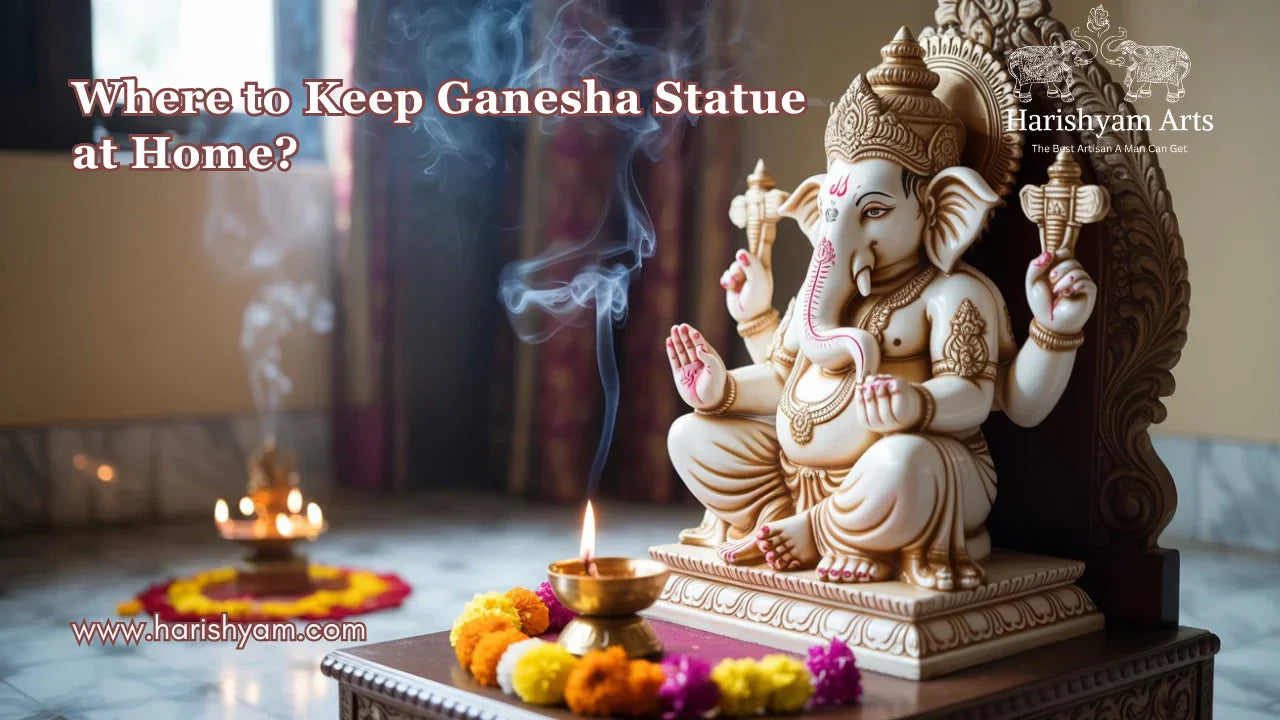
Lord Ganesha, the remover of obstacles and the symbol of wisdom, prosperity, and good fortune, is one of the most revered deities in Hinduism. It is a common tradition across Indian households to keep a Ganesha idol at home. However, many people often wonder: Where should Ganesha statue be placed in the house? What is the correct direction as per Vastu? Is it okay to keep more than one Ganpati idol? Let’s explore these questions in detail.
In this comprehensive blog, we will discuss where to keep Ganesha statue at home, the best direction for Ganpati placement, Vastu tips, and rules that ensure positivity and blessings in your home.
Which Direction is Good for Lord Ganesha?
One of the most frequently asked questions is: "Ganesh Idol Should Face Which Direction?" or "In which direction Ganesh idol should face?"
Ideal Direction for Placing Ganesha Idol at Home
According to Vastu Shastra, the north-east corner (also known as the Ishan corner) is the best place to keep the Ganesha idol at home. This direction is considered sacred and attracts the most spiritual vibrations.
-
The north direction, ruled by Lord Kuber (the deity of wealth), is also auspicious.
-
The west direction is another favorable choice if north or north-east is not feasible.
Vastu Tip: Never place the Ganesha idol in the south direction or facing south, as it is considered inauspicious.
Ganesha Idol Should Face Which Direction?
Along with the placement, the facing direction of the idol is also important.
-
Lord Ganesha’s idol should ideally face the east or west direction.
-
The back of the idol should face the house entrance or wall.
-
You should sit facing east or north while offering prayers.
Spiritual Insight: A Ganesha idol facing the main door (from the inside) brings protection and wards off negative energy.
Placing Ganesha at Home Entrance
Can I Put Ganesha at Entrance?
Yes! Placing Ganesha at the home entrance is a common and powerful practice. It is believed to bless your home with positive energy, remove obstacles, and protect against evil influences.
Which Ganesha Idol is Good for Home Entrance?
-
Stone Ganesh Murti for Home Entrance is considered highly auspicious, especially if made from marble or granite.
-
Brass or metal idols are also suitable for entrance placements.
-
Ensure that the idol is not placed directly on the ground — use a pedestal or wooden platform.
Note: Always place a pair of elephants or traditional door guardians beside the Ganpati idol at the entrance for additional protection.
What Are the Rules for Keeping Ganpati at Home?
When bringing Lord Ganesha home, it’s essential to follow certain traditional and Vastu-based rules to ensure that his divine presence blesses your household.
📜 Key Rules to Follow
Avoid Broken or Damaged Idols
Never keep a broken or chipped Ganesha idol in the house. It is considered inauspicious and can lead to obstacles.
Limit the Number of Idols
According to Vastu, you should avoid keeping multiple Ganpati idols. Ideally, one idol is sufficient and spiritually potent.
Cleanliness is Important
The space around the idol must be kept clean and pure. Light a diya and offer fresh flowers regularly.
No Placement in Bathrooms or Bedrooms
Lord Ganesha’s idol should never be placed in a bathroom or near dustbins. Bedroom placement is also discouraged (more on that later).
Posture of Ganesha Idol Matters
-
-
Sitting Ganesha (Lalitasana) is ideal for homes as it represents calmness and prosperity.
-
Dancing Ganesha symbolizes enthusiasm and energy – best suited for art spaces or studios.
-
Important Vastu Tips to Place Ganesha Idol at Home
Here are some specific Vastu tips to maximize the positive energy and blessings from Lord Ganesha:
|
Tip |
Description |
|
Direction |
North-east is the best; north and west are also good. |
|
Idol Facing |
Should face east or west; avoid south-facing idols. |
|
Posture |
Sitting Ganesha is best for homes. |
|
Cleanliness |
Keep the area clean, tidy, and fragrant. |
|
Rituals |
Light incense, offer modaks or laddoos, and chant mantras. |
|
Materials |
Clay, brass, silver, or stone are best. Avoid plastic. |
Bonus Tip: Keeping a small bowl of modaks or sweets in front of the idol is said to invite sweetness and abundance into your life.
Which Ganesha Idol is Best for Home?
The design and symbolism of the idol matter too. Here are some commonly chosen idols and what they represent:
-
Right Trunk Ganesha: Powerful and strict; ideal for temples, not homes.
-
Left Trunk Ganesha: Calming and benevolent; perfect for home use.
-
Standing Ganesha: Denotes enthusiasm and activity.
-
White Ganesha Idol: Brings peace and happiness.
-
Red Ganesha Idol: Enhances power and success.
Conclusion
Placing a Ganesha idol at home isn’t just a decorative choice — it’s a spiritual one. By following the right Vastu principles and understanding where to keep Ganesha statue at home, you can invite joy, prosperity, and divine blessings into your life.
Whether it’s a Ganesh murti for the home entrance or a serene white marble idol in your puja room, the right placement and intention make all the difference. Be mindful of which direction is good for Lord Ganesha, ensure your idol faces the proper way, and follow the rules for keeping Ganpati at home to create a harmonious and spiritual environment.
Frequently Asked Questions (FAQs)
Q1. Can we keep Ganesh idol in bedroom?
Ans: Ideally, no. According to Vastu and traditional beliefs, placing religious idols in the bedroom is discouraged. The bedroom is a space for rest and intimacy, whereas idols should be in a clean and sacred space meant for worship.
Q2. How many Ganesh idols can be kept at home?
Ans: As per Vastu, only one Ganesh idol should be kept in the home temple. Multiple idols can create a conflict of energies and are considered inauspicious.
Q3. Can I put Ganesha at the entrance?
Ans: Yes, placing Ganesha at the home entrance is highly auspicious. It invites prosperity and wards off negativity. Use a sturdy stone or brass idol for this purpose.
Q4. Which material is best for a Ganesh idol at home?
Ans: The best materials for a Ganesh idol at home include clay, marble, brass, wood, and stone. A marble Ganesha statue is ideal for promoting peace and purity in the home. A wooden Ganesha murti adds warmth and natural energy, making it perfect for traditional settings. A brass Ganesha idol is durable and considered highly auspicious, especially for daily worship. You can also place a stone Ganesh murti at the entrance or in the puja room to invite prosperity and stability. It is best to avoid plastic or synthetic materials, as they lack spiritual and environmental value.
Q5. What should I offer to Lord Ganesha daily?
Ans: Offerings can include modaks, durva grass, red flowers, and a lit ghee diya. Chanting Ganapati mantras regularly is also beneficial.
Q6. Where to buy Ganesha statue online?
Ans: If you're looking to buy a beautifully crafted Ganesha statue online, Harisyam Arts is an excellent choice. Known for their exquisite craftsmanship and attention to detail, Harisyam Arts offers a wide variety of Ganesha idols made from premium materials such as marble, brass, wood, and stone. Whether you’re looking for a marble Ganesha statue for your puja room or a stone Ganesh murti for your home entrance, Harisyam Arts provides authentic, handcrafted pieces that align with traditional aesthetics and Vastu principles. You can explore their full collection on their official website and order with confidence, knowing each idol is made with devotion and care.

Lakshay Sharma
I’m Lakshay Sharma, a writer with a deep passion for Hindu mythology, Vastu Shastra, and home interiors. I enjoy exploring the rich traditions of Hindu gods and goddesses, sharing insights into Vastu principles, and offering guidance on creating sacred spaces like Puja Mandirs. Through my writing, I aim to inspire harmony and spiritual well-being, blending traditional knowledge with modern perspectives.
Harishyam Arts | Jaipur
Related Blogs

Bhagavad Gita Chapter 3 Verse 27 Meaning in Hindi & English
Lakshay Sharma | June 10, 2026
Bhagavad Gita Chapter 3 Verse 27 presents one of the most profound philosophic...
Read More...
Bhagavad Gita Chapter 3 Verse 26 Meaning in Hindi And English
Lakshay Sharma | June 10, 2026
Bhagavad Gita Chapter 3 Verse 26 contains a profound lesson on leadership, tea...
Read More...
Bhagavad Gita Chapter 3 Verse 41 Meaning in Hindi and English
Lakshay Sharma | June 10, 2026
Bhagavad Gita Chapter 3 Verse 41 is Lord Krishna's practical instruction for o...
Read More...
Bhagavad Gita Chapter 3 Verse 40 Meaning in Hindi and English
Lakshay Sharma | June 10, 2026
Bhagavad Gita Chapter 3 Verse 40 continues Lord Krishna's explanation of desir...
Read More...
Bhagavad Gita Chapter 3 Verse 39 Meaning in Hindi and English
Lakshay Sharma | June 10, 2026
Bhagavad Gita Chapter 3 Verse 39 continues Lord Krishna's explanation about de...
Read More...
Bhagavad Gita Chapter 3 Verse 38 Meaning in Hindi and English
Lakshay Sharma | June 10, 2026
Bhagavad Gita Chapter 3 Verse 38 continues Lord Krishna's explanation about de...
Read More...
Bhagavad Gita Chapter 3 Verse 37 Meaning in Hindi and English
Lakshay Sharma | June 10, 2026
Bhagavad Gita Chapter 3 Verse 37 contains Lord Krishna's direct answer to Arju...
Read More...
Bhagavad Gita Chapter 3 Verse 36 Meaning in Hindi and English
Lakshay Sharma | June 10, 2026
Bhagavad Gita Chapter 3 Verse 36 marks the beginning of one of the most import...
Read More...
Bhagavad Gita Chapter 3 Verse 35 Meaning in Hindi and English
Lakshay Sharma | June 10, 2026
Bhagavad Gita Chapter 3 Verse 35 is one of the most famous verses in the entir...
Read More...
Bhagavad Gita Chapter 3 Verse 34 Meaning in Hindi and English
Lakshay Sharma | June 10, 2026
Bhagavad Gita Chapter 3 Verse 34 is a profound teaching on contro...
Read More...
Bhagavad Gita Chapter 3 Verse 25 Meaning in Hindi and English
Lakshay Sharma | June 10, 2026
Bhagavad Gita Chapter 3 Verse 25 is important because:

Bhagavad Gita Chapter 3 Verse 23 Meaning in Hindi and English
Lakshay Sharma | June 10, 2026
Bhagavad Gita Chapter 3 Verse 23 continues Lord Krishna's explanation of why H...
Read More...
Bhagavad Gita Chapter 3 Verse 22 Meaning in Hindi and English
Lakshay Sharma | June 10, 2026
Bhagavad Gita Chapter 3 Verse 22 is a profound teaching where Lord Krishna spe...
Read More...
Bhagavad Gita Chapter 3 Verse 21 Meaning in Hindi and English
Lakshay Sharma | June 10, 2026
Bhagavad Gita Chapter 3 Verse 21 is one of the most influential teachings on <...
Read More...
Bhagavad Gita Chapter 3 Verse 20 Meaning in Hindi and English
Lakshay Sharma | June 10, 2026
Bhagavad Gita Chapter 3 Verse 20 is a powerful teaching on Karma ...
Read More...
Bhagavad Gita Chapter 3 Verse 19 Meaning in Hindi and English
Lakshay Sharma | June 10, 2026
Bhagavad Gita Chapter 3 Verse 19 is one of the most important teachings on Read More...

The Hidden Meaning Behind the Eyes, Mudras, and Expressions of Marble Idols
Lakshay Sharma | June 10, 2026
Marble idols are not merely decorative sculptures; they are living symbols of ...
Read More...
Bhagavad Gita Chapter 3 Verse 16 Meaning in Hindi and English
Lakshay Sharma | June 09, 2026
Bhagavad Gita Chapter 3 Verse 16 continues Lord Krishna's explanation of the d...
Read More...
Bhagavad Gita Chapter 3 Verse 15 Meaning in Hindi and English
Lakshay Sharma | June 09, 2026
Bhagavad Gita Chapter 3 Verse 15 deepens the understanding of the sacred cycle...
Read More...
Bhagavad Gita Chapter 3 Verse 14 Meaning in Hindi and English
Lakshay Sharma | June 09, 2026
Bhagavad Gita Chapter 3 Verse 14 explains the sacred cycle that sustains life ...
Read More...
Bhagavad Gita Chapter 3 Verse 11 Meaning in Hindi and English
Lakshay Sharma | June 09, 2026
Bhagavad Gita Chapter 3 Verse 11 highlights the principle of mutual cooperatio...
Read More...
Bhagavad Gita Chapter 3 Verse 9 Meaning in Hindi & English
Lakshay Sharma | June 09, 2026
Bhagavad Gita Chapter 3 Verse 9 introduces one of the most important principle...
Read More...
Bhagavad Gita Chapter 3 Verse 7 Meaning in Hindi & English
Lakshay Sharma | June 09, 2026
Bhagavad Gita Chapter 3 Verse 7 presents Lord Krishna's solution to the proble...
Read More...
Bhagavad Gita Chapter 3 Verse 5 Meaning in Hindi & English
Lakshay Sharma | June 09, 2026
Bhagavad Gita Chapter 3 Verse 5 continues Lord Krishna's explanation of Karma ...
Read More...
Bhagavad Gita Chapter 3 Verse 4 Meaning in Hindi & English
Lakshay Sharma | June 09, 2026
Bhagavad Gita Chapter 3 Verse 4 continues Lord Krishna's explanation of Karma ...
Read More...
Bhagavad Gita Chapter 3 Verse 3 Meaning in Hindi & English
Lakshay Sharma | June 09, 2026
Bhagavad Gita Chapter 3 Verse 3 is Lord Krishna's direct response to Arjuna's ...
Read More...
Bhagavad Gita Chapter 3 Verse 2 Meaning in Hindi & English
Lakshay Sharma | June 09, 2026
Bhagavad Gita Chapter 3 Verse 2 continues Arjuna's confusion regarding the tea...
Read More...
Bhagavad Gita Chapter 3 Verse 1 Meaning in Hindi & English
Lakshay Sharma | June 09, 2026
Bhagavad Gita Chapter 3 Verse 1 marks the beginning of Karma Yoga...
Read More...
The Spiritual Warmth and Natural Energy of Handcrafted Wooden Statues
Lakshay Sharma | June 09, 2026
In a world filled with machine-made décor and mass-produced art, handcrafted w...
Read More...
Bhagavad Gita Chapter 3 Verse 18 Meaning in Hindi and English
Lakshay Sharma | June 08, 2026
Bhagavad Gita Chapter 3 Verse 18 continues Lord Krishna's description of the s...
Read More...
Bhagavad Gita Chapter 3 Verse 17 Meaning in Hindi and English
Lakshay Sharma | June 08, 2026
Bhagavad Gita Chapter 3 Verse 17 marks an important transition in Lord Krishna...
Read More...
Bhagavad Gita Chapter 3 Verse 12 Meaning in Hindi and English
Lakshay Sharma | June 08, 2026
Bhagavad Gita Chapter 3 Verse 12 continues Lord Krishna’s teaching on <...
Read More...
Bhagavad Gita Chapter 2 Verse 65 Meaning in Hindi and English
Lakshay Sharma | June 08, 2026
Bhagavad Gita Chapter 2 Verse 65 explains the profound benefits of attaining i...
Read More...
Bhagavad Gita Chapter 2 Verse 64 Meaning in Hindi and English
Lakshay Sharma | June 08, 2026
Bhagavad Gita Chapter 2 Verse 64 presents a powerful teaching on self-control,...
Read More...
Bhagavad Gita Chapter 3 Verse 10 Meaning in Hindi & English
Lakshay Sharma | June 08, 2026
Bhagavad Gita Chapter 3 Verse 10 continues Lord Krishna's teaching on <...
Read More...
Why Traditional Wooden Mandirs Are Still Preferred in Modern Homes
Lakshay Sharma | June 08, 2026
In today’s fast-paced world, modern homes are becoming more stylish, compact, ...
Read More...
The Symbolic Meaning of the Lotus in Hindu Tradition
Lakshay Sharma | June 08, 2026
The lotus flower holds a sacred and timeless place in Hindu tradition. Known f...
Read More...
Bhagavad Gita Chapter 2 Verse 23 Meaning in Hindi & English
Lakshay Sharma | June 08, 2026
As Lord Krishna continues to explain the eternal and indestructible nature of ...
Read More...
Bhagavad Gita Chapter 2 Verse 21 Meaning in Hindi & English
Lakshay Sharma | June 08, 2026
After revealing that the soul is unborn, eternal, and indestructible in the pr...
Read More...
The Greatest Philosophers and Thinkers of Ancient India
Lakshay Sharma | June 08, 2026
India has long been regarded as one of the world’s oldest centers of wisdom, s...
Read More...
Bhagavad Gita Chapter 2 Verse 22 Meaning in Hindi & English
Lakshay Sharma | June 08, 2026
Bhagavad Gita Chapter 2 Verse 22 contains one of the most famous and beautiful...
Read More...
Bhagavad Gita Chapter 2 Verse 20 Meaning in Hindi & English
Lakshay Sharma | June 08, 2026
Bhagavad Gita Chapter 2 Verse 20 is one of the most famous and profound verses...
Read More...
Bhagavad Gita Chapter 2 Verse 19 Meaning in Hindi & English
Lakshay Sharma | June 08, 2026
As Lord Krishna continues to reveal the eternal nature of the soul, He now add...
Read More...
Bhagavad Gita Chapter 2 Verse 18 Meaning in Hindi & English
Lakshay Sharma | June 08, 2026
After explaining the indestructible nature of the soul in the previous verse, ...
Read More...
Bhagavad Gita Chapter 2 Verse 16 Meaning in Hindi & English
Lakshay Sharma | June 08, 2026
As Lord Krishna continues to guide the grief-stricken Arjuna, He now introduce...
Read More...
Bhagavad Gita Chapter 3 Verse 8 Meaning in Hindi & English
Lakshay Sharma | June 08, 2026
Bhagavad Gita Chapter 3 Verse 8 is one of the most practical teachings in the ...
Read More...
Bhagavad Gita Chapter 2 Verse 56 Meaning in Hindi And English
Lakshay Sharma | June 08, 2026
In Bhagavad Gita Chapter 2 Verse 55, Lord Krishna explained that a person of steady wisdom (St...
Read More...
Bhagavad Gita Chapter 2 Verse 54 Meaning in Hindi And English
Lakshay Sharma | June 08, 2026
Bhagavad Gita Chapter 2 Verse 54 marks the beginning of one of the most important discussions ...
Read More...
Bhagavad Gita Chapter 2 Verse 30 Meaning in Hindi & English
Lakshay Sharma | June 08, 2026
Bhagavad Gita Chapter 2 Verse 30 serves as the conclusion of Lord Krishna's pr...
Read More...
Bhagavad Gita Chapter 2 Verse 17 Meaning in Hindi & English
Lakshay Sharma | June 08, 2026
After establishing the distinction between the eternal (Sat) and the temporary...
Read More...


